
When violinist Ron Patterson joined the School of Music faculty in 1999, he was wrapping up 20 years as concertmaster of the l'Orchestre Philharmonique de Monte Carlo, reporting directly to Prince Rainier of Monaco. His 35-year professional career had included concertmaster positions with orchestras and chamber orchestras in Miami, Los Angeles, Houston, Denver, and St. Louis, and his formal violin studies were with the great Russian violinist Jascha Heifetz. He had performed throughout the United States and Europe with his wife, violist Roxanna Patterson, in Duo Patterson, as well as in other respected chamber music ensembles. As associate professor at Rice University in Houston, he had co-authored the music curriculum of the Shepherd School of Music. Expecting to take a leadership role in shaping the strings program at the UW – and the direction of the School of Music itself—he was discouraged when some of his most innovative ideas did not come to pass. But a word of advice from a trusted colleague helped him adjust his flow and focus toward his studio in Room 210 of the Music Building and his work with the gifted young musicians and scholars who have studied with him over the past 26 years. Professor Patterson sat down with us for a wide-ranging conversation over Zoom on the cusp of his UW retirement. This interview has been condensed and edited for publication.
When did you know you were destined for a life in music?
My mother was a concert pianist, so I played piano from birth, and I switched to violin at five years old. I performed the 1st movement of Lalo’s Symphonie Espagnole with my summer camp orchestra when I was 11. At that point I started seeing myself as a violinist. I started having a self-identity. Whereas so many kids look to see who they are, I knew what I was from a very early age. My life has been a very, very, very fortunate ride. And I’ve had a wonderful flow in my river. I became concertmaster of an orchestra in LA—it was called the Debut Orchestra –when I was 15. I felt so comfortable in the concertmaster role. Suddenly my life sort of flowed that way, and so I was very lucky.
What is something about you that might surprise people who don’t know you well?
I don't know if people knew that I grew up in L.A. at a time when Heifetz and Piatigorsky and Primrose and Stravinsky and Schoenberg, all the greatest Russian musicians, were out there, and that I am of Russian heritage. I felt I was sort of in the same water. My environment as a child was just super in terms of helping me grow. It helped certainly shape my whole musical attitude, just growing up around these musicians, and Piatigorsky, for instance, was a very good friend of mine — at 15 years old. I grew up with these people, and I first played for Heifetz when I was 11. And then I played for him again when I was 19 and went into the year-long master class. And then I never graduated college. I had two and a half years at USC, and then one year with Jascha Heifetz, and then in 1965, I was named concertmaster of the Miami Philharmonic. I was 21 years old. And so I never graduated college.
What are some of your proudest achievements or fondest memories of your time at the UW?
Playing with (piano professor) Craig Sheppard. When I came here for my interview, I played with Craig then. Roxanna and I and (the late cellist and UW professor) Toby Sachs played the Brahms g minor Piano Quartet with Craig.
Editor’s note: Patterson’s debut faculty performance at Meany Hall in October 1999 featured Ronald Patterson, Roxanna Patterson, and Craig Sheppard performing works by Poulenc, Martinu and Brahms.
Another highlight was playing Vivaldi Four Seasons with my students at Meany Hall in 2003. I played the solos and there was no conductor or anything. Just my students with the violins, and oh, it was fantastic. The level of violin playing was phenomenal.
Editor’s note: This concert, titled “1/2/4” Solo/Duo/Quartet was in April 2003 at Meany Hall. In addition to the Vivaldi, the program featured performances by Duo Patterson and by the Rainier Quartet—the Pattersons with cellist Walter Gray and violinist Ella Marie Gray.
Another time, eight of my students in my orchestra rep class went out into the courtyard next to the art building. And they set up and played together all the incredibly difficult orchestral excerpts that violinists learn in order to get a job. Those young people … the level at which they played…it was an amazing day.
I have a lot of students who have gone on to careers in music or kept music as a love of their life. At a school that has so many double majors and all that kind of stuff, you can't just look at the number of people who've gone on to professional performance careers, though I have had bunches of them. Some are making a living here in Seattle. They're making a living with music, and then there are many that are just using it as a loving. And that really, to me, I think, is what has been my best achievement.
What will you miss about teaching at the UW?
All the extremely gifted and intelligent students I have always had. You know, when you work with them closely over years, sometimes four or even more years with someone, you get to know not just their playing, but you get to know them as people. Because of the double major status of so many, even the ones who went on to be professional musicians, they were often double majors here. And to get to know someone whose major is anthropology—not something I know very much about—and to get to know them over a period of years. And to see how some people have taken their instrument …. I have one student who became a forest ranger who traveled with her violin literally all over the world, including in the Andes, it's just incredible. So just this high level of gifted people that I've worked with. That’s what I’ll miss.
What won’t you miss about teaching at the School of Music?
The squeaky floor in my Room 210. The students stand when they audition to get into the School of Music and when they take lessons. It's not good to watch students try to find a place that doesn't squeak. It's been that way for 26 years. And I think that's a bad first impression when somebody goes to audition and they can't find a place to stand. That's something that I will not miss. I've complained about it. They came; they filled in some areas of it about 15 years ago. It didn't really do anything.
What is something you always tell your students?
It’s not a horse race. It's not about who finishes first in life or who is the fastest or who gets the first thing. It's not a horse race. And sometimes I mention that with violinists, the winners are the students who are playing the violin and who go on to become computer scientists, or whatever, and they’re still playing the violin. The ones that continue playing the violin, they may not have been the very “best” ones when they were kids. The ones who keep going, those are the winners. I tell them not to judge themselves as who is better and who is worse. They will be what they will be relative to other people. Life is not a competition. The ones that keep the music going. They're the winners.
So much that I feel is important is not just to be prepared for music, but to be prepared for life. If my students know they are prepared to go out with the next step, whether it's going on in music, or going on in education, or getting out of the bubble and going on and making a living, they're prepared for that. I try to do that.
What is something a faculty colleague said to you that you never forgot?
(The late former longtime UW orchestral director) Peter Erös told me, “Ron, just teach violin.” And that was a result of when I first came here in 1999. I came with an idea called Personal Trainer, and it was to develop computers as practice tools, and I got involved fairly deeply with it. When I had my first interview when I came here, I talked to the vice president or provost, one of those people. I said, “One of my reasons for wanting to come to the University of Washington is that it's a research university.” At that time in my life, I was really involved in the idea of developing this idea so that somebody could play their trumpet in front of a computer. And they could see their volume line and see their pitch line, and so that when they got louder, they didn't get sharper. They could fix themselves with bio feedback. This was way back in 1999. One of the major fundraisers at the university was on board with the idea. We had maybe a half a dozen meetings. But in the end, the idea didn't get past the front office.
When I came here, I was a tenured full professor, head of Strings, and the first Ruth Sutton Waters professor. My mind thinks in terms of ideas about schools and things like that. And I realized that the school, our school, had a great faculty who didn't necessarily cover all the areas that the string players needed. And I had been playing for about two years with a group called the Rainier String Quartet with Walter Gray, cellist, and his wife, Ella Gray, second violin, and Roxanna and me. We were playing concerts. And we were very good, and I tried to bring that into the School of Music. “Let us come in as a resident string quartet.” And Ella would teach some contemporary. Roxanna and Walter would teach orchestral rep…In other words, it would fill the gaps. Plus, we'd have a quartet in residence, which is a huge draw for students to come. Anyway, the idea didn't make it past the front door.
So that's when Peter said, "Just teach violin.” I’ve had a very fulfilling life, but those things that I could have maybe done and maybe contributed, didn't happen. So that was probably the most important thing that was ever advised to me, because that made it so that suddenly, I didn't have that frustration. I didn’t need it. I certainly did not make a mistake in coming here because my kids flourished, we have a fantastic place to live. You know, my son is a horn player in the Oslo Philharmonic, and my daughter is viola player in the Cleveland Orchestra with her own business now, and my middle daughter is still my wonderful beekeeper and painter, and she lives in Seattle, so I have her around me all the time to hug. So, I can't be happier. It's not like, well, I wish I hadn't. But had things been different…everything would have been different. It would have been a scientific school of music. We would have been at the forefront.
What music do you listen to at home when you're relaxing?
Queen. And sometimes what's really fantastic is if I am in my car, for instance, I can turn it up real loud and just scream along with Queen. I like Queen, I like the Beatles. I love the chord progressions of the Beatles. I think they're ingenious. I like the total imagination of Queen.
What do you most look forward to doing once you are retired?
Having nothing to do. It'll be the first time since I became concert master in Miami in 1965 at age 21. I'm 81 now. It'll be the first time in 60 years that I haven't been employed. Haven't had a job, haven't had to show up somewhere, haven't had to teach or play or plan a program. I have absolutely nothing to do. I want to see what it does to my mind. I know I won't have to plan my trips in accordance with anything other than my doctor's appointments. I will continue teaching, I just won't be at the university, but I have a fantastic group of private students.
It's almost like I didn't make the decision (to retire). I was reading my emails and came on one that said "voluntary retirement incentive." And in all my years at the UW, I'd never seen that. So that intrigued me, especially the word “incentive.” I looked into it, and eventually the university made me an offer. So, it’s not I who chose to retire; it's the incentive that opened up the possibility for me to retire. But it was like something said, “Listen, this is an opportunity,” and all my life, I've taken advantage of opportunities. I think this was my mother up there who's guiding me, or somebody's up there guiding my river a little bit, and my flow. Whatever it is, it came at a perfect time. Perfect. I am 81 years old, and I've had a couple of really rough, rough, rough medical years.
I really don't have any idea what I'm going to do. What's funny, the very first result is that for Christmas and New Year's, my whole family is going someplace where I would never have thought, but that's where we're going. We're going to Marrakesh for Christmas and New Year's. I was going fly back right after New Year's to Seattle to start school the first week of January. Now we don't have to do that. What I'll do, I don't know, but I don't have to do that. That has been released. And for me, I've never had that. Everything in my life has to do with time. You have meters that you play in, you have rehearsal, you have to be there at certain time. You have to learn a piece for the middle of August of next year. Everything has to do with measuring of time. Be at rehearsal on Friday at 9. And now suddenly—no time. I love that.
I'm not trying to, in any way, shape, or form, say that I begrudge my 26 years at the UW because I absolutely do not. My life is the way it is. I do believe in the flow of life. I tell my kids that we sit, each one of us sits in a little boat. We hold an umbrella, so we don't have too much rain or too much sunshine. And I have a Negroni. Some people have a mint julep. And you don’t have any oars, you have nothing, you just sit there, and that's it, and you float along, and sometimes you hit a log, but eventually you go around and anything that is still there is part of your flow. So there's no such thing as a bad thing happening to somebody. I mean, so many bad things that have happened to people have led to changes in themselves that made gigantic, wonderful things happen that wouldn't have happened if the bad thing hadn't happened. So, I just believe in the flow.
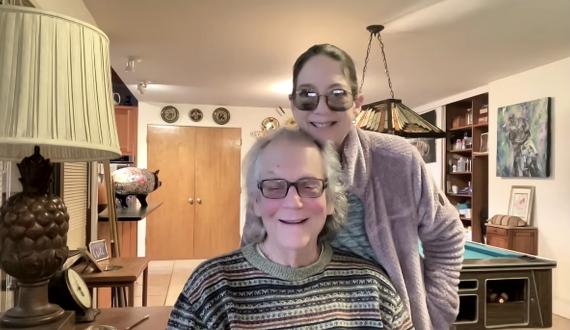
Ron and Roxanna Patterson at home in Seattle (Photo: Zoom).