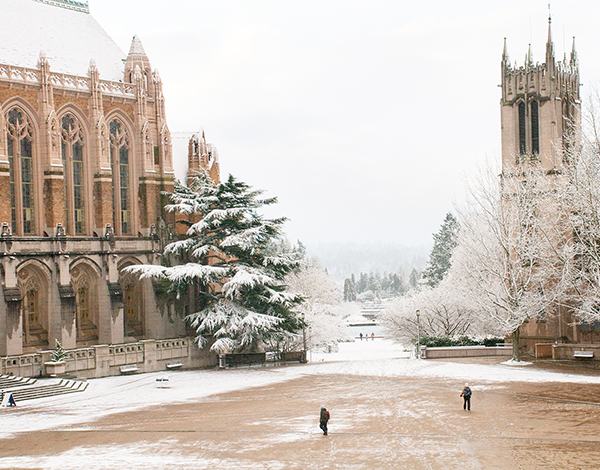
David Alexander Rahbee and the UW Symphony present "Winter Sky," a program of music by Saariaho, Sibelius, Humperdinck, Tchaikovsky, and Rimsky-Korsakov.
Program
Kaija Saariaho (1952-2023): Ciel d’hiver (Winter Sky)
Jean Sibelius (1865-1957): Symphony No.6 in D minor, op.104
I. Allegro molto moderato
II. Allegretto moderato<
III. Poco vivace
IV. Allegro molto
Engelbert Humperdinck (1854-1921): Prelude to Hänsel und Gretel
Piotr Ilyich Tchaikovsky (1840-1893): Suite No. 1 from Nutcracker
I. Overture miniature
II. Danses caractéristuques
III. Marche
IV. Danse de la fée-dragée
V. Danse russe trepak
VI. Danse des mirlitons
VII. Valse des fleurs
Robert Stahly, conductor
Nikolai Rimsky-Korsakov (1844-1908): Dance of the Tumblers from The Snow Maiden
Zach Banks, conductor
Program Notes
By Nathan Evans
Kaija Saariaho (1952-2023): Ciel d’hiver
Saariaho was a composer from Finland, who notably studied at the Sibelius Academy, where her early interest in timbre and color set her apart from more traditional Nordic modernism. From 1982 to the end of her life, Saariaho lived in Paris and conducted research at the IRCAM (Institut de recherche et coordination acoustique/musique), a center dedicated to music and sound, particularly in the avant-garde. Ciel d’hiver (Winter Sky), which the composer extracted from a larger work Orion, is less a narrative work and more a sensory one. This piece investigates the particular colors and textures possible within an orchestra, and explores using these sounds to create the atmosphere of a winter sky. Saariaho strived to create a new sonic experience, experimenting with sound itself with the goal of bringing more beauty to contemporary music. In Ciel d’hiver, Saariaho uses the orchestra not for its symphonic weight, but for transparency. She combines uncommon musical techniques to form the piece’s vastly colorful and unique atmosphere.
Sibelius (1865-1957): Symphony No. 6 in D minor, op.104
Jean Sibelius was a Finnish composer, famous for his seven symphonies and violin concerto, both of which are regularly performed around the world. His formative years in the Grand Duchy of Finland, not yet independent from the Russian Empire, saw a young Sibelius’s enthusiasm for music bloom into an inexhaustible passion. This led him to quietly drop out of the University of Helsinki’s law school, and while remaining at the institution, Sibelius decided to reallocate his efforts to the Institute of Music. Growing older, Sibelius began to develop a more mature style, and started moving away from his overt romantic styles, such as seen in earlier works. The Sixth Symphony took Sibelius nearly 5 years to complete. It was the tail end of World War 1, during a time in the composer’s life where he had already achieved international recognition. But, with his age (now in his fifties), Sibelius became increasingly perfectionist and scrutinous of his work, eventually leading him to cease composing almost entirely less than a decade later, with his last major work premiering in 1926.
Sibelius describes his Sixth Symphony as akin to “pure, cold water”. Unlike the storm-driven Fifth Symphony, or grandiose Seventh, this symphony opens without declaration, and unfolds with colors more pastel than bright. Sibelius uses the D-dorian mode, a naturally occurring minor scale found in the keys of C major and A minor. This effect gives the piece a feeling of restrained wistfulness, like the music is reminiscing a distant memory. It is said Sibelius took inspiration writing this piece from his childhood memories of rural Finland, long before the political turmoil of the Russian Empire’s collapse, and Finland’s subsequent independence. The music is nostalgic for the pastures of his hometown, reflecting a quiet, unfulfilled longing. The finale begins playfully and soft, with sound gradually developing. Yet, even in moments of tension, the music retains its characteristic transparency and restraint. By the penultimate moments of this Finale, the strings play a rich, hymn-like chorale, desperately trying to cadence in F major, but are met with a response in D minor by the woodwinds. As the Violins take over the melody, the music is able to keep itself composed and focused, then thins to almost nothing. Still and majestic, like final rays of light fading as the sun disappears below a wintry horizon.
Humperdinck (1854-1921): Hänsel and Gretel: Prelude
Engelbert Humperdinck was a German composer from Siegburg, near Cologne. Arguably best known for his work writing fairytale opera, Humperdinck was also heavily inspired by Wagner, and made use of leitmotifs regularly throughout his works. Leitmotifs are a musical technique, popularized by Wagner, that attaches short phrases to particular characters, or ideas. Who do you think of when you hear John Williams’ Imperial March? Darth Vader. This is an example of a leitmotif. Notably in this Prelude, listen for the “Evening Prayer” leitmotif at the beginning of the piece, a 4-bar chorale played by the French horns. A story taken from the ever-popular Grimms’ fairy tales, Hänsel and Gretel has long been associated with Christmastime and the holiday season in general since it’s premier on December 23rd, 1893. Humperdinck’s music treats this folklore with the seriousness it deserves and fills it with late-Romantic orchestral opulence.
Tchaikovsky (1840-1893): The Nutcracker: Suite no. 1, op. 71
Premiered in March of 1892, The Nutcracker Suite is a selection of 8 movements from the ballet The Nutcracker, which Tchaikovsky compiled and published before the first full performance of the ballet in December of the same year. It features a miniature overture, a collection of dances from both acts (notably Trepak, and Dance of the Sugar Plum Fairy), then concludes with the famous Waltz of the Flowers. The suite’s premiere was met with enthusiasm, particularly for Tchaikovsky’s addition of a curious new instrument, the celesta. He was the first composer to include it in a major work, and was so excited at his discovery of the instrument that he went out of his way to ensure its secrecy. In a letter to his publisher, he wrote “Have it sent direct to Petersburg; but no one there must know about it. I am afraid Rimsky-Korsakov and Glazounov might hear of it and make use of the new effect before I could” (Life and Letters of Peter Ilich Tchaikovsky). The celesta looks and operates functionally similar to a piano, yet instead of striking strings, the celesta’s hammers chime metal, or steel plates to create the instrument’s unique resonance. In The Nutcracker Suite, listen for the Celesta tiptoeing the melody in the Dance of the Sugar Plum Fairy. You may also recognize the Celesta as playing Hedwig’s Theme from John Williams’ score for Harry Potter and the Sorcerer’s Stone.
Rimsky-Korsakov (1844-1908): The Snow Maiden: Dance of the Tumblers
A Russian composer and conductor, Nikolai Rimsky-Korsakov was a member of The Five: a group of composers dedicated to creating a distinctly Russian style of classical music, and is perhaps best known for his compositions Scheherazade, Capriccio Espagnol, and Flight of the Bumblebee. Rimsky-Korsakov spent his early career as an officer in the Imperial Russian Navy, where he composed his First Symphony. However, his exceptional musical talent soon led him to become one of Russia’s most influential composers, and later a respected professor at the Saint Petersburg Conservatory. Dance of the Tumblers is a scene from Act III of the opera The Snow Maiden (Snegurochka), premiered in 1882. It tells the story of Snegurochka, a girl made of snow, who is the daughter of Spring Beauty and Grandfather Frost. She wishes to live among humans in the nearby village, and learn the ability to feel love. Her parents are quite hesitant to fulfill this wish, but eventually Snegurochka is allowed to go to the village. Quickly thereafter, the Snow Maiden becomes entangled in a love square with another girl and 2 boys. This only deepens her longing to feel real love, and Snegurochka begs her mother to grant her this second wish. In act four, her desire materializes, yet upon finally confessing her love to one of the boys, this first warmth of love prompts Snegurochka to melt into the morning mist~ and her love to throw himself into the nearby lake. Incidentally, Pyotr Ilyich Tchaikovsky was also commissioned to write music for a play of The Snow Maiden 9 years earlier, in 1873. Furious upon the discovery of Rimsky-Korsakov’s publication, Tchaikovsky’s initial tumultuous impression turned to admiration upon reading the composer’s score. While to Tchaikovsky, this was still an artistic injustice to him, he could not help but praise Rimsky-Korsakov’s subsequent production. In a diary entry, Tchaikovsky detailed his reflection: “Read Korsakov’s Snow Maiden and marveled at his mastery and was even (ashamed to admit) envious.” (Taruskin, Richard. Stravinsky and the Russian traditions).
Biographies

David Alexander Rahbee is an Associate Professor at the University of Washington School of Music, where he is Director of Orchestral Activities and Chair of Orchestral Conducting. He is Music Director and Conductor of the University of Washington Symphony Orchestra and founder of the Campus Philharmonia Orchestras. He is a recipient of the American-Austrian Foundation's 2003 Herbert von Karajan Fellowship for Young Conductors, the 2005 International Richard-Wagner-Verband Stipend, a fellowship the Acanthes Centre in Paris (2007), and is first prize winner in conducting from The American Prize national non-profit competitions in the performing arts for 2020. His work at UW has earned national recognition. In 2021 he was praised by The American Prize as “Consistently one of the most courageous and comprehensive [orchestral] programmers working in higher education in the U.S. today…”
Dr. Rahbee has appeared in concert with orchestras such as the Seattle Symphony, RTE National Symphony Orchestra of Ireland, Orchestre Philharmonique du Luxembourg, Kammerphilharmonie Berlin-Brandenburg, Guernsey Symphony Orchestra, Chattanooga Symphony, Bellingham Symphony, National Chamber Orchestra of Armenia, Orchestre de la Francophonie, the Boston New Music Initiative, Seattle Modern Orchestra, Orquesta Sinfónica de Loja, Cool Opera of Norway, Schönbrunner Schloss Orchester and the Divertimento Ensemble of Milan. His collaborations with the Seattle Symphony include assistant conductor for the performance and recording of Ives’ Fourth Symphony, and as guest conductor for their Native Lands project and the North American premiere of Páll Ragnar Pallson's Quake. He has collaborated with several prominent soloists such as Sarah Chang, Michelle Cann, Jon Kimura Parker and Jonathan Biss. He has taught at the Pierre Monteux School, as has conducted at a number of summer festivals such as the Atlantic Music Festival, Sewanee Music Center, Bar Harbor Music Festival and Hawaii Performing Arts Festival.
Dr. Rahbee was an assistant at the Vienna State opera from 2002-2010. As part of his fellowship and residency at the 2003 Salzburg Festival, where he worked with members of the Vienna Philharmonic. Masterclasses with prominent conductors such as Kurt Masur, Sir Colin Davis, Jorma Panula, Zdeněk Mácal, Peter Eötvös, Zoltán Peskó and Helmut Rilling, and counts Nikolaus Harnoncourt to be among his most influential mentors.
Dr. Rahbeeʼs principal conducting teachers were Charles Bruck and Michael Jinbo at the Pierre Monteux School. He holds a Bachelor of Music degree in violin and composition from Indiana University, a Master of Music degree from the New England Conservatory in orchestral conducting, and a Doctorate of Musical Arts from the University of Montreal in orchestral conducting. He has also participated in post-graduate conducting classes at the Universität für Musik und Darstellende Kunst, Vienna. His orchestrations of music by Clara Schumann, Fanny Mendelssohn Hensel, Ravel, Debussy and others are published by LeDor; his brass arrangements and an original composition are published by Warwick Music, and his articles on the music of Gustav Mahler have appeared in journals of the International Gustav Mahler Gesellschaft, among others.
In addition to being awarded first prize in conducting from The American Prize for 2020, he was awarded 2nd place in 2019. He has also placed among winners for five consecutive years for The American Prize Vytautas Marijosius Memorial Award for Orchestral Programming, recognizing his programming with the UW Symphony and its affiliated ensembles for every season since he joined the faculty. The UWSO has also been a finalist in the category of orchestral performance in 2018, 2019 and 2020.
Dr. Rahbee is co-editor of Daniels’ Orchestral Music (6thedition) and Daniels’ Orchestral Music Online (DOMO), the gold standard among conductors, orchestral administrators, orchestra librarians as well as other music professionals and students researching for orchestral programming.
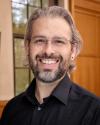
Conductor Robert Stahly passionately furthers orchestral music through programs that reimagine classical works alongside engaging new and underperformed works. Robert made his debut conducting Copland’s “The Tender Land” in the Spring of 2023 at Colorado State University. He also conducted portions of Mozart’s “The Marriage of Figaro” and “Symphony No. 33” in performance at the CCM Opera Bootcamp. Perpetually studying his craft, Robert additionally participated in conducting workshops at the Eastman School of Music, Bard College, University of Missouri Kansas City, and University of Colorado. His conducting teachers include Harold Farberman, Gianmaria Griglio, Mark Gibson, Apo Hsu, Neil Varon, Kevin Noe, Gary Lewis, Wes Kenney, and Dr. Rachel Waddell.
Robert is currently pursuing his doctorate in Orchestral Conducting at the University of Washington. He serves as conductor of the Campus Philharmonia Orchestra and is an assistant conductor for the University of Washington Symphony. In recent years Robert was the apprentice conductor for the Fort Collins Symphony, the conductor of the Denver Young Artists Orchestra String Ensemble and conductor of the Longmont Youth Symphony String Ensemble. Off of the podium he was the associate principal cellist with the Longmont Symphony Orchestra and was the cellist for the Elevation String Quartet. A conductor who is passionate about music education, Robert continues to visit school music programs to coach new generations of musicians and teachers. During his 13 years at Longmont High School Robert tripled the size of the orchestra program while at the same time increasing the quality and diversity of the ensembles. In 2016, he was recognized as one of the top six educators in the St. Vrain Valley School District with an “Encore Award” and in 2019 he was a finalist for “Teacher of the Year.” Robert received his Bachelor’s Degrees in Music Education, Tuba Performance, and a String Pedagogy Certificate from Colorado State University in 2008. In 2024 he completed a Master’s Degree in Instrumental Conducting at Colorado State University.
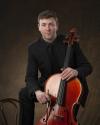
Zach Banks is a dedicated cellist, conductor, and educator, who resides in Seattle, Washington. What he loves most about the field of music are the abundant opportunities for collaboration, and the subsequent moments of growth for everyone involved - audiences, students, and performers alike.
As a cellist, he performs with numerous regional symphonies and chamber music festivals, and currently sits as principal cellist for the Oregon East Symphony. Outside of the concert hall, he has performed for many years in bluegrass folk bands, chamber music collectives, and has performed and recorded with various non-classical artists and recording studios throughout the Pacific Northwest.
From 2018 to 2025, Banks served as the music director of the Grande Ronde Symphony where he programmed and conducted classical, pops, and educational programs. Zach concurrently served as the education director and assistant conductor for the Oregon East Symphony, where in addition to conducting their youth orchestra, he maintained a multi-faceted music education initiative for young musicians in Eastern Oregon.
Banks, still carrying a passion for artistic growth, attended the Pierre Monteux School & Music Festival in 2022 and 2023 as a conducting fellow where he studied with renowned conductors such as Ludovic Morlot, Arthur Fagen, Hugh Wolf, Kenneth Kiesler, and Tiffany Lu. He is now attending the University of Washington to pursue a DMA in orchestral conducting with Dr. David Rahbee.
Banks received bachelor’s and master’s degrees in music performance at Portland State University under the tutelage of Hamilton Cheifetz and Ken Selden.