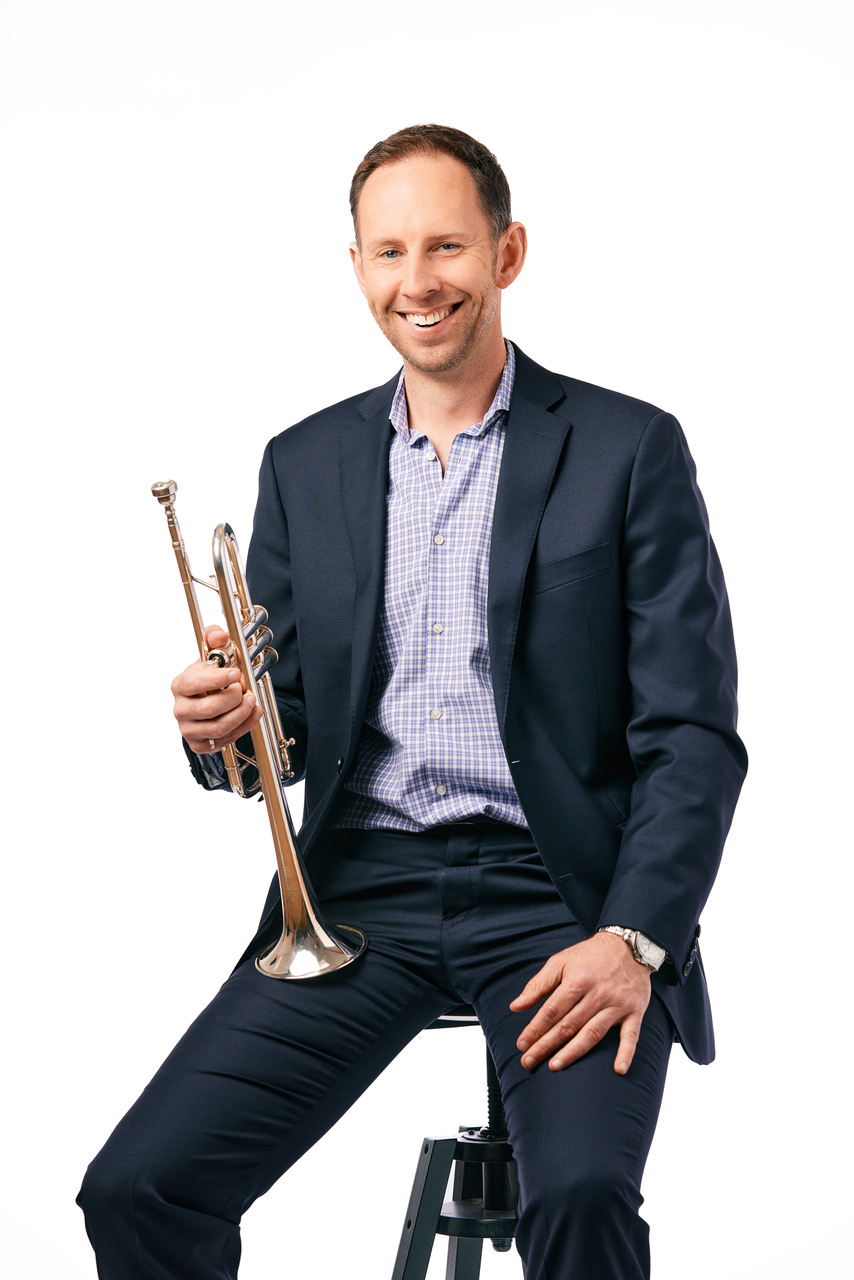
David Alexander Rahbee leads members of the UW Symphony in special free outreach program at the Nordstrom Recital Hall at Seattle's Benaroya Hall. The program includes music by Marianna Martines, Haydn, and Mozart. Artist-in-residence (and Seattle Symphony principal) David Gordon, trumpet, is featured soloist with the orchestra on Haydn's Trumpet Concerto in E-flat major.
Program
Sinfonia in C major - Marianna Martines (1744-1812)
I. Allegro con spirito
Trumpet Concerto, in E-flat major - Franz Joseph Haydn (1732-1809)
I.Allegro
II. Andante
III. Finale: Allegro
David Gordon, trumpet
-Intermission-
Symphony No. 41, in C major, “Jupiter”- Wolfgang Amadeus Mozart (1756-1791)
I. Allegro vivace
II. Andante cantabile
III. Allegretto
IV. Molto allegro
Program Notes
By Nathan Evans
Marianna Martines (1744 - 1812): Symphony in C major
Marianna Martines is a lesser known composer, yet one of influential female figures of the industry during her time, this may be the only surviving symphony written by a woman in the classical era. While other female composers were active during the time, such as Anna Amalia, Princess of Prussia, none have existing symphonies, marking this piece as historically one of a kind. Of Spanish name and family, Martines was born, raised, lived and died in Vienna, Austria. Growing up, she was regarded as a musical prodigy for her talent in vocal performance, keyboard, and composing. She was schooled by several prominent musical figures in the area, notably Haydn, who lived in the attic of Martines’s childhood apartment building. You can visit the site today at Vienna’s famous Michaelerplatz. The Großes Michaelerhaus, is one of only 2 buildings still standing in which Haydn lived. He taught the young Martines keyboard, and as she became more renowned as a composer the two became colleagues. Martines’s Symphony in C major is poised, stylish, and expertly crafted work fitting of the Viennese classical tradition. Tonight you will hear the work’s first movement functioning as on overture.
F. J. Haydn (1732 - 1809): Trumpet Concerto in E-flat major
The Trumpet of the eighteenth century was quite a different when compared with the modern instrument. A coiled brass tube of approximately eight feet, and with no valves could only produce notes within the overtone series. However, a newly invented trumpet called the Keyed Trumpet opened up the possibilities of chromaticism in the instrument’s middle and low registers, a feat impossible on “natural” counterparts. It features keys on tone holes along its tubing, similar to woodwind instruments we see today, which greatly expanded its melodic territory. Haydn takes full advantage of this in his E flat Trumpet concerto. Being arguably the most famous concerto written for this particular instrument, this piece memorializes an otherwise forgotten member of the trumpet family, which was quickly discarded from popular use after the invention of the more practical and versatile Valved Trumpet in the early nineteenth century. In the first and third movements, listen for stepwise motion and chromatic runs that would have never been achieved on earlier trumpets. While not as groundbreaking to our ears today, these passages highlighted the technological breakthrough of the keyed trumpet during the final years of the century. For the younger audience, you may also recognize the third movement of this concerto from the popular TV series Squid Game, where the opening theme is played to wake the characters up for the 1st game; the joyful melody plays in stark contrast with the dark fate the players are soon to face.
W. A. Mozart (1756 - 1791): Symphony No. 41 in C major, K.551 “Jupiter”
Titled “Jupiter” posthumously, this was Mozart’s final symphony, and the last of three which the composer wrote during a creative burst the summer of 1788. It is commonly agreed upon that the piece received its nickname from the opening figure of the piece. According to Mozart’s son Franz Xaiver Wolfgang Mozart, it was German violinist and conductor Johann Peter Salomon who coined the name. The theme reminded Salomon of Jupiter, specifically the Roman god’s lightning bolts. Symphonies no. 39 - 41 were composed without a commission, or concert date in sight. Mozart rarely composed symphonies outside of being paid to do so, making the circumstances around writing them uncharacteristic for. There is the claim that Mozart could have intended to use these works to draw crowds in Vienna for a new concert series, but no such plans materialized, and no existing letters support this. All three of these final symphonies would have to wait until after Mozart’s death to be published and performed. They may be seen as a unified trilogy, as they share similar musical motifs. No. 39 is the only one with the stately introduction, and number 41 is the only one with the coda. The 4th movement of no. 41, Molto Allegro (very fast/ lively), is particularly extraordinary as it features a mixture of both sonata form and fugue. It begins conventionally, yet as the themes develop and motifs introduce themselves, they start to overlap, all while retaining their clarity. The ending features the combination of all these motifs, with more than rive or them sounding. This grandeur and was groundbreaking for its time, and a clear inspiration for future composers such as Beethoven.
University of Washington Chamber Orchestra
(members of the University of Washington Symphony Orchestra)
David Alexander Rahbee, Music Director and Conductor
Robert Stahly and Zach Banks, Assistant Conductors
Flute
Xinyi Liu, DMA Flute Performance
Peyton Ray, BM Flute Performance
Claire Wei, BM Flute Performance
Oboe
Max Bolen, Music Education/Marine Biology
Minh-Thi Butler, BM Oboe Performance
Aika Ishizuki, Pre-science
Bassoon
Levi Beck, BM Bassoon Performance
Alex Fraley, Music Education
Ryan Kapsandy, BM Bassoon Performance
Eric Spradling, BM Bassoon Performance
Horn
Nicole Bogner, BM Horn Performance
Sam Nutt, Molecular & Cellular Biology
Trumpet
Hans Faul, BM Trumpet Performance
Antti Männistö, BS Physics
Timpani
Kaisho Barnhill, Music Education/Music Theory/Psychology
Violin I
Grace Pandra, Violin Performance/Business Administration (Co-Concertmaster)
Hanu Nahm, Violin Performance/Chemistry(Co-Concertmaster)
David Teves-Tan, Pre-Sciences
Michaela Klesse, Music
Yerin Hwang, Music
Kieran Horowitz, Biology
Justin Chae, Computer Science/Mathematics
Brandon Bailey, Computer Science
Violin II
Martessa Davis, MM Violin Performance (Principal)
Gustavo Berho, BM Music
Rosalia Feng, Statistics
Victoria Zhuang, Informatics and Geography: Data Science
Vitaliy Duvalko, Engineering
Saraim Gebretsadik, Biochemistry
Qurin Choi, Biochemistry
Alice Leppert, Chemistry
Thea Higgins, MS Industrial Engineering
Viola
Flora Cummings, Viola Performance (CoPrincipal)
Mica Weiland, Viola Performance and conducting (CoPrincipal)
Abigail Schidler, Computer Science/BA Music
Helen Young, MM Music Education
Emma Boyce, Music History
Mia Grayson, Biochemistry
Violoncello
Cory Chen, BA in Music/BS MCD Biology (Principal)
Sota Emura, BM Cello Performance
Ian Jung, Engineering
Oliver Tiu, Biochemistry
Nathan Evans, BA Music History
Bass
Amelia Matsumoto, BM Bass Performance (Principal)
Eddie Mospan, BM Bass Performance
Nathan Eskridge, MM Bass Performance
Biographies

David Alexander Rahbee is an Associate Professor at the University of Washington School of Music, where he is Director of Orchestral Activities and Chair of Orchestral Conducting. He is Music Director and Conductor of the University of Washington Symphony Orchestra and founder of the Campus Philharmonia Orchestras. He is a recipient of the American-Austrian Foundation's 2003 Herbert von Karajan Fellowship for Young Conductors, the 2005 International Richard-Wagner-Verband Stipend, a fellowship the Acanthes Centre in Paris (2007), and is first prize winner in conducting from The American Prize national non-profit competitions in the performing arts for 2020. His work at UW has earned national recognition. In 2021 he was praised by The American Prize as “Consistently one of the most courageous and comprehensive [orchestral] programmers working in higher education in the U.S. today…”
Dr. Rahbee has appeared in concert with orchestras such as the Seattle Symphony, RTE National Symphony Orchestra of Ireland, Orchestre Philharmonique du Luxembourg, Kammerphilharmonie Berlin-Brandenburg, Guernsey Symphony Orchestra, Chattanooga Symphony, Bellingham Symphony, National Chamber Orchestra of Armenia, Orchestre de la Francophonie, the Boston New Music Initiative, Seattle Modern Orchestra, Orquesta Sinfónica de Loja, Cool Opera of Norway, Schönbrunner Schloss Orchester and the Divertimento Ensemble of Milan. His collaborations with the Seattle Symphony include assistant conductor for the performance and recording of Ives’ Fourth Symphony, and as guest conductor for their Native Lands project and the North American premiere of Páll Ragnar Pallson's Quake. He has collaborated with several prominent soloists such as Sarah Chang, Michelle Cann, Jon Kimura Parker and Jonathan Biss. He has taught at the Pierre Monteux School, as has conducted at a number of summer festivals such as the Atlantic Music Festival, Sewanee Music Center, Bar Harbor Music Festival and Hawaii Performing Arts Festival.
Dr. Rahbee was an assistant at the Vienna State opera from 2002-2010. As part of his fellowship and residency at the 2003 Salzburg Festival, where he worked with members of the Vienna Philharmonic. Masterclasses with prominent conductors such as Kurt Masur, Sir Colin Davis, Jorma Panula, Zdeněk Mácal, Peter Eötvös, Zoltán Peskó and Helmut Rilling, and counts Nikolaus Harnoncourt to be among his most influential mentors.
Dr. Rahbeeʼs principal conducting teachers were Charles Bruck and Michael Jinbo at the Pierre Monteux School. He holds a Bachelor of Music degree in violin and composition from Indiana University, a Master of Music degree from the New England Conservatory in orchestral conducting, and a Doctorate of Musical Arts from the University of Montreal in orchestral conducting. He has also participated in post-graduate conducting classes at the Universität für Musik und Darstellende Kunst, Vienna. His orchestrations of music by Clara Schumann, Fanny Mendelssohn Hensel, Ravel, Debussy and others are published by LeDor; his brass arrangements and an original composition are published by Warwick Music, and his articles on the music of Gustav Mahler have appeared in journals of the International Gustav Mahler Gesellschaft, among others.
In addition to being awarded first prize in conducting from The American Prize for 2020, he was awarded 2nd place in 2019. He has also placed among winners for five consecutive years for The American Prize Vytautas Marijosius Memorial Award for Orchestral Programming, recognizing his programming with the UW Symphony and its affiliated ensembles for every season since he joined the faculty. The UWSO has also been a finalist in the category of orchestral performance in 2018, 2019 and 2020.
Dr. Rahbee is co-editor of Daniels’ Orchestral Music (6thedition) and Daniels’ Orchestral Music Online (DOMO), the gold standard among conductors, orchestral administrators, orchestra librarians as well as other music professionals and students researching for orchestral programming.

David Gordon, whose playing has been described as “spectacular” by The Chicago Tribune, is Principal Trumpet of the Seattle Symphony Orchestra, Seattle Opera and the Grant Park Symphony Orchestra, Chicago. Prior to his appointment in Seattle, he was Principal Trumpet of the Charleston Symphony Orchestra.
As a guest artist, he has performed, recorded and toured as Principal Trumpet of the London Symphony Orchestra and the Orchestre Philharmonique de Radio-France, and has performed as Principal Trumpet of the Saint Louis Symphony Orchestra. As soloist, David has appeared with the Seattle Symphony Orchestra, the Grant Park Symphony Orchestra, the Charleston Symphony Orchestra (with whom he performed as soloist every season of his tenure), the National Repertory Orchestra, and the Lake George Chamber Orchestra. In an orchestral context, he has performed with the Boston Symphony Orchestra, the New Jersey Symphony Orchestra, the Moscow Chamber Orchestra and the Savannah Symphony Orchestra, and has held the position of Principal Trumpet with the Jupiter Symphony and the Prometheus Chamber Orchestra.
Mr. Gordon has toured extensively in Europe, North America and South America, and has performed in such prestigious festivals as Tanglewood, Lucerne and Schleswig-Holstein. As a chamber musician, he has performed with Music of Remembrance, Seattle Chamber Players and as a member of the Seattle Symphony Chamber Series, among others. In addition to his performance activities, he records frequently for radio, television, and film. A committed educator, David is a faculty member at the University of Washington, and regularly presents master classes and coachings nationwide.
A native of Narragansett, RI, David Gordon was educated at Columbia University, from which he holds a degree in philosophy, and The Juilliard School. He lives in Seattle with his wife, Seattle Symphony Principal Harp Valerie Muzzolini Gordon, daughter Anaïs, and English bulldog Massimo.