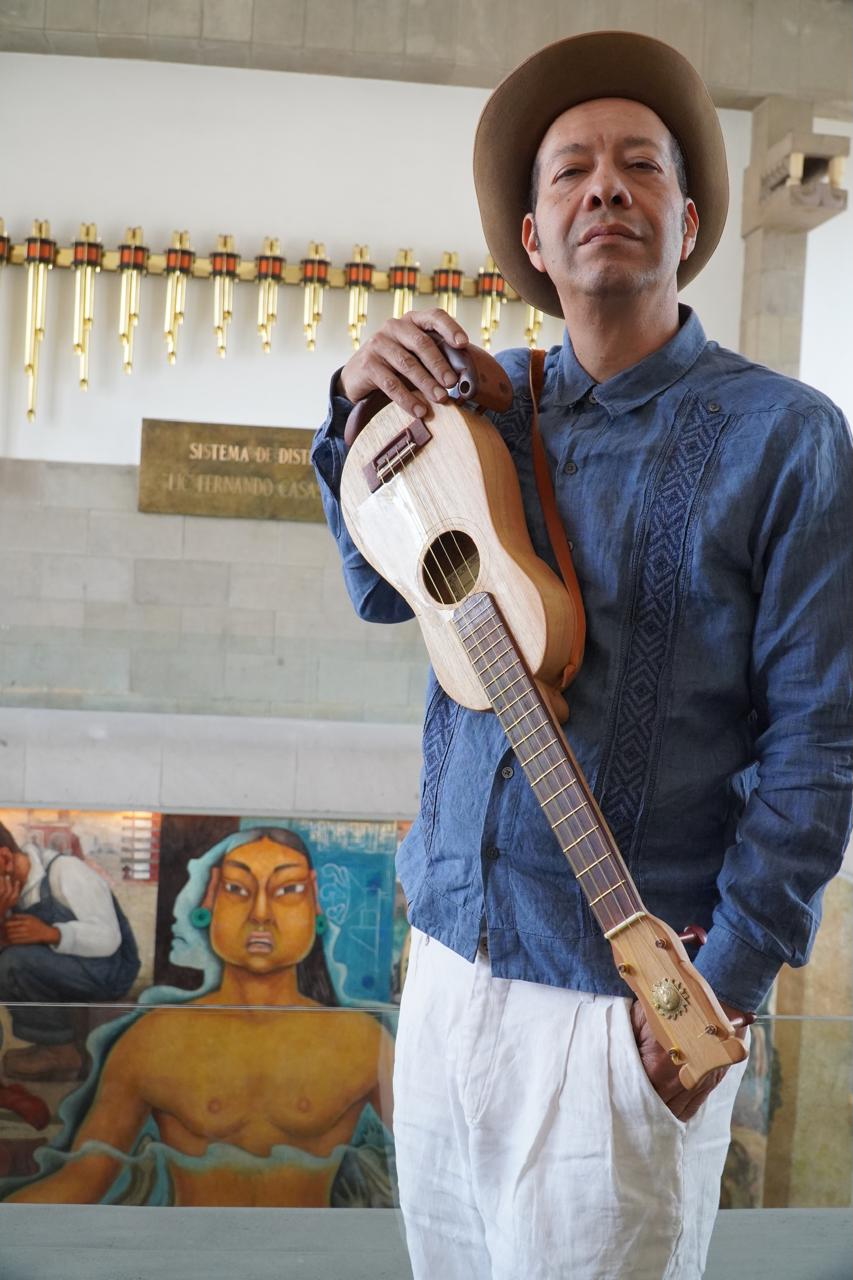
Winter Quarter Ethnomusicology Visiting Artist Ramón Gutierrez Hernández concludes his UW residency with a concert of music from the Son Jarocho tradition, joined by his UW students and special guests.
Program
Ramón Gutierrez Hernández
UW Ethnomusicology Community Artist in Residence, Winter 2026
Son Jarocho
Ramón Solo
“El Trompito” (traditional son)
“Amores Imaginarios” (c. Ramón Gutierrez)
Small Ensemble
“Los Chiles Verdes” (traditional son)
“Fantasia de Santiago” (c. Ramón Gutierrez)
“Old Lady Walk a Mile and a Half” (traditional carnival song from Trinidad)
“El Buscapiés” (traditional son)
Ramón with his students
“La Guacamaya” (traditional son)
“Los Juiles” (traditional son)
“El Pájaro Cú” (traditional son)
“La Bamba” (traditional son)
Performers
Supporting Musicians
Shannon Dudley, steel pan and marimbol
Soledad Mayorga-Maldonado, voice
John-Carlos Perea, bass
Ricardo Perez, congas
Eduardo Sierra, jarana
Iris Viveros, zapateado
Students in Musap 389/589
Rowan Beverd
Lucy Brandt
Haley Chavez
Ashley Cook
Penny Crichton
Rayne Mescallado
Juan Posada
Markus Teuton
About the Artist
Ramón Gutierrez Hernández was born in 1967 in the state of Veracruz, Mexico, where he currently resides in the city of Xalapa. At a young age he became fascinated with the requinto, also known as guitarra de son, a four-stringed guitar played in son jarocho, the traditional music of the Veracruz region. He is recognized today as one of the foremost performers on the instrument. Ramón came to national and international attention especially with his ensemble, Son de Madera, who have performed all over Mexico and internationally, and have recorded numerous albums, most recently with Smithsonian Folkways. Ramón has also collaborated with artists in other genres, ranging from the Grammy-winning Chicano rock band Quetzal, from Los Angeles, to the Mexican early music scholar and performer, Antonio Corona. He is the recipient of numerous awards in Mexico. He is also a luthier, and several of the instruments played in tonight’s performance were built by him.
Son Jarocho
Son jarocho is a centuries-old tradition from Veracruz that consists of many traditional sones, each with a characteristic meter, chord progression, verse form and poetic theme. Unlike a song, a son is never performed the same way twice. Every performance is shaped by the singers’ choices of which verses to sing (or perhaps to invent on the spot) and how to render them melodically, and by the improvisations of the instrumentalists and the dancers, who sound percussive rhythms with their feet in the style known as zapateado. The most ubiquitous instruments of son jarocho are the jarana (a strumming guitar), the tarima (a platform on which the dancers sound rhythms) and the requinto, whose melodies signal the beginning and end of the son and animate it throughout. Other instruments commonly played in son jarocho include the harp, the leona (essentially a larger and deeper-sounding version of the requinto), the pandereta (a frame drum) and the marimbol (a large lamellophone that plays bass lines). The traditional context for the performance of son jarocho is the fandango, a participatory event that integrates singing, instrumental playing and dancing.
Since the 1970s son jarocho has undergone a revival driven by efforts to restore it as a community practice in the face of commodification and folklorization. An important leader of this movement, known as the nuevo movimiento jaranero, was Ramón’s brother, Gilberto, and his group Mono Blanco, who began collecting verses and oral histories from elders in the 1970s and promoting community fandangos. As a participant in the nuevo movimiento jaranero, Ramón Gutierrez has helped spread the practice of the fandango to communities throughout the U.S. and internationally (including Seattle, where he spent a month-long residency in 2009) and has bridged the worlds of participatory music and concert performance.
Acknowledgements
Thank you to the School of Music, especially director Joël Durand, for their ongoing support of the Community Artist in Residence program, and to members of the Seattle Fandango Project, who have helped to host Ramón and welcomed him to their workshops in Seattle.