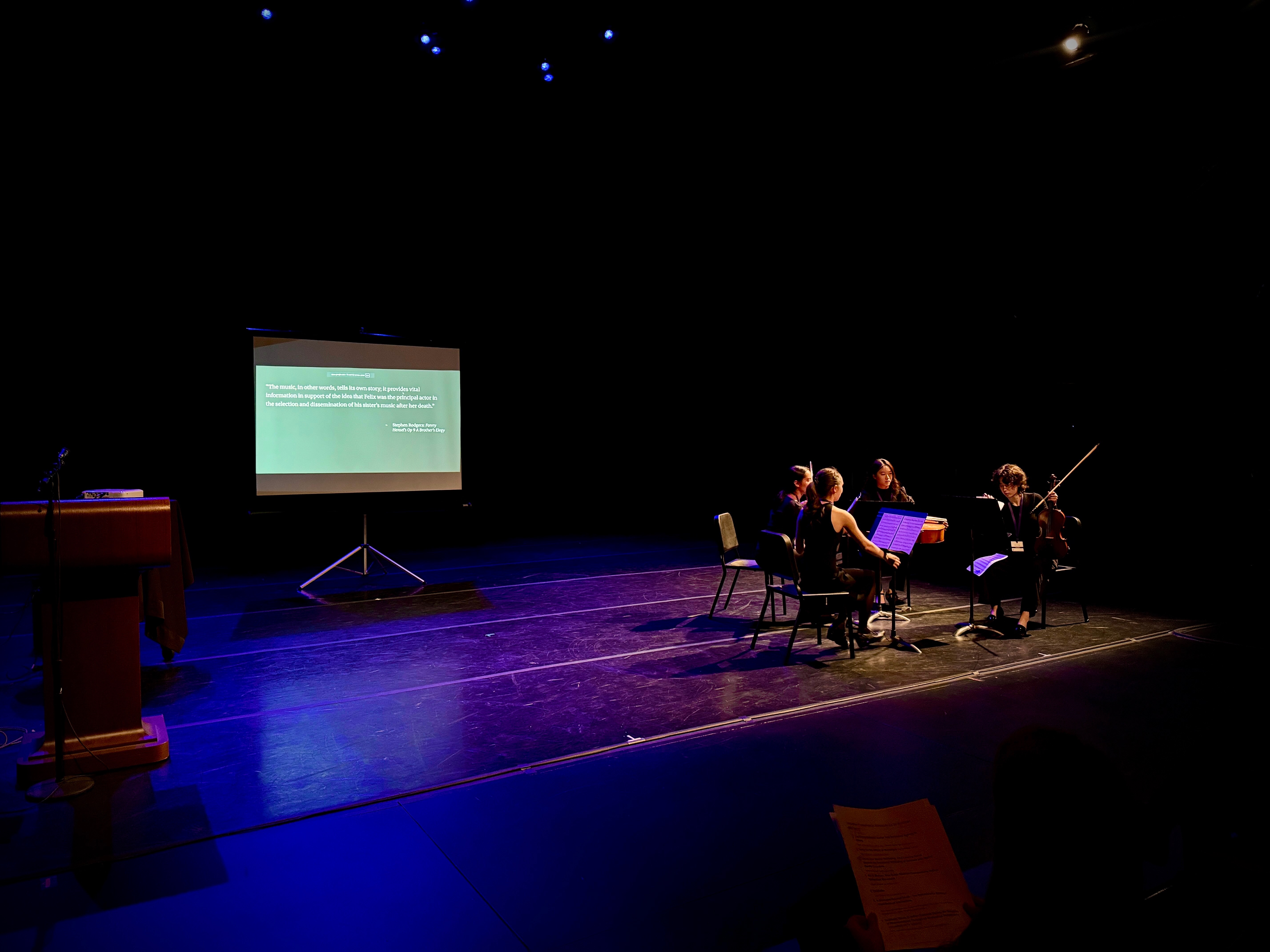
The School of Music was well-represented at the 28th Annual Undergraduate Research Symposium held on campus on May 15, with three presentations in the performing arts category by School of Music students. Hosted by the UW’s Office of Undergraduate Affairs, the symposium encompassed a day of presentations, design showcases, and performances demonstrating the breadth and depth of undergraduate research at the UW and in its local communities. The eight performing arts presentations, held in the Meany Studio Theater, included work from student researchers in UW Dance and Music, as well as presentations from student researchers at Bellevue College.
In “Song for the Ghost of Montaigne,” cellist and composer Serena Tideman created an original song, under the guidance of faculty mentor Huck Hodge, in honor of the women who figured prominently in the life of French Renaissance philosopher Michel de Montaigne. “It is my intention to take a musical perspective to honor the women in Michel de Montaigne's life, who have been largely forgotten: his wife the Duchess of Bordeaux, and his daughter Leonore, and his protege, the self-taught literary phenom Marie de Gournay,” Tideman writes. Taking musical influences and harmonic inspiration from a troubadour folk song of L'Occitan published in the 16th century, and cautionary notes from an opera by Phillip Glass, she devises a background scene featuring the three woman organizing Montaigne’s office after his death. The resulting composition, she concludes, “is from an imagined perspective rooted in historical truth; for this project looks back five centuries, down the long, windowed corridor of history.”
More details about "Song for the Ghost of Montaigne"
In “A Dialogue Beyond Death - The Mendelssohn Siblings’ Final Musical Intersection,” School of Music students Cory Chen, Abigail Schidler, Tia-Jane Fowler, and Hailey Vaught, guided by faculty mentor John Popham, explored the profound musical and familial connections between siblings (and similarly talented composers) Fanny and Felix Mendelssohn, noting how Felix’s music changed in style following his sister’s death. Using analysis techniques in harmony and history of Felix Mendelssohn’s String Quartet No. 6 in F Minor alongside Fanny’s Schwanenlied, or Swan Song, and her final composition, Trio in D minor, the students’ findings “illustrate the dual purpose of Mendelssohn’s final compositional work, also regarded as his ‘swan song,’ or final transcendent piece, that also serves as a requiem for his sister. These results indicate that the influence the Mendelssohn siblings held over each other both in familial relations and compositional virtuosity transcended death.”
More details on "A Dialogue Beyond Death"
Juan Posada Abal, a senior in Ethnomusicology graduating in June 2026, presented “Oubliette,” focused on the UW’s Ethnomusicology instrument collection, housed in less-than-ideal conditions in the School of Music basement. Guided by faculty mentor John-Carlos Perea, Posada created a musical piece by which to communicate the status of the instruments, which he declares are “far from their original cultural spaces and not cared for properly.” He maintains that the instruments in the collection have been “tuned by the forces of being forgotten.”
“To communicate the instruments’ distance from their home cultures I sample and assemble them in a larger musical piece emphasizing the sounds of the basement,” Posada wrote. “I draw inspiration from Ryuichi Sakamoto’s use of a piano that had been moved by the 2011 Fukushima tsunami. He frames the piano as an industrial distortion of nature and the now ‘out-of-tune’ Fukushima piano as being nature’s preferred tuning for said instrument. I argue that the instruments in the collection have been tuned by the forces of being forgotten.
The goal of the piece is to portray instruments as signifiers of their peoples - those who made the instruments and have a cultural connection with the item - and question how an archive comes into play in that process.”
More details about "Oubliette"
“We are proud of all of our students for the work they put into their projects and for participating in this important research opportunity,” says School of Music director Joël-François Durand. “The work these motivated artists and scholars have produced under the guidance of their professors is a testament to the ways in which students may take full advantage of opportunities and resources available to them at a major research institution.”