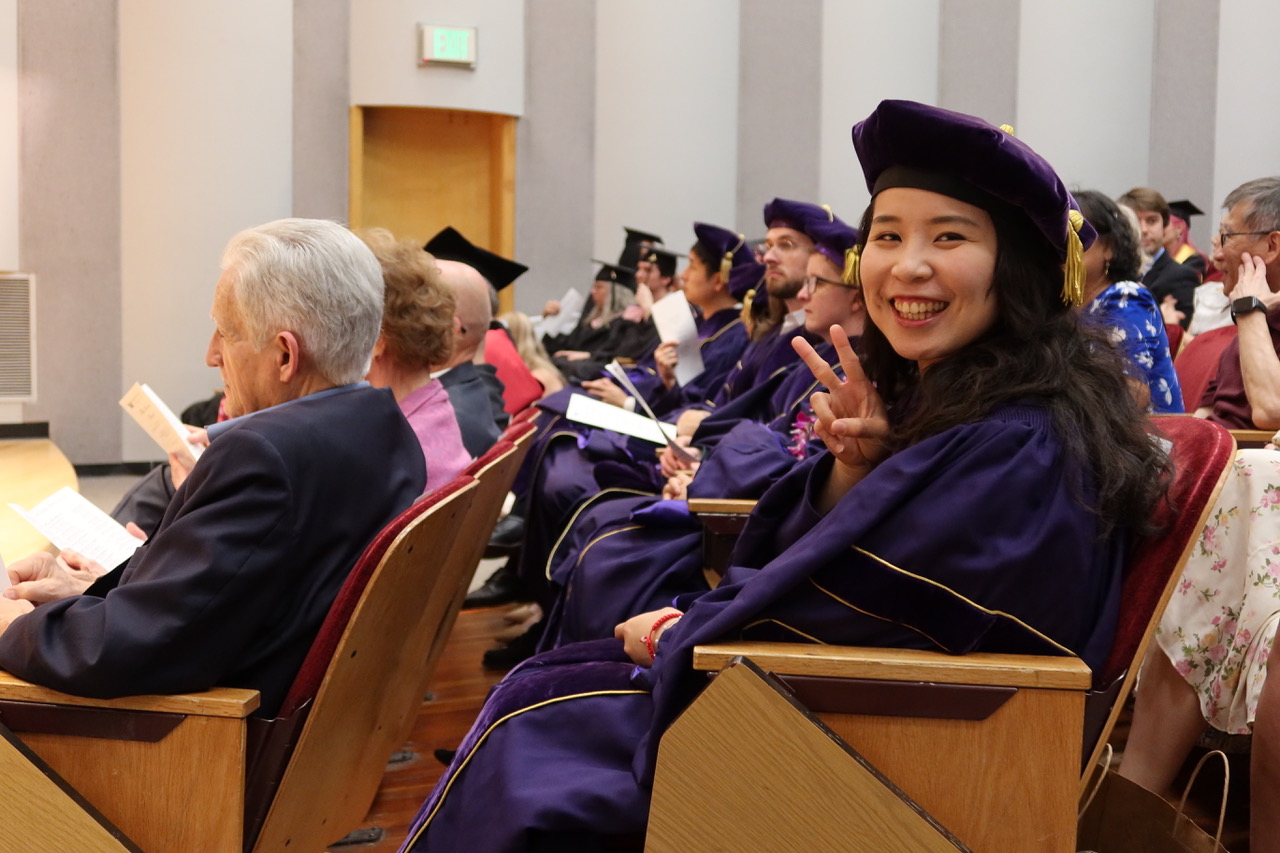
Among the outstanding and highly engaged students selected for the University of Washington's 2026 Husky 100 cohort was School of Music Class of 2026 graduate Chiao-Yu Wu, a doctoral piano student of Robin McCabe selected from hundreds of applicants for the recognition. Chiao-Yu speaks of music as a “powerful tool for connection, healing, and community” and puts into practice that ethos through teaching, performing with university and community ensembles, and playing at hospitals, senior communities, and multicultural spaces. “I am honored to be recognized as a Husky 100 for integrating performance, mentorship, and service," she says, "sharing music in ways that foster empathy, belonging and cultural connection.” The following emailed interview between Chiao-Yu and School of Music publicist Joanne DePue, conducted shortly after graduation, has been lightly edited for publication.
Q: As you finish your UW education, what are some of your favorite memories from your time at the University?
A: There are so many, and I have never once regretted coming to UW. Of course, I am grateful for all the opportunities I had here—performing a concerto with a Seattle-based orchestra, collaborating with musicians across the Seattle community, participating in masterclasses with world-renowned pianists, teaching as a piano TA, and many more. Yet when I look back, what I will carry with me for the rest of my life is not any particular performance or milestone. It is the people who shared those experiences with me. The teacher who guided me. The classmates who became close friends. The students who taught me as much as I taught them—perhaps even more. The colleagues who made music alongside me and became lifelong friends. Even the warm smiles and hugs from administrators and advisors I happened to meet in the hallway. The UW School of Music is filled with people who genuinely want to see one another succeed, and I am deeply grateful to have been part of this community.
First and foremost are my piano lessons and weekly studio classes. My piano teacher, Dr. McCabe has been one of the most important people throughout this five-year journey, and her influence will continue throughout my life. I hope that one day I can be the kind of teacher she has been to me. Her guidance and example will stay with me for years to come. She knows exactly what her students need. She can be incredibly kind, but also direct and honest, which I appreciate so much. She accompanied all my ups and downs these past five years. I cannot count how many emails she has sent to me after performances, competitions, or even studio classes to deliver congratulations, to encourage me to keep my faith, or to make sure I am okay. She cares for each of us so much.
One memory I will never forget happened before my DMA concerto recital. Pianists in our program perform two concerti in the same recital, and I chose two of my favorites: Beethoven's Third Piano Concerto and Rachmaninoff's Second Piano Concerto. Standing backstage, I was terrified. As I watched people entering the hall, I seriously considered canceling the performance. As she always did, Dr. McCabe came backstage to check on me. I think she could see exactly how frightened I was. Instead of offering gentle reassurance, she looked at me and said simply, "Now, put yourself together and go." It was exactly what I needed to hear. I walked onto the stage and performed both concerti. That moment perfectly captures who she is as a teacher—someone who understands her students deeply and knows how to help them become stronger than they believe they are.
Studio class was also one of the highlights of every week. I loved listening to my studio mates perform, sharing repertoire, and supporting one another at concerts. The friendships I built there mean so much to me, and I hope those relationships will continue for years to come.
I also cherished my time as a piano TA. Every student I taught was exceptional in their own way, and I learned so much from them. My goal was always to create an environment where students felt supported, challenged, and excited to learn. Some of my happiest moments were when students told me they genuinely enjoyed practicing piano or that piano class had become one of their favorite courses.
I am equally thankful for the support of the wonderful School of Music administrators who were part of my journey. Joanne, Brenda, Rylan, Michiko, and Maya were incredibly encouraging throughout my time at UW.
Finally, I loved performing in choir and orchestra. I played in the UW orchestra from my first year and later joined the UW Choirs as an accompanist. I appreciate so much these opportunities to make music with good friends.Through those experiences, I worked with inspiring conductors and musicians and formed friendships that I know will last a lifetime.
Q: During your time at UW, you explored multiple roles in your piano studies: Performer, Educator, Collaborator, Student, and Researcher. Which role or roles do you find most fulfilling?
A: One goal I set for myself when I decided to pursue a doctoral degree was to become a well-rounded pianist. I hope to be someone who not only performs, but also teaches, engages in outreach, and conducts research.
If I had to choose a common thread among performing, teaching, and research, it would be connection and engagement with people. Whether I am performing a piece, teaching a student, or sharing research, I am trying to connect people with ideas, stories, and emotions through music—the language through which I feel most fully myself. I have loved performing since I was very young, both as a soloist and as an ensemble musician. At the piano, I find great joy in bringing the worlds of different composers to life. Every piece invites me into a different story, and I hope I can bring audiences into that world with me.
When I was a child, I wanted to become a doctor because I wanted to help people. Life ultimately led me to music instead, but over time I realized that music also has the power to comfort, heal, and connect people. We may not save lives in the way doctors do, but I hope that through music I can bring comfort, joy, and companionship to others. That is why I find just as much meaning performing in senior centers and hospitals as I do performing in major concert halls.
As an educator, I treasured my time as a piano TA at UW. I was fortunate to teach remarkable students, and I learned so much from them. I believe every student is unique, and I hope to create learning environments that are both supportive and challenging—places where students feel motivated, curious, and excited to grow.
As a researcher, I arrived at UW with very little research experience and was initially intimidated by the process. I feel especially fortunate that my dissertation focused on a subject I care deeply about: The evocation of childhood in piano music, painting, and poetry. The topic I love a lot. I have always believed that the arts are interconnected, and I loved exploring those connections through interdisciplinary research. I love going to the museum, standing in front of those paintings, and wondering what evokes those painters to paint those arts. I love reading poems and reflecting on what the poets might express.
More importantly, completing the dissertation reminded me once again that meaningful accomplishments are rarely achieved alone. I would not have finished this project without the guidance of my teachers, the support of friends, and the help of the UW Writing Center. The process made me even more grateful for the wonderful people I met during my time at UW.
Q: What is a discovery you made about yourself while working toward your doctoral degree?
A: As a pianist, I spend many hours alone in the practice room. I understand that without hours and hours of practice and discipline, I will not be able to accomplish the level of music I aspire to. But during this degree, I discovered that what I value equally important is the human connection.
I remember finishing a recital during my first year at UW after countless hours of preparation. I was pleased with my performance, yet when the applause ended and arrived home, I felt so lonely. That experience taught me something important: success by itself is not enough.
The most meaningful moments were never the accomplishments themselves. They were the people who celebrated, encouraged, challenged, and shared those moments with me. I would not have achieved this degree on my own, and my accomplishments would feel far less meaningful without people to share them with.
That realization has changed how I think about both music and life. Moving forward, I hope to continue pursuing excellence in my profession while also making time for the people I love and care about. Without them, success feels incomplete.
Q: What music do you enjoy listening to when you are not at school or work?
A: I love jazz and enjoy attending live jazz performances whenever I can. I am fascinated by the freedom, spontaneity, and creativity of jazz, and I especially admire the way musicians listen and respond to one another in real time. There is something deeply inspiring about that level of freedom, communication, and collaboration.
I also love listening to traditional Taiwanese songs. Whenever I hear them, I feel a sense of home, no matter where I am.
Q: What comes next for you now that you have finished your dissertation and completed your degree?
A: That is a very good question—and one I have been asking myself throughout the graduation trip I am currently taking with my family. I have many goals and dreams for the future, but whatever path I take, I hope to continue sharing music with others as a performer, educator, and scholar. I also hope to have the same positive impact on my future students that my teachers have had on me.
Receiving the Husky 100 recognition is deeply meaningful because it reflects not only my own work, but also the support of the many people who helped me along the way. Music is often seen as an individual pursuit, but everything I have accomplished at UW has been shaped by mentors, colleagues, students, family, and friends. I see this recognition as something I share with all of them.
As I leave UW, that may be the most important lesson I take with me: that our achievements become meaningful because of the people who help us achieve them and the people with whom we share them. I have been incredibly fortunate to receive so much generosity, guidance, and love from the people around me. My hope is that I can now carry that forward—through my teaching, my performances, and my work—and offer the same encouragement and support to others that so many people have offered to me.
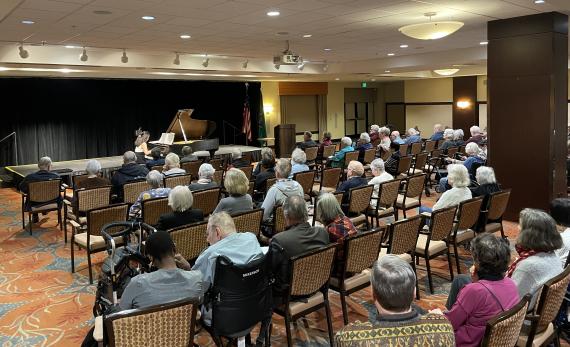
Doctoral piano student Chiao-Yu Wu performs for residents of the Mirabella senior community (Photo: Rylan Virnig).
Related Content: Two from School of Music among 2026 Husky 100