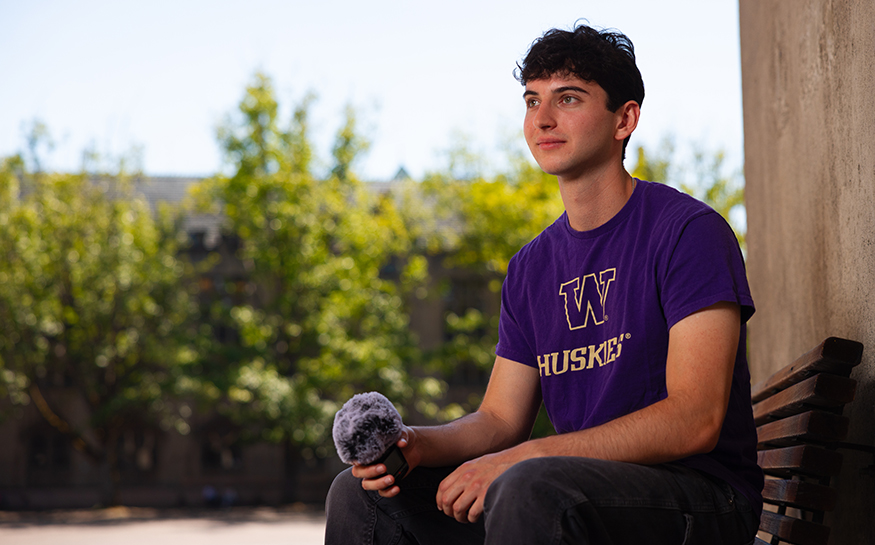
School of Music student Leo Freedman graduated in June 2026 with bachelor’s degrees in International Studies and Ethnomusicology and a minor in Environmental Studies. He was selected In April from among 734 applicants for the Husky 100, students who have been highly engaged in their communities on and off campus while completing their degree studies. Following Commencement, he graciously sent answers to our emailed questions while on a post-graduation international backpacking trip.
Q: While a UW student you have been variously engaged in classroom learning, field studies, working at the library in the Ethnomusicology Archives, and outside activities like playing in a band with friends, among other things. What have been some of your most valuable experiences during your time at the University?
A: My most valuable experiences have always been moments or projects where I could bridge knowledge and communities across borders. In my research and coursework, I enjoyed interdisciplinary projects where I could connect ideas across seemingly disparate topics like music, geopolitics, history, economics, nursing, and environmental science. A few examples of this work include published research on Inuit approaches to Greenlandic independence, ethically redeveloping informal urban settlements in Mumbai, and integrating music-based programming into memory care facilities. The concept of bridging knowledge and communities across borders also led to valuable experiences in my life outside of the classroom. I actively mixed Greek Life with UW's DIY house show community, led recruitment for an intentionally international-inclusive fraternity, and found joy in connecting different corners of campus in unexpected ways, with music often serving as the focal point.
Q: What is a discovery you made about yourself while working toward your degrees?
Not a singular moment, but when I reflect upon what I discovered about myself over the past four years I think of the confidence I developed in my leadership abilities. Through various music clubs, faith groups, and collaborative courses at UW, I had the opportunity to serve in multiple leadership positions. But even on teams without titles, I learned how to lead from below and from within, aiming to support my peers and organizations with enthusiasm and humility.
Q: While a student at the UW, you were engaged in research into the potential of music to improve quality of life for people with memory issues like Alzheimer’s disease or dementia. Can you tell us a little bit about this research? Do you intend to delve deeper into this area of research?
Research already demonstrates that playing and listening to music not only improves cognitive health, but visibly reinvigorates people even in late-stage dementia. However, our understanding of this phenomena on a neurological level is just developing. I collaborated with Dr. Sarah McKiddy in the UW School of Nursing on an interdisciplinary study that investigated how memory care facilities can leverage music-based programming to enhance treatment plans for people with dementia. I contributed to various tasks including data collection and input on the study. However, my main deliverable was an 11-minute soundscape I produced that documents several live musical engagements between a professional string quartet and community members at UW Medicine's Memory Hub, a center for people with memory loss. This work is incredibly meaningful because it has the potential to positively impact millions of lives including not only people with dementia, but their family members and caretakers. I absolutely am intending on continuing my involvement in research on music in medical contexts.
Q: Do your future career aspirations look different now than they did when you were first entering the UW? How so?
A: When I first entered UW, I had many passions — including music, international relations, and supporting my personal communities — but I wasn't sure how to connect these interests with a particular career path. Through coursework, research, clubs, and connections, UW gave me the resources to develop my passions while identifying more specific career paths. So while my core interests are largely the same, my goals, although diverse, have become much more focused.
Q: What music do you enjoy hearing when you are not at school or work?
I love ambient electronic music, especially Boards of Canada and Aphex Twin. I also love exploring international artists and genres that my friends introduce to me.
Q: What comes next for you now that you have finished your degrees?
Starting this summer, I am working for the Seattle Chamber Music Society in support of their festival season. Long term, I hope to work in marketing and communications or development for an arts or internationally-oriented organization. I also would like to start my own business developing soundscapes for medical and commercial purposes. Business school or graduate school in international relations is another possibility on the horizon.
Related Content
Two from School of Music among 2026 Husky 100
Arts and Sciences News: Capturing the Sounds of Campus