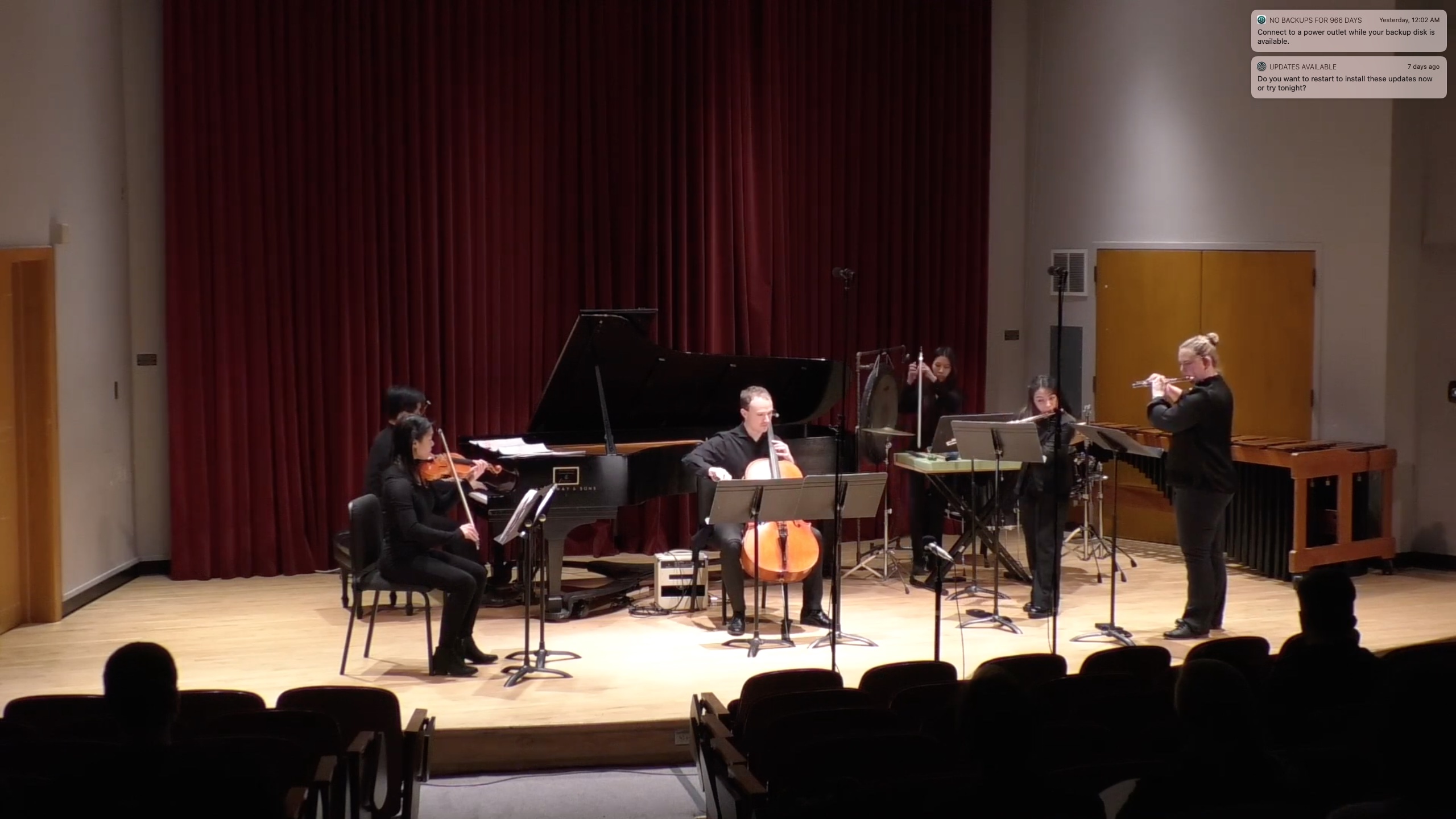
The Modern Music Ensemble (Cristina Valdés, director) performs music by Rebecca Saunders, Alex Mincek, Angelica Negron, Elliott Carter, Christian Wolff, and George Crumb.
Program
O Yes & I (2017-2018): Rebecca Saunders (b.1967)
Soledad Mayorga Maldonado, soprano; Rachel Reyes, bass flute
PENDULUM VI: TRIGGER (2010): Alex Mincek (b.1975)
Jiaxuan Wu, Xinyi Cao, piano; Devon Rafanelli, Tyler Smith, percussion
TRES INSULTOS para dos violines (2004): Angelica Negron (b.1981)
Martessa Davis, Taylor DeCastro, violin
Esprit Rude/Esprit Doux II (1994): Elliott Carter (1908-2012)
Rachel Reyes, flute; Cameron DeLuca, clarinet; Devon Rafanelli, percussion
— intermission —
Eleven Echoes of Autumn (1965): George Crumb (1929-2022)
Eco 1. Fantastico
Eco 2. Languidamente, quasi lontano ("hauntingly")
Eco 3. Prestissimo
Eco 4. Con bravura
Eco5. Cadenza Ⅰ (for Alto Flute)
Eco 6. Cadenza Ⅱ (for Violin)
Eco 7. Cadenza Ⅲ (for Clarinet)
Eco 8. Feroce, Violento
Eco 9. Serenamente, quasi lontano ("hauntingly")
Eeo 10. Senza misura ("gently undulating")
Eeo 11. Adagio ("like a prayer")
Rachel Reyes, alto flute; Cameron DeLuca, clarinet; Taylor DeCastro, violin; Jiaxuan Wu, piano
I LIKE TO THINK OF HARRIET TUBMAN (1985): Christian Wolff (b.1934)
Soledad Mayorga Maldonado, soprano; Rachel Reyes, flute; Cameron DeLuca, bass clarinet; Martessa Davis, violin
Program Notes
O Yes & I (2017-2018)
M4 - O Yes & I (2017-2018) is module 4 of 28 modules which make up Yes (2017), a 82-minute large scale spatialised performance work, which explores parts of Molly Bloom’s monologue, the final chapter of James Joyce's Ulysses. This new version is expanded and completely re-worked. O Yes & I was written for Juliet Fraser and Helen Bledsoe for the Louth Contemporary Music Festival The Book of Hours. With my grateful thanks to the sopranos Juliet Fraser, Donatienne Michel-Dansac and Sarah Sun, and the flautists, Helen Bledsoe, Eva Furrer and Bettina Junge.
–– Rebecca Saunders
PENDULUM VI: TRIGGER (2010)
Commissioned by Yarn/Wire for two pianos and two percussionists, Pendulum VI: Trigger (2010), continues Mincek’s “Pendulum” series and explores the metaphor of swinging motion and structural motion in sound. Working with large-scale loops, Mincek uses the essential components of form, sound and silence, to build the types of rigorous structures that give even the most unexpected ideas clarity. Through oscillations between activity and stillness, the piece invites listeners to follow along even when things like direction and meaning seem mysterious. Pendulum VI: Trigger serves as a testing ground for the continued relevance of the sonata-allegro principle within contemporary sound practice.
—Jiaxuan Wu
TRES INSULTOS para dos violines (2004)
Angelica Negron (b.1981) explores unexpected accents and dynamic interplay between two violins in her work Tres Insultos para dos violines (2004). The work is composed of three contrasting movements: Burlesco, Seco, and Insistente. Negron creates a vivid dialogue that is both playful and intense. Listeners are invited to experience the contrasting moods and the subtle tension that evolves throughout the work.
—Jiaxuan Wu
Esprit Rude/Esprit Doux II (1994)
Esprit rude/Esprit doux II was composed for the celebration of Pierre Boulez’s 70th birthday on March 30, 1995, in Chicago. The title, translated as “rough breathing/smooth breathing,” refers to the pronunciation of classical Greek words beginning with a vowel or a ρ. With esprit rude (rough breathing), the initial vowel is to be preceded by a sounded H, and is indicated by a reversed comma above the letter. With esprit doux (smooth breathing), the initial vowel is not to be preceded by H and is indicated by a comma above the vowel. In Greek for seventieth year (transliterated as hebdomekoston etos), the initial epsilon of the first word has a rough breathing sigh while the epsilon of the second has a smooth one.
–– Elliott Carter
Eleven Echoes of Autumn (1965)
The ELEVEN ECHOES OF AUTUMN (1965) were composed during the spring of 1966 for the Aeolian Chamber Players (on commission from Bowdoin College). The eleven pieces constituting the work are performed without interruption:
Each of the echi exploits certain timbral possibilities of the instruments. For example, eco 1 (for piano alone) is based entirely on the 5th partial harmonic, eco 2 on violin harmonics in combination with 7th partial harmonics produced on the piano (by drawing a piece of hard rubber along the strings). A delicate aura of sympathetic vibrations emerges in echi 3 and 4, produced in the latter case by alto flute and clarinet playing into the piano strings. At the conclusion of the work the violinist achieves a mournful, fragile timbre by playing with the bow hair completely slack.
The most important generative element of Eleven Echoes is the “bell motif”—a quintuplet figure based on the whole-tone interval—which is heard at the beginning of the work. This diatonic figure appears in a variety of rhythmic guises, and frequently in a highly chromatic context.
Each of the eleven pieces has its own expressive character, at times overlaid by quasi-obbligato music of contrasting character, e.g., the “wind music” of the alto flute and clarinet in eco 2 or the 'distant mandolin music” of the violin in eco 3. The larger expressive curve of the work is arch-like: a gradual growth of intensity to a climactic point (eco 8) followed by a gradual collapse.
Although Eleven Echoes has certain programmatic implications for the composer, it is enough for the listener to infer the significance of the motto-quote from Federico Garcia Lorca: “. . . y los arcos rotos donde sufre el tiempo” (“. . . and the broken arches where time suffers”). These words are softly intoned as a preface to each of the three cadenzas (echi 5.7) and the image “broken arches” is represented visually in the notation of the music which underlies the cadenzas.
––George Crumb
I LIKE TO THINK OF HARRIET TUBMAN (1985)
Christian Wolff is a renowned American composer known for his experimental and contemporary music. His piece I Like to Think of Harriet Tubman (1985) sets a poem by the feminist writer Susan Griffin, which draws into the present the forceful presence of a famous black heroine of the campaign to liberate slaves in the United States before the Civil War.
This work is for woman's voice, treble, alto and low bass instrument (for instance, E♭ clarinet or violin; B♭ clarinet or viola or alto saxophone (able to play high); electric bass (guitar) or string bass or contrabassoon or contrabass clarinet). Instruments and (or) voice may be amplified. Voice part may be performed by a non-wind bass player who is a woman.
Director Biography
Recently hailed by Fanfare Magazine as “excellent” and “clearly sensitive,” Cuban-American pianist Cristina Valdés is known for presenting innovative concerts with repertoire spanning over 300 years. A fierce advocate for new music, she has premiered countless works, including many written for her. She has performed across four continents and in venues such as Lincoln Center, Benaroya Hall, Carnegie Recital Hall, Le Poisson Rouge, Roulette, Miller Theatre, Jordan Hall, and the Kennedy Center. Ms. Valdés has appeared both as a soloist and chamber musician at festivals worldwide including New Music in Miami, the Foro Internacional de Música Nueva in Mexico City, Brisbane Arts Festival, the Festival of Contemporary Music in El Salvador, Havana Contemporary Music Festival, and the Singapore Arts Festival.
An avid chamber musician and collaborator, Ms. Valdés has toured extensively with the Bang On a Can “All Stars”, and has performed with the Seattle Chamber Players, the Mabou Mines Theater Company, the Parsons Dance Company, and Antares. Her performances on both the Seattle Symphony’s Chamber Series and [UNTITLED] concerts have garnered critical acclaim, including her “knockout” (Seattle Times) performance of Bartok’s Sonata for Two Pianos and Percussion, and her “arrestingly eloquent performance” of Dutilleux’s Trois Preludes (Bernard Jacobson/MusicWeb International).
Ms. Valdés has appeared as concerto soloist with the Seattle Symphony, Seattle Philharmonic, the Lake Union Civic Orchestra, Johns Hopkins Symphony Orchestra, the Binghamton Philharmonic, NOCCO, Philharmonia Northwest, the Eastman BroadBand, and the Stony Brook Symphony Orchestra, amongst others. In 2015 she performed the piano solo part of the Ives 4th Symphony with the Seattle Symphony under the direction of Ludovic Morlot, which was later released on CD to critical acclaim and made Gramophone’s list of Top 10 Ives Recordings. Other recent recordings include Orlando Garcia’s From Darkness to Luminosity with the Málaga Philharmonic on the Toccata Classics label, and the world premiere recording of Kotoka Suzuki’s Shimmer, Tree | In Memoriam Jonathan Harvey. She can also be heard on the Albany, Newport Classics, Urtext, and Ideologic Organ labels.
In recent seasons she gave performances of Beethoven’s Piano Concerto No. 3, Bartok’s Piano Concerto No. 3, the world-premiere performance of Carlos Sanchez-Guttierez’s Short Stories for piano and string orchestra with the Orquesta de Cámara de Bellas Artes in Mexico City, and the US Premiere of Under Construction for solo piano and tape playback by Heiner Goebbels at Benaroya Hall. Last season included a wide variety of performances including Gershwin’s Rhapsody in Blue, the premiere of her own composition Sketches of an Anniversary Prelude for trumpet and piano, and the premiere of composer Jeremy Jolley’s (contro-)clessidra IV for piano and electronics written especially for her.
Since 2006 she has made her home in Seattle where she has been an integral part of the new music scene. Ms. Valdés founded the SLAM Festival, a new music festival dedicated to the music of Latin-American composers, and is a core member of the Seattle Modern Orchestra - the only large chamber orchestra in the Pacific Northwest solely dedicated to the music of the 20th and 21st centuries. With the Seattle Modern Orchestra, she has premiered works by Anahita Abbasi, Darius Jones, Wang Lu, Kaley Eaton, Jeremy Jolley, and Yigit Kolat, amongst others.
Ms. Valdés received a Bachelor of Music from the New England Conservatory of Music, and a Master of Music and Doctor of Musical Arts from SUNY Stony Brook. While at Stony Brook, she was a recipient of the Thayer Minority Fellowship, a member of the Stony Brook Graduate Piano Trio, and a winner of the Concerto Competition. She is currently an artist-in-residence at the University of Washington, where she teaches piano and is the director of the UW Modern Music Ensemble.