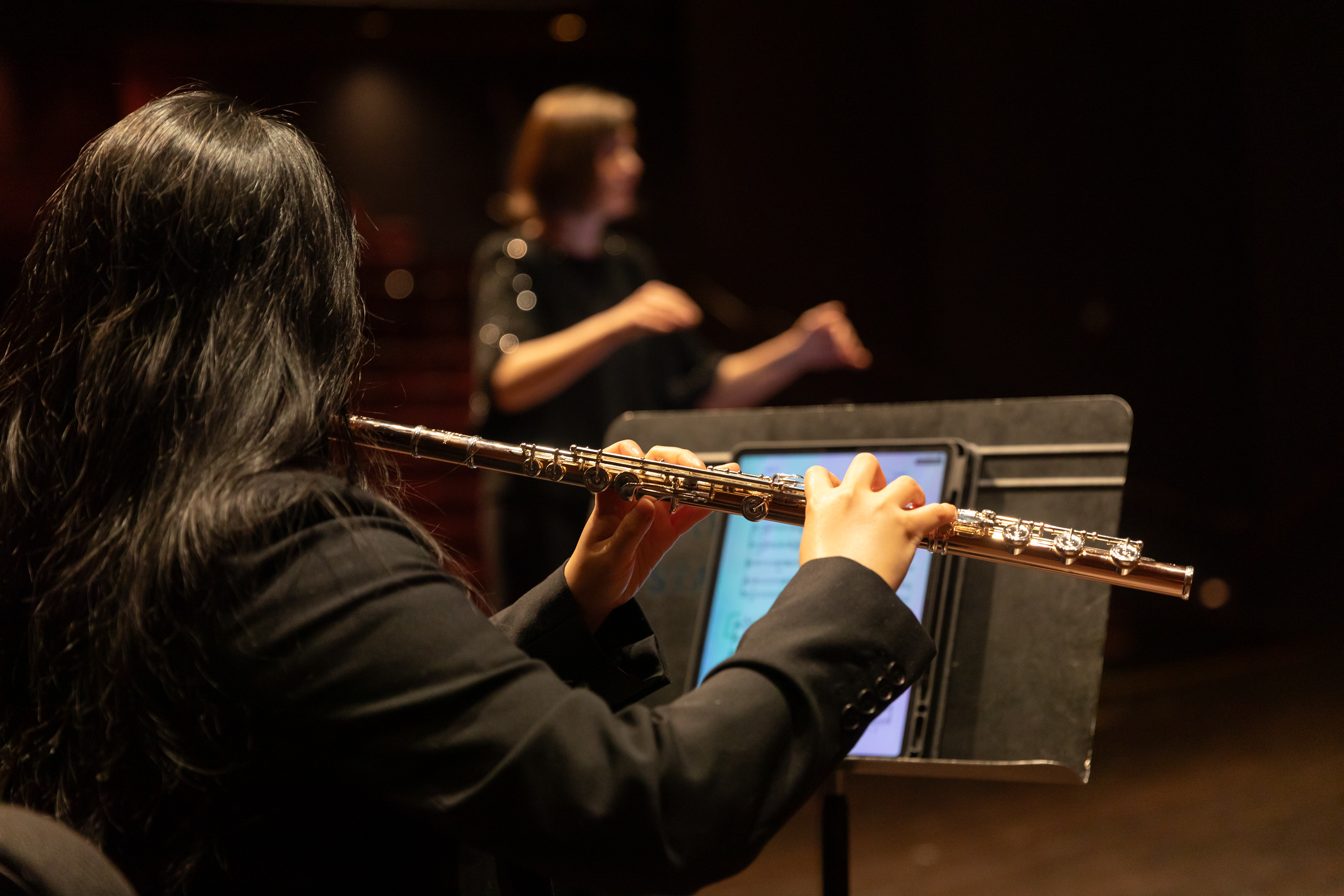
The Modern Music Ensemble (Cristina Valdés, director), in collaboration with actors from the School of Drama, presents a unique performance of four seminal works of John Cage, all performed simultaneously. The concert opens with works by Hilda Paredes and Sofia Gubaidulina.
Program
Modern Music Ensemble
Cristina Valdés, director
"Winter Music"
A collaboration with UW Drama
Actors: Jeffrey Fracé (director), Zo Eisenbrey, Taylor McWilliams-Woods, Sebastián Bravo Montenegro, Natalia Poliakova, Sebastian Wang, Yeonshin Kim
Sofia Gubaidulina - Dots, Lines, and Zigzag for bass clarinet and piano
Cameron DeLuca, bass clarinet; Jiaxuan Wu, piano
Hilda Paredes - Canciones sobre poemas de Eduardo Hurtado
Claire Wei, flute/piccolo; Cameron DeLuca, clarinet/bass clarinet; Soledad Mayorga Maldonado, soprano; Jiaxuan Wu, piano
- Intermission -
John Cage:
Winter Music
Zixi Fu, piano; Boheng Wang, piano; Jiaxuan Wu, piano
Four6
Minh-Thi Butler, oboe; Kyle Grant, alto saxophone; Soledad Mayorga Maldonado, soprano, Brayson Young, drums
Atlas Eclipticalis
Grace Playstead, flute; Cameron DeLuca, clarinet; Taylor DeCastro, violin
Variations III
Zo Eisenbrey, Jeffrey Fracé, Taylor McWilliams-Woods, Sebastián Bravo Montenegro, Natalia Poliakova, Sebastian Wang, actors (Jeffrey Fracé, director).
Program Notes
Dots, Lines, and Zigzag for bass clarinet and piano
One consistent feature of [Sofia] Gubaidulina’s output has been a reluctance to write absolute music. As often as not there exists some extra-musical stimulus, even if not stated openly, or a ritualistic or theatrical element. The latter plays a major role in the [Dots, Lines, and Zigzag], which moreover displays a typical fondness for using conventional instruments - in this case bass clarinet and piano - in less than conventional ways. The title alludes to the visual appearance of the score, in which traditional notation exists side by side with a freer indication of effects which need not be notated precisely. The “zig-zag,” for example, refers to the instructions to the pianists to produce sulla corda glissandi within a given pitch range. The great variety of pitches, rhythmic patterns, textures and articulation interlock to create a multi- layered counterpoint of ideas. As the piece starts, it is the bass clarinettist rather than the pianist who occupies the piano stool, depressing the instrument’s
sustaining pedal. This not only turns the piano into a large resonating chamber but has the effect of enhancing certain harmonics present in the chords which the bass clarinettist is instructed to produce through applying certain fingerings. On entering, the pianist plays a series of glissando figures directly on the lower strings of the piano, first with fingers alone and then with a variety of objects including a pair of coins. The bass clarinettist is meanwhile asked to improvise upon given material within a fixed set of pitches. Finally, the latter, still playing, leaves the piano, which is occupied by the pianist. Thus is symbolised through physical gesture the process of interchange and final coming together embodied in the music.
Geoffrey Thomason, 1993
Canciones sobre poemas de Eduardo Hurtado (1992/2012)
I have found setting poetry to music a very enriching and enlighten [sic] experience, which always sparks off my imagination into directions I don’t necessarily go towards when I write instrumental music. From the very first time I heard Eduardo Hurtado reading his poems in Mexico city in the early 90’s, I realised that in his poetry there was an invitation to create a world of sound. So I wrote this song cycle in 92, at a time when I was living in Mexico. The songs were originally written for the Mexican mezzo Adriana Díaz de León and the pianist Oscar Tarragó, but have since been revised. The instrumental version for soprano, flute, clarinete [sic] and piano, was written in 2012 for Lourdes Ambriz and Ensamble 3.
Hilda Paredes
Atlas Eclipticalis
Atlas Eclipticalis, commissioned by the Montreal Festivals Society, was composed over a period of nine months in 1961. It has 86 parts total, each one for a specific instrument. However, any number of these parts can be used for a performance of the work. In a letter dated December 1, 1963, Cage writes:
“In 1954 while in Europe I met the Japanese musicologist, Hidekazu Yoshida who gave me his notion of the three lines of Haiku poetry, the first line referring, he said, to nirvana, the second to samsara, and the third to specific happening. I thought in writing Atlas Eclipticalis of the first line and the stars as nirvana. And I had the intention of writing two other works which would complete this trilogy. I did this in 1963 with Variations IV and 0'0".”
“The title, Atlas Eclipticalis, is that of the book of astronomical maps I used in the composition.”
Winter Music
Winter Music was composed in the winter of 1956-57. It is scored for any number of pianos between one and twenty. The work is in twenty pages, with each page containing different chords, interpretation of which is largely left up to the performer; in some places, notation of clefs is left intentionally ambiguous. Chords are played as singular events; notes that the pianist cannot produce are prepared ahead of time as sympathetic vibrations. Time is also largely left up to interpretation, and performances of Winter Music vary greatly in duration.
Variations III
Variations III is the third piece in Cage’s Variations series, which is made up of eight total pieces composed between 1958-1967. Rather than making any reference to music or musicians, Variations III is built around various visual and audio events - in other words, it can be performed by people who are not singers or instrumentalists. The “score” consists of 42 circles, each marked with a specific event. The circles are then dumped on the ground or otherwise laid out randomly. The outcome of this randomization determines which events will occur and how they will unfold during performance. Other aspects of the events, such as sounds and actions, are determined by the performers ahead of time.
Four6
Four6 is part of John Cage’s Number Pieces, a series of works he wrote towards the end of his life. Each Number Piece’s title indicates the number of performers for each work and the iteration of that particular piece - in this case, Four6 is for four players and is the sixth such work he wrote. All four players devise twelve different sounds - on or off their instruments - and produce these sounds at designated intervals.
Biographies
Jeffrey Fracé is a veteran theater artist with more than 100 professional credits as an actor, director, writer, or producer. Best known as an actor, he is a former Associate Artist of Anne Bogart’s SITI Company, performing, touring, and teaching with the company for over 10 years. Recent performance credits include The War of the Worlds Radio Play with SITI Company, Father Comes Home From the Wars with UW Drama, Home with Doug Varone and 11 Comets with Rachael Lincoln at Meany Theatre, The Life Model at On the Boards, Betrayal at North Coast Rep in California, and Rapture, Blister, Burn; Celebration and Old Times (Pinter Festival); and Lieutenant of Inishmore, all at ACT Theatre in Seattle. Other credits include the Kennedy Center, New York Shakespeare Festival, American Repertory Theatre, Actors Theatre of Louisville, Alabama Shakespeare Festival, Nashville Shakespeare Festival, Stonington Opera House, Cleveland Public Theatre, Chopin Theatre Chicago, La MaMa ETC and the Iberoamericano Festival of Bogota. His directing credits include Merry Wives of Windsor, Measure for Measure, As You Like It, Hamlet, Macbeth and Romeo & Juliet for Stonington Opera House; Mother Courage and Her Children and 1984 for People's Branch Theatre; Romeo & Juliet and A Midsummer Night's Dream for Arkansas Shakespeare Theatre; Don Giovanni for New York Repertory Ensemble. His original work/devised performance credits include 11 Comets at Meany Theater; The Life Model at On the Boards; 10 Real Star Acts at Stonington Opera House; and Once Upon a Time 6x in the West, Harp Song for a Radical, Barbarians and Untying My Cement Shoes for UW Drama; plus, independently produced adaptations of King Lear, and Camus’ The Stranger. He is a founding member of the award-winning ensemble Conni's Avant Garde Restaurant, writing for and performing in their original shows in New York and nationally. Originally from Nashville, Tennessee, he worked in Chicago for four years before relocating to New York City, where he received his MFA from Columbia University. He is now based in Seattle, where he teaches acting, directing, movement, and devising theater at University of Washington.
Recently hailed by Fanfare Magazine as “excellent” and “clearly sensitive,” Cuban-American pianist Cristina Valdés is known for presenting innovative concerts with repertoire spanning over 300 years. A fierce advocate for new music, she has premiered countless works, including many written for her. She has performed across four continents and in venues such as Lincoln Center, Benaroya Hall, Carnegie Recital Hall, Le Poisson Rouge, Roulette, Miller Theatre, Jordan Hall, and the Kennedy Center. Ms. Valdés has appeared both as a soloist and chamber musician at festivals worldwide including New Music in Miami, the Foro Internacional de Música Nueva in Mexico City, Brisbane Arts Festival, the Festival of Contemporary Music in El Salvador, Havana Contemporary Music Festival, and the Singapore Arts Festival.
An avid chamber musician and collaborator, Ms. Valdés has toured extensively with the Bang On a Can “All Stars”, and has performed with the Seattle Chamber Players, the Mabou Mines Theater Company, the Parsons Dance Company, and Antares. Her performances on both the Seattle Symphony’s Chamber Series and [UNTITLED] concerts have garnered critical acclaim, including her “knockout” (Seattle Times) performance of Bartok’s Sonata for Two Pianos and Percussion, and her “arrestingly eloquent performance” of Dutilleux’s Trois Preludes (Bernard Jacobson/MusicWeb International).
Ms. Valdés has appeared as concerto soloist with the Seattle Symphony, Seattle Philharmonic, the Lake Union Civic Orchestra, Johns Hopkins Symphony Orchestra, the Binghamton Philharmonic, NOCCO, Philharmonia Northwest, the Eastman BroadBand, and the Stony Brook Symphony Orchestra, amongst others. In 2015 she performed the piano solo part of the Ives 4th Symphony with the Seattle Symphony under the direction of Ludovic Morlot, which was later released on CD to critical acclaim and made Gramophone’s list of Top 10 Ives Recordings. Other recent recordings include Orlando Garcia’s From Darkness to Luminosity with the Málaga Philharmonic on the Toccata Classics label, and the world premiere recording of Kotoka Suzuki’s Shimmer, Tree | In Memoriam Jonathan Harvey. She can also be heard on the Albany, Newport Classics, Urtext, and Ideologic Organ labels.
In recent seasons she gave performances of Beethoven’s Piano Concerto No. 3, Bartok’s Piano Concerto No. 3, the world-premiere performance of Carlos Sanchez-Guttierez’s Short Stories for piano and string orchestra with the Orquesta de Cámara de Bellas Artes in Mexico City, and the US Premiere of Under Construction for solo piano and tape playback by Heiner Goebbels at Benaroya Hall. Last season included a wide variety of performances including Gershwin’s Rhapsody in Blue, the premiere of her own composition Sketches of an Anniversary Prelude for trumpet and piano, and the premiere of composer Jeremy Jolley’s (contro-)clessidra IV for piano and electronics written especially for her.
Since 2006 she has made her home in Seattle where she has been an integral part of the new music scene. Ms. Valdés founded the SLAM Festival, a new music festival dedicated to the music of Latin-American composers, and is a core member of the Seattle Modern Orchestra - the only large chamber orchestra in the Pacific Northwest solely dedicated to the music of the 20th and 21st centuries. With the Seattle Modern Orchestra, she has premiered works by Anahita Abbasi, Darius Jones, Wang Lu, Kaley Eaton, Jeremy Jolley, and Yigit Kolat, amongst others.
Ms. Valdés received a Bachelor of Music from the New England Conservatory of Music, and a Master of Music and Doctor of Musical Arts from SUNY Stony Brook. While at Stony Brook, she was a recipient of the Thayer Minority Fellowship, a member of the Stony Brook Graduate Piano Trio, and a winner of the Concerto Competition. She is currently an artist-in-residence at the University of Washington, where she teaches piano and is the director of the UW Modern Music Ensemble.