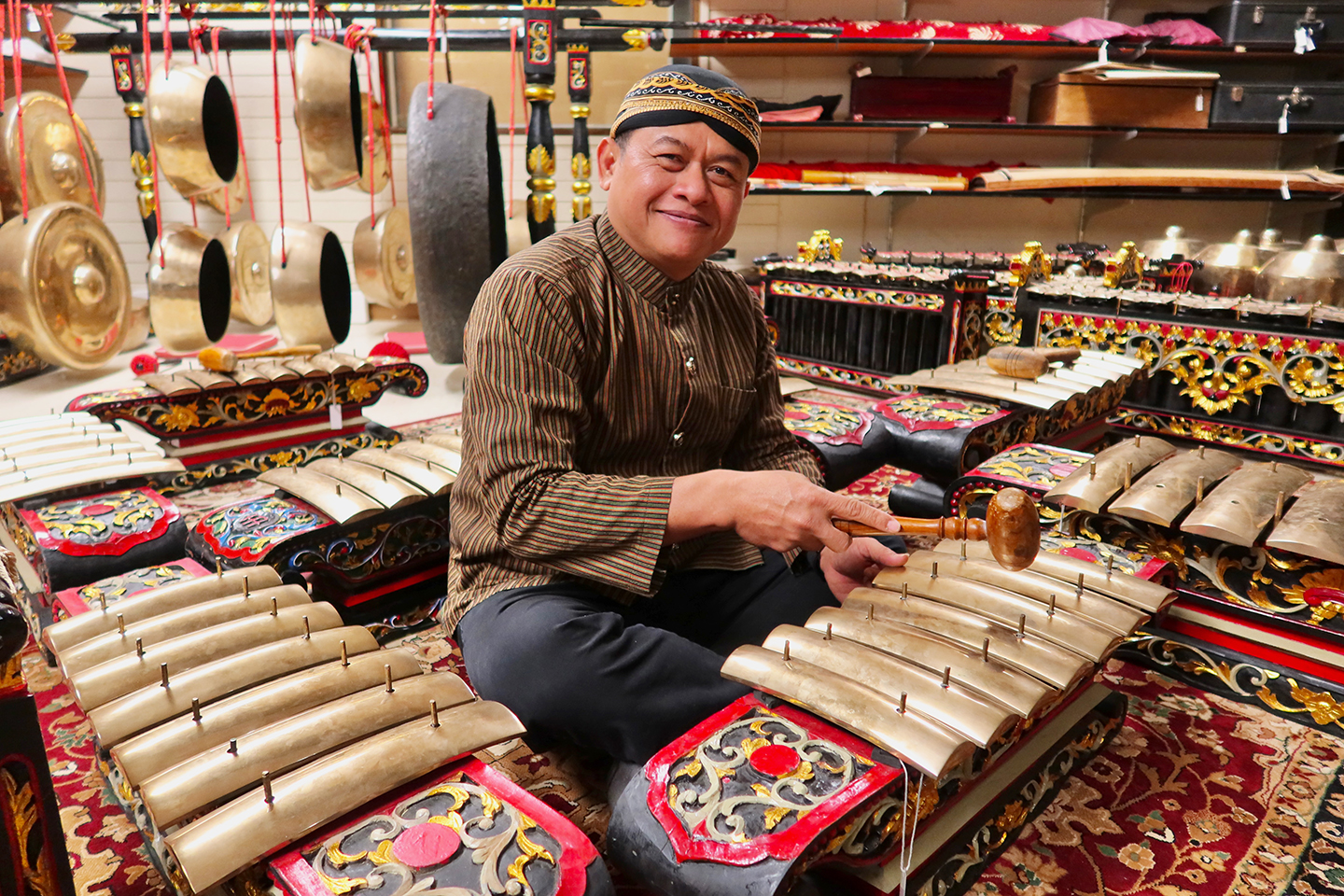
The master Javanese gamelan musician Heri Purwanto from Indonesia performs with students and special guests in this evening of music from central and east Java, Indonesia. With guest musicians Jesse Snyder and Stephanie Shadbolt.
Program
Ethnomusicology Visiting Artist Concert
Heri Purwanto & UW Students
With Stephanie Shadbolt and Jesse Snyder
Central and East Javanese Gamelan Music
- Bedhat, laras pélog pathet barang
This piece usually accompanies the masked dance Gunungsari in a style from Malang, east Java. - Ladrang Santi Mulyå, laras pélog pathet limå
This is a classical composition with 32 beats per gong stroke. - Gendhing Caranggantung - Ladrang Sigråmangsah - Ketawang Manggung Soré, laras sléndro pathet manyura
This suite features three pieces, each in a different structure, transitioning from a composition with 64 beats per gong stroke to one with 32 beats per gong to one with 16 beats per gong. - Trebangan, Måcåpat Gambuh - Gendhing Santiswårå Kaumdawuk, laras pélog pathet barang
This is usually played as an offering to celebrate a baby’s birth or to mark a person’s passing. - Suite to accompany a shadow puppet theater excerpt video projection:
Lancaran Whrahatbålå – Srepeg – Sampak laras sléndro pathet nem
Puppet master - Bagus Cahya Kesawa
Video camera - Devon Berkeley Purwanto - Lancaran Warung Pojok, laras slendro pathet sångå
This piece, by Ki Nartosabdo, often accompanies puppet theater, providing a happy mood.
Acknowledgements
The University of Washington acknowledges the Coast Salish peoples of this land, the land which touches the shared waters of all tribes and bands within the Suquamish, Tulalip and Muckleshoot nations.
This concert would not have been possible without the generous support of the School of Music under the directorship of Joël Durand and the Floyd & Delores Jones Endowed Professorship in the Arts program. We are grateful for this support. Many thanks go as well to Tom Burke, Doug Niemela, the staff at the Katharyn Alvord Gerlich Theater, the staff in the School of Music, Martinson Piano Moving, John-Carlos Perea, Shannon Dudley, Jarrad Powell and all the performers.
About Gamelan
Gamelan are ensembles largely composed of gongs and keyed percussion instruments. Although many such ensembles are found throughout Southeast Asia, gamelan are primarily associated with musical cultures on the Indonesian islands of Java, Madura, Bali, and Lombok. In Java, the most preferred material is bronze, but iron and brass are also used as less expensive alternatives.
Although different gamelan may vary slightly in their tunings, most gamelan music in central and east Java uses a five-tone tuning system called sléndro or a seven-tone tuning system called pélog. There are a number of modes, or pathet, in each tuning system. Tonight’s performance features compositions in both pélog and sléndro using the instruments of the UW School of Music’s bronze gamelan, which is named Hapsari Kusumajaya (Heavenly Nymph Flower Power).
Most gamelan include four groups of instruments. The large gongs of various sizes mark the musical structure of repeated gong cycles. The largest hanging gongs (gong) mark the very end of each cycle while the smaller hanging gongs (kempul) and horizontal gongs (kenong, kethuk, and kempyang) divide the cycle into phrases. A family of one-octave metallophones (saron, demung, and slenthem) plays a basic or skeletal version of the melody. A third group of instruments elaborates the melody and includes other metallophones (peking, gendèr, and gendèr panerus), the xylophone (gambang), gong-chimes (bonang and bonang panerus), flute (suling), bowed fiddle (rebab), and voice, although sometimes the saron, demung and slenthem elaborate the melody as well. The drums (kendhang), the fourth group, control the tempo. Tonight’s performance includes a set of kemanak—two banana-shaped bronze percussion instruments that play interlocking patterns--lent to us by Jarrad Powell.
Performers
Heri Purwanto, a highly respected teacher, performer, and master musician of Javanese gamelan, comes from a family of musicians in Wonogiri, Central Java. After graduating from the college level academy (now Institut Seni Indonesia) in Surakarta, Central Java, at the top of his class in 2000, he taught gamelan at the University of California-Berkeley from 2001 to 2004 and directed the Berkeley-based ensemble Gamelan Sari Raras. Since returning to Java in 2004, Heri has continued his work as an artist, building and running an arts studio in his community as well as performing as a musician throughout Indonesia, as well as in Singapore, Thailand, China, and across the United States. He has been a Visiting Artist in the Ethnomusicology Program at the University of Washington in 2011, 2014, 2019, and 2022 and has performed with the Seattle-based ensemble Gamelan Pacifica. From 2014 to 2016 he taught gamelan at Earlham College in Richmond, Indiana, where he was in residence on a Fulbright award during the 2014-2015 year. Over the course of 2025-2026 before returning to the UW, he taught and performed in the U.S. Northeast with the Nusantara Arts Gamelan in Buffalo and Cornell University.
Guest Musicians: Stephanie Shadbolt and Jesse Snyder
UW gamelan musicians (students of Heri Purwanto)
Rowan Bever, Lucy Brandt, Haley Chávez, Samuel Chen, Elene Liu, Rayne Mescallado, Tierra Nakamura, Jimmy Pollard, Jaye Regalado, Juan Santiago Posada Abal, Shahin Shahbazi, Christina Sunardi, Esther Sunardi, Sunardi, Genta Takasu, Markus Teuton, Joel Tibbs, David Yu