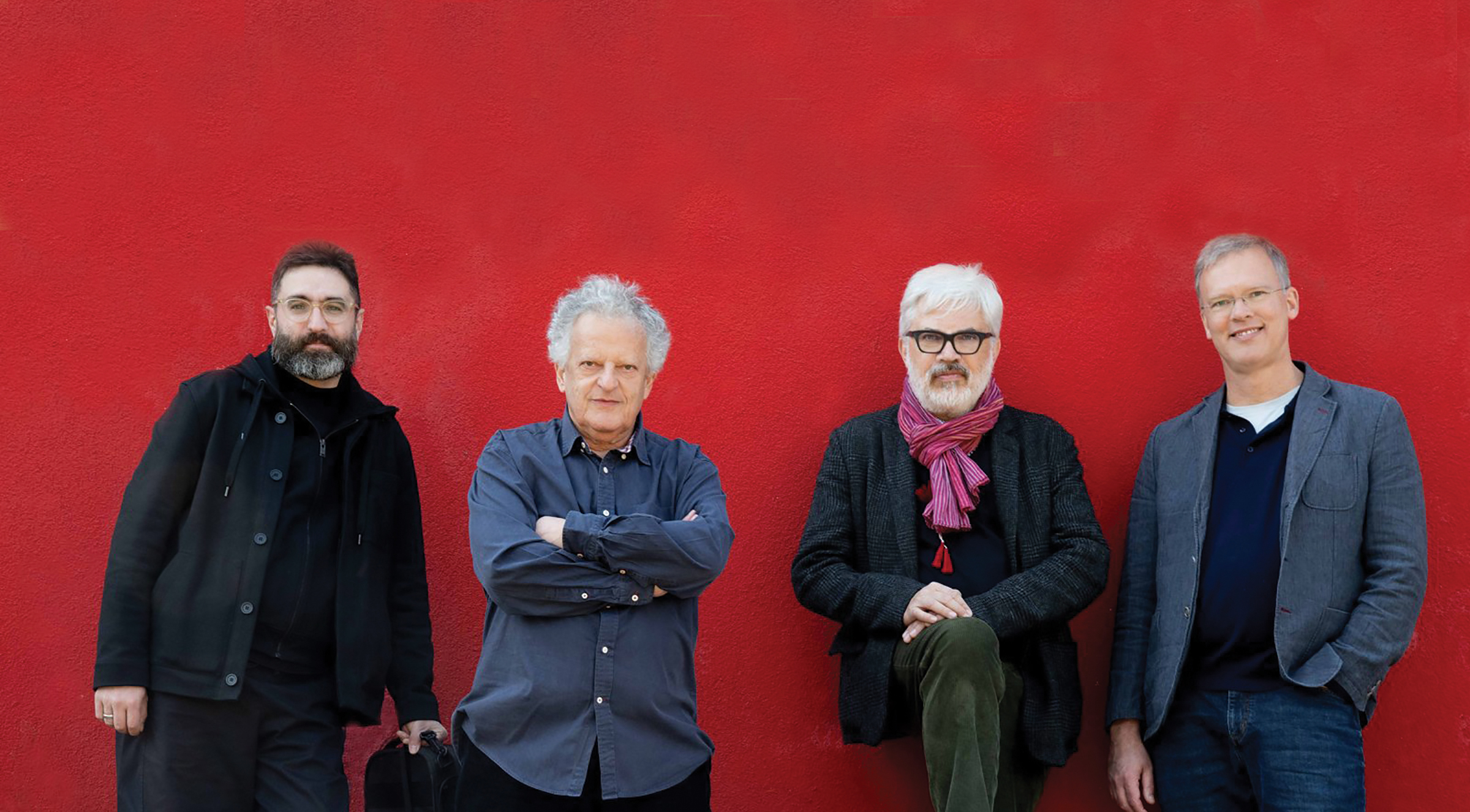
Since its founding in 1974 by violinist Irvine Arditti, the world-renowned Arditti Quartet has inspired hundreds of composers to write groundbreaking works specifically for the ensemble, among them School of Music director and faculty composer Joël-Francois Durand, whose connection to the group goes back decades.
In this free concert following the Quartet’s Oct. 16 Meany Center appearance, the quartet premieres Durand’s String Quartet No. 4, a new work written for the group for this performance, as well as pieces by James Clarke and Brian Ferneyhough.
Co-presented by Meany Center for the Performing Arts and the University of Washington School of Music. Tickets are not required for this performance.
Late Night Program
JAMES CLARKE (1957-): String Quartet No. 1 (2003)
JOËL-FRANÇOIS DURAND (1954-): String Quartet No. 4 (2026, World Premiere)
BRIAN FERNEYHOUGH (1943-) String Quartet No. 3 (1987)
Program Note
Clarke: String Quartet No. 1 (2003)
Describing his "String Quartet" commissioned for the Arditti Quartet, The Globe and Mail states: "James Clarke's 'String Quartet' was obsessive chiefly in its manner, which was that of someone determined to break through to a new sound, a new feeling, a new zone in the psyche. The piece seethed and glittered, bursting from silence with pungent tutti respirations, arraying its speedy surface melodies (whether heard as tune, ornament or symptom) like broken glass. It was rock music by other means...."
Concerning the same work, The Toronto Star observes: "The music pulsed with fabulous rhythmic and tonal effects that the Ardittis shaped into palpable 3-D soundscapes. Clarke's mastery of dissonance and overtone, aided by the Ardittis' playing, created sound waves that are not usually heard in a quartet program."
Durand: Quatuor à cordes no. 4, Musica fict(iv)a II (2026)
Like my second (2020) and third (2024) string quartets , this fourth quartet makes extensive use of “first order beats,” an acoustic phenomenon which naturally occurs when two tones of very close frequency are played at the same time. When these two tones approach the unison, one can perceive pulsations (beats) of ever slower frequency. Musica fict(iv)a II is based on musical materials from Musica fict(iv)a, Six pièces et deux interludes, for wind quintet. Four of the five movements of the string quartet (I., II, IV and V) are dervied from movements of the wind quintet, while the 3rd movement, the Prologue and the two Interludes present new materials that puts the other movements in a new perspective.
The title, Musica fict(iv)a, refers to both the notion of "outside" notes found in the musical theory of musica ficta from the middle ages, and to the "fictive" character of the beats produced by these outside notes. In parallel to the medieval notion of Musica ficta, the reference here is to the fact that the tonal inflections that generate beats don’t so much create a microtonal language as they are explorations of the musical potential of beats, in particular as we approach the unison. In that sense, they operate outside the conventional notion of intervals. Additionally, since the beats are not actually produced by the musicians (the performers just play two different, closely related tones), but result from the acoustic phenomenon of interference, one could argue that the sound they create is not "real": it exists in another, non-material dimension. The beats produce a "fictive," but clearly perceived musical line above the more traditional musical gestures.
One the main reasons why I find this particularly interesting is because these two types of discourse, the fictive and the traditional ones, require very different types of listening, different types of attention. In order to perceive these beats, one must almost “not hear” the tones that are produced by the instruments, but concentrate on the resulting beats that emanate from their combination. This requires shifting our listening attention from one level to the other, as if listening to some sort of new polyphony. The beats are a very delicate acoustic phenomenon—often much fainter than the main tones. They are also fairly unstable because they rely on the performers maintaining an absolutely steady intonation, something that is almost impossible to achieve for a long period of time: on string instruments, in particular, the pitch can vary minutely with the pressure of the bow on the string, or with the slightest movement of the finger on the string that is being stopped. These tiny changes are usually not heard because with larger intervals, the ear adapts to the context—“understands the pitch,” so to speak. But the production of beats requires extremely small intervallic differences and, in this world, these changes in frequency can alter the effect dramatically. Far from being an inconvenience, I value this evanescence, this uncertainty, both in the production and the perception, as an essential part of the musical language based on this acoustic phenomenon. This fourth string quartet, like the preceding two, invites us to bring our listening attention to a very focused kind of concentration, inside the movement of the sound.
Ferneyhough: String Quartet No. 3 (1987)
The final form of this quartet is quite different from that which I had planned at the outset. Initially (several years before the main period of composition) I had sketched out a five-movement structure; in the event this was finally reduced to a two-movement layout, in which the second movement contains superimposed elements of several other movemental types. The change may be attributed, in large part, to questions of musical balance: at the same time the altered perspective permitted me to regard the piece very much as a record of two very different reactions to a state of extreme inner crisis. Since both movements, very different in regard of contents, are approximately of the same length, I thought of them as polar opposites, reflecting, by their very intransigent extremity, the empty spaces in between.
The first movement moves in an almost frozen, dazed, autistic world of isolated fragments, partial, disconnected repetitions and sudden, unmotivated outbursts. The more than twenty basic textural elements are constantly being mutated, erased and recombined in a fashion which practically eliminate the possibility of establishing a singled underlying continuity. At the same time, the overall form reflects closely the self-preoccupied nature of its materials in a dual mirroring strategy: on the one hand, the individual sections are interlocked in a complex pattern of subsurface symmetries, on the other, the final third of the movement reflects the patterns and texture-types of the first two thirds by replacing each element with its 'complementary' element from the opposite end of the spectrum.
The second and final movement explodes into an iridescent flood of irate images, almost cadence-like in its constantly changing instrumental combinations of wildly fluctuating superpositions of texture and tempo. The complexity of this movement resides largely in the fact that a number of movements have been, in effect, compacted together, each of them having been 'damaged' in greater or lesser degree by the impact. Whilst the attentive listener may well discover residual features of a rondo structure, this should be understood less as a consciously imposed dictate than as a reflection of the fact that at least three distinct processual strata are running concurrently, albeit surfacing into the domain of the audible only at certain precalculated moments.
String Quartet No 3 is dedicated to the members of the Arditti Quartet, and was commissioned with funds provided by the Arts Council of Great Britain -- B. Ferneyhough.
Biographies
The Arditti Quartet enjoys a world-wide reputation for their spirited and technically refined interpretations of contemporary and earlier 20th century music. Many hundreds of string quartets and other chamber works have been written for the ensemble since its foundation by first violinist Irvine Arditti in 1974. Many of these works have left a permanent mark on 20th century repertoire and have given the Arditti Quartet a firm place in music history. World premieres of quartets by composers such as Abrahamsen, Ades, Andriessen, Aperghis, Birtwistle, Britten, Cage, Carter, Denisov, Dillon, Dufourt, Dusapin, Fedele, Ferneyhough, Francesconi, Gubaidulina, Guerrero, Harvey, Hosokawa, Kagel, Kurtag, Lachenmann, Ligeti, Maderna, Manoury, Nancarrow, Reynolds, Rihm, Scelsi, Sciarrino, Stockhausen and Xenakis and hundreds more show the wide range of music in the Arditti Quartet’s repertoire.
The ensemble believes that close collaboration with composers is vital to the process of interpreting modern music and therefore attempts to work with every composer it plays.
The players’ commitment to educational work is indicated by their masterclasses and workshops for young performers and composers all over the world.
The Arditti Quartet’s extensive discography now features over 200 CDs.
42 CD’s were released as part of the ensemble’s series on Naive Montaigne. This series set the trend, by presenting numerous contemporary composer features, recorded in their presence as well as the first digital recordings of the complete Second Viennese School’s chamber music for strings. The quartet has recorded for more than 20 other CD labels and together this CD collection is the most extensive available of quartet literature in the last 40 years. To name just a few, Berio, Cage, Carter, Lachenmann, Ligeti, Nono, Rihm, the complete chamber music of Xenakis and Stockhausen’s infamous Helicopter Quartet. Some of the most recent releases with the French company Aeon include profiles of Birtwistle, Gerhard, Ferneyhough Paredes and Dusapin, and with Winter and Winter Abrahamsen.
Over the past 30 years, the ensemble has received many prizes for its work. They have won the Deutsche Schallplatten Preis several times and the Gramophone Award for the best recording of contemporary music in 1999 (Elliott Carter) in 2002 (Harrison Birtwistle) and in 2018 (Pascal Dusapin). In 2004 they were awarded the ‘Coup de Coeur’ prize by the Academie Charles Cros in France for their exceptional contribution to the dissemination of contemporary music. The prestigious Ernst von Siemens Music Prize was awarded to them in 1999 for ‘lifetime achievement’ in music. They remain to this day, the only ensemble ever to receive it.
The complete archive of the Arditti quartet is housed in the Sacher Foundation in Basle, Switzerland.

Composing, writing, teaching, inventing new ways of hearing – all are linked in the work of Joël-François Durand. As a composer, his career was launched in Europe with important prizes: a Third Prize at in the 1983 Stockhausen Competition for the piano piece “…d’asiles déchirés…,” the Kranichsteiner Preis from the Darmstadt Summer Courses for New Music in 1990. Commissions and performances from many of today’s most significant ensembles followed – Ensemble Intercontemporain, London Sinfonietta, Arditti Quartet, Jack Quartet, Quatuor Diotima, ASKO, Ensemble Recherche, musikFabrik, Talea Ensemble, Dal Niente Ensemble, BBC Symphony Orchestra, Orchestre Philarmonique de Radio France, Deutsches Symphonie Orchester Berlin, Seattle Symphony Orchestra. Durand is Professor of Composition at the School of Music, University of Washington, as well as Acting Director. He has been awarded the Donald E. Petersen Endowed Professorship for 2019-22. Durand’s works are singular and powerful, combining rigorous and innovative structures with a prominent lyrical impulse. Durand’s music and personality received critical attention in the 2005 book Joël-François Durand in the Mirror Land (University of Washington Press and Perspectives of New Music) edited by his University of Washington School of Music colleague Jonathan Bernard, which features in addition to analyses by Bernard and several of the School’s students, an innovative self-interview authored by Durand himself. Recent projects for Durand include a work for large orchestra, Tropes de : Bussy, based on some of Debussy’s piano Préludes, commissioned by the Seattle Symphony Orchestra, which was premiered April 18-20, 2019 and a work for viola and ensemble, to be premiered by Melia Watras, viola and the Dal Niente ensemble in May 2020.
Commercial recordings of his music are available on the Auvidis-Naïve, Mode Records, Wergo, Albany Records and Soundset Recordings labels. In 2010, Durand embarked on a new path: he designed and started commercial production of a new tonearm for record players. The Talea, as it was called, took the audio world by storm and was followed by three further models, the Telos, the Kairos and most recently (2019), the Tosca also aimed at the most refined audio reproduction systems. For his work at his company Durand Tonearms LLC, he was made a University of Washington Entrepreneurial Fellow in 2010. As a guest composer and lecturer, Durand has contributed to the “Centre de la Voix” in Royaumont, France where he was co-director of the composition course in September 1993, the “Civica Scuola di Musica” in Milan, Italy (1995), the Royal Academy for Music in London, UK (1997), the Internationale Ferienkurse für Neue Musik in Darmstadt (1984, 1990, 1992, 1994), the “VIII. Internationaler Meisterkurs für Komposition des Brandenburgischen Colloquiums für Neue Musik”, Rheinsberg (1998), Washington State University, Pullman, WA (2004), and Stanford University (2006), among others. In the Fall 1994 he was Visiting Assistant Professor in Composition at the University of California at San Diego.
Durand is listed in the New Grove Dictionary of Music and Musicians.