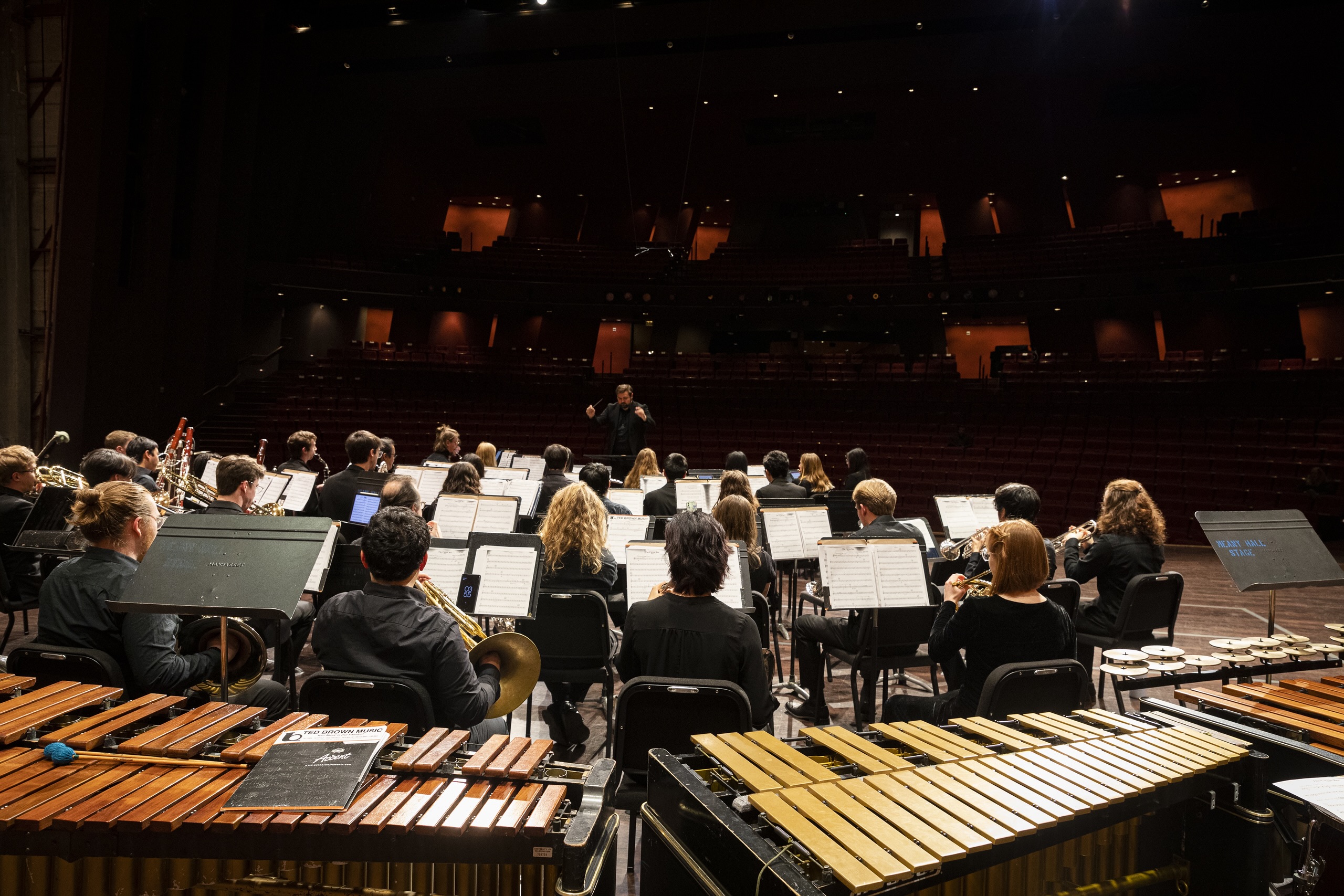
The Wind Ensemble and Symphonic Band (Erin Bodnar, director) present A Carnival of Animals, featuring music by Viet Cuong, Karel Husa, Ryan George, Holly Harrison, Robert Cichy, Jodie Blackshaw, Nubia Donjuan, and others.
Program
UW Symphonic Band
BUGS (2000) - Roger Cichy (b. 1956)
Prelude
Dragonfly
Praying Mantis
Black Widow Spider
Tiger Swallowtail
Army Ants
Monarch Migration (2023) - Nubia Jaime-Donjuan (b. 1984)
Solomon Encina, graduate conductor
Vulnerable Joy (2022) - Jodie Blackshaw (b. 1971)
Equus (2000) - Eric Whitacre (b. 1970)
INTERMISSION
UW Wind Ensemble
Firefly (2008) - Ryan George (b. 1978)
Yuman Wu, graduate conductor
Cheetah (2007) - Karel Husa (1921-2016)
POUNCE (2023) - Holly Harrison (b. 1988)
Moth (2013) - Viet Cuong (b. 1990)
Program Notes
BUGS (2000): Roger Cichy (b. 1956)
Bugs came to mind a few years ago and the thought of giving a "musical personality" to the selected bugs seemed humorous, inventive and capricious all at the same time. The insect and spider collection at the Fields Museum of Natural History in Chicago, Illinois, provided inspiration, and at the same time made it difficult for Cichy to narrow the list down to about six or so. The particular bugs represented in this suite were chosen partly because of the contrasting styles of music that would be composed for each.
Prelude, which begins the suite, was not conceived as part of the original set of movements but was included when Cichy began work on the piece. "The suite seemed to need an introduction, and this just came out and fell into place," commented Cichy. The prelude is meant to suggest many of the creatures we associate as bugs.
Dragonfly portrays several issues. First, the insect is really considered an aquatic bug, spending most of its life under water while emerging only in its adult stage to take to the air. The second issue is reflected in folklore where the dragonfly is responsible for flying around at night and sewing all the mouths of fibbing boys and girls.
Praying Mantis, as its name implies, provides a perfect topic for a slow, religioso movement. The mantis is often pictured resting with its front legs folded as though in meditation or prayer. The rather bizarre mating tendencies of the praying mantis were purposefully left out of this movement.
Black Widow Spider was a movement Cichy could not resist. Set to a cool blues, the opening statement was written with an eight note pattern (eight legs of the spider) which changes several times in order of notes but contains the same pitches. Within a few repetitions of the pattern, five more notes are added to complete a dodecaphonic (twelve-note) scale. In its entirety, the dodecaphonic scale is played from C to C an octave higher, working inward to the center pitch (F#) which represent the spider's web. The textures begin changing from cool blues to hot as the black widow spider approaches its prey with its deadly venom.
The suite would be incomplete without the most gorgeous of all insects, the butterfly. Cichy chose Tiger Swallowtail for no particular reason other than it is commonly the "flying flower." Set in a lyrical style, this movement tries to musically depict the grace and beauty of such a remarkable insect.
The final movement, Army Ants, provides the perfect subject for a march-style piece. Cichy created a dissonant march portraying the ants as savage predators which are constantly on the move.
~Program Note from the Wind Repertory Project
Monarch Migration (2023): Nubia Jaime-Donjuan (b. 1984)
In the realm of art and education, collaborations between artists and schools have proven to be a powerful tool for creativity and learning. Such partnerships bring fresh perspectives, inspire young minds, and ignite a passion for the arts. Today, we delve into the story of a remarkable composer who, in close collaboration with schools, embarked on a journey to create a mesmerizing musical piece for wind-band and full orchestra titled Monarch Migration.
At the heart of this captivating project is Matthew Oyen, a high school band and orchestra director from Saint Paul, Minnesota. Matthew was inspired by the award-winning picture book Monarch Butterflies: Explore the Life Journey of One of the Winged Wonders of the World (Storey Publishing) by author Ann Hobbie and illustrator Olga Baumert. This book shares the remarkable biology, cultural significance, and importance of supporting this iconic species and its spectacular yearly migration to the coasts of California and the mountains of central Mexico. The journey and peril of the monarch butterflies tell an important story of the interconnectedness of our actions.
Matthew saw in the book an opportunity to share a musical version of the unique monarch migration with high school, college, and university-level musicians nationwide. Through his network with Dr. Brian Messier’s Mexican Repertoire Initiative at Dartmouth College, these directors connected with the talented Mexican composer Nubia Jaime Donjuan. With a deep admiration for nature's wonders and a desire to connect youth with the world around them, Nubia was an excellent choice to create a musical composition that would not only narrate the fascinating journey of the monarch butterfly but also engage and educate students on the importance of conservation and the wonders of the natural world.
Through Matthew and Brian, Monarch Migration was commissioned by a consortium of 41 schools throughout the United States. The impact of Monarch Migration extends far beyond the concert hall. Students who participate in the project are developing a newfound appreciation for music, nature, and their own creative abilities. The experience instills a sense of environmental responsibility and sparks a desire to explore and protect the world around them. The project serves as a catalyst for interdisciplinary learning, combining music, science, and conservation into a unified educational experience.
The Monarch Migration stands as a testament to the incredible potential that lies within collaborations between composers and schools. Through the shared experience of creating a musical composition, students gain not only musical skills but also a profound connection to the natural world. The project demonstrates that art has the power to transcend boundaries, inspire change, and ignite a lifelong love for both music and the environment. As we celebrate the triumph of Monarch Migration, let it serve as a reminder of the transformative power of creativity and the lasting impact it can have on the lives of young minds.
~Program Note by composer
Vulnerable Joy (2022): Jodie Blackshaw (b. 1971)
Vulnerable Joy is inspired by the self-sacrifice, commitment and humility of the mother humpback whale. As a mammal, baleen whale, she grows to approximately 16m (52 feet) and lives at the ocean's surface in order to breath. She travels up to 6,500km (approx. 4,000 miles) from her feeding ground to birth her calf in warmer tropical waters. Once she leaves the feeding grounds of Antarctica or the cooler oceans of the Northern Hemisphere, she will not feed again until she returns some 8-9 months later, all the while nursing her newborn calf with up to 600 litres (132 gallons) of milk per day.
In realizing the enormity of this feat, my mind turned to the whales who are closest to me, those who migrate along the east coast of Australia from Tonga to Antarctica. I imagined the sheer relief she must feel in that moment when the cool waters of the Southern Ocean rub her skin for the first time. She is tired and hungry, but in that moment (in my imagination) I feel her joy, her intense, overwhelming joy.
~Program Note by composer
Equus (2000): Eric Whitacre (b. 1970)
At the Midwest Band and Orchestra convention in 1996, Gary Green approached me about a possible commission for his wind ensemble at the University of Miami. I accepted, and the commission formally began July 1st, 1997. Two years later I still couldn’t show him a single note. That’s not to say I hadn’t written anything. On the contrary, I had about 100 pages of material for three different pieces, but I wanted to give Gary something very special and just couldn’t find that perfect spark.
Around this time my great friend and fellow Juilliard composer Steven Bryant was visiting me in Los Angeles, and as I had just bought a new computer I was throwing out old sequencer files, most of them sketches and improvisational ideas. As I played one section Steve dashed into the room and the following conversation ensued:
Steve: "What the hell was that!?!"
Me: "Just an old idea I’m about to trash."
Steve: "Mark my words, If you don’t use that I’m stealing it."
The gauntlet had been thrown.
That was the spark, but it took me a full eight months to write the piece. There are a LOT of notes, and I put every one on paper (with pencil). I wanted to write a moto perpetuo, a piece that starts running and never stops (equus is the Latin word for horse) and would also be a virtuosic show piece for winds. The final result is something that I call “dynamic minimalism,” which basically means that I love to employ repetitive patterns as long as they don’t get boring. We finally premiered the piece in March 2000, nearly three years after the original commission date, and the University of Miami Wind Ensemble played the bejeezus out of it.
Equus is dedicated to my friend Gary Green, the most passionate and patient conductor I know.
~Program Note by the composer
Firefly (2008): Ryan George (b. 1978)
I'm amazed at how children use their imaginations to transform the ordinary and normal into the extraordinary and fantastic. Just about anything they come across can be used to spark their fantasies and usher their minds into unseen worlds. A stick on the ground becomes a wand with magical powers or a sword to fight off bad guys. A collection of rocks turns into buried treasure, and a blanket stretched over two chairs becomes a cave to hide in. And things found in nature -- birds, waterfalls, flowers, and even insects -- can take on mythic identities when viewed through the eyes of a child.
The idea for Firefly was born one night as I watched my four-year-old become mesmerized by a firefly that had wandered into our front yard. When I asked her what she thought of the "firefly" she looked at me with a puzzled look and said with a corrective tone, "Dad, that is not a firefly... that's Tinkerbell, and she's come to take me with her on an adventure!"
Firefly is dedicated to my daughters Sophia and Nyla, who ignite my imagination and bring awe and wonder into my life every day.
~Program Note by composer
Cheetah (2007): Karel Husa (1921-2016)
Cheetah is a portrait of a magnificent wild animal, now an endangered species -- its colors, movements, power, speed – and finally, exhaustion after an unsuccessful chase.
~Program Note by composer
POUNCE (2023): Holly Harrison (b. 1988)
When I first started writing this piece, there was a trifecta of feline activity in my life: the adoption of a boisterous kitten, a visit to a wild cat conservation centre, and Penrith Panthers, my local team, winning the NRL [National Rugby League] premiership. While visiting the conservation centre, I was amazed to learn that Caracals can jump up to four metres high! Add to that my new obsession with my Novation LaunchPad, and POUNCE was born.
This piece explores and imagines different types of pouncing behaviour in cats and their ability to initiate spontaneous play. The opening sets the scene for stalking and predatory behaviour, staying low and close to the ground and creeping up on potential prey. Musically, this is heard as a series of low instrument solos with a bluesy undertow that rumbles with a faux sense of tension. Yet, this is soon interrupted by spring-loaded pounces that pull the work in a friskier and funkier direction. For anyone that’s ever owned a cat, we all know how their mood can change on a dime: how quickly a savage bite can give way to nap time or bravado turn to fear!
The rhythmic language of the work is defined by what I like to refer to as pounce rhythms -- a syncopated bounce, the saunter of a cat’s hips, a spring in the step, or the confidence of a tail whip. In this way, POUNCE embraces splashes of funk, jazz, honky-tonk, rock, and metal styles. Celebratory soundblocks burst with joy and are intercepted by covert pounce operations, recalling the stalking behaviour from the beginning. Here, the line between brave domestic shorthair and spotted wild cat begins to blur, as they camouflage in and out of the ensemble’s texture, treading the tightrope between frivolity and stealth.
In the middle of POUNCE, a heavier groove emerges, conjuring up the muscular physique of the mighty Penrith Panthers and their namesake. For the uninitiated, Australia’s National Rugby League is arguably our most popular form of football and is considered a brutal contact sport. This rockier soundworld, led by brass, invokes a head-banging energy and visceral sense of clashing bodies across the football field. From here, all three feline threads are at work: the frisky, the wild, and the muscular. Each of these blocks interrupts the next, weaving its way in and out, though ultimately it is play that wins out.
Creatively, this was the first piece I’d written using the LaunchPad as my primary creative tool: as a composer who tends to begin with drum kit and flute improvisations, I found this a new way to experiment with rhythmic cells and pitch patterns. It’s worth noting that the physical configuration of the LaunchPad as 64 small pads allows a type of pouncing motion across the squares, so I often found myself devising lines which required a certain nimbleness and agility that I associate with our feline friends.
~Program note by composer
Moth (2013): Viet Cuong (b. 1990)
The “moth to the flame” narrative is a familiar one. We have all seen moths in the glow of flames or stadium lights. Scientists call this phenomenon “phototaxis,” but I prefer to think of this attraction in much more romantic terms. The dusty moth, though destined to live in shadow, has an insatiable craving for the brightness of day. Drab, but elegant; nervous, but swift; his taste for the glow of the flame or the filament is dire. Perhaps he dances in the light because it holds the promise that he might be as beautiful as his favored kin, the butterfly. For only there, in its ecstatic warmth, may he spend the last of his fleeting life, and believe himself to be.
Moth seeks inspiration from the dualities between light and dark, beautiful and grotesque, reality and fantasy, and the ultimate decision to sacrifice sensibility for grace.
Thank you to the members of the Brooklyn Wind Symphony and their artistic director, Jeff W. Ball, for trusting me to write a piece for their momentous 2013 Midwest Clinic performance. I have nothing but gratitude and respect for their dedication to the music, and for their commitment to sharing the wind repertoire with the New York City community. The Brooklyn Wind Symphony’s ability to flourish outside of an institution is, in a word, extraordinary.
- Program Note by the composer
UW Symphonic Band
Flute
Naomi Cho, Fr., Flute Performance
Ananya Sai Parlapalli, Fr., Biochemistry & Flute Performance, Spokane, WA
Rob Rosenthal, Frl, Flute Performance, Evanston, IL
Gabriel Rui, Fr., Engineering Undeclared, San Francisco, CA
Emily Wen, Fr., Flute Performance, Sherwood, OR
Xiage Zhang, Gr., Music, Shanxi Province, China
Oboe
David Kelly, Fr., Pre-Sciences
Meagan Paxman, So., Pre-Sciences, Vancouver
Brandon Tsai, So., ECE
Bassoon
Arina Pushkina, So., Materials Science Engineering, Woodinville
Clarinet
Willow Chartrand, So., Biology (MCD), Los Alamos, NM
Nick Hildebrand, Fr., Microbiology, San Pedro, CA
Audrey Jamrowski, Fr., English, Port Orchard
Andrew Kester, Fr., Pre-Science, Aurora, CO
Matthew Shell
Bass Clarinet
Conrad Gauss, So., Electrical & Computer Engineering, Bellevue
Saxophone
Rohith Dinesh, Fr., Pre-Science, Pleasanton, CA
Polina Dorogova, Jr., Psychology & Music, Gig Harbor
Kaua Roberton, Fr., Music Education, Spokane
Vichet Ros, Sr., Music Education, Burien
Daniel Song, So., Chemical Engineering, Bothell
Trumpet
Deneil Betfarhad, So., Pre-Sciences, Westport, CT
Nico Masputra, Jr., Neuroscience
Vaughn B. Schnelle, Sr., Music History, West Seattle
Arjun Sur, Fr., Pre-Sciences, San Diego, CA
Reimer Wolf, Fr., Mechanical Engineering, Oahu, HI
Horn
Andrew Chen, Community Member, Othello
Yihan Li, Jr., Horn Performance
Alex Morgan, Sr., Physics, Gig Harbor
Arya Nagvekar, Fr., Pre-Sciences, Redmond
Elliana Wagner, Sr., Biochemistry, Snohomish
Trombone
Daniel Abraham, So., Math, Tacoma
Steve Teng, So., Pre-Science
Robin Yi, Fr., Pre-Humanities, Santa Cruz, CA
Bass Trombone
Isaiah Ikeda, Fr., Medical Laboratory Science, Spokane
Jason Lai, So., Mechanical Engineering, Camas
Euphonium
John Yi, Community Member
Tom Lewis,
Tuba
Sam Charney, Gr., Astronomy, Swarthmore, PA
Robin Ding, Fr., ECE
Percussion
Avinash Bose, Gr., Civil Engineering, Brooklyn, NY
Patrick Henry,
Kendall Johnson, Gr., Mechanical Engineering, La Conner
Alexander McLean, So., Environmental Science, Snoqualmie
Jaden Zika, Jr., Psychology, Livermore, CA
UW Wind Ensemble
Flute/Piccolo
Brooke Bart, Jr., Scandinavian Studies & Music, Endwell, NY
Xinyi Liu, Gr., Flute Performance, Xiamen, China
Xinyi Ma, Gr., Flute Performance, Henan, China
Tracia Pan, Sr., Statistics & Flute Performance, Bellevue
Grace Playstead, Gr., Flute Performance, Olympia
Peyton Ray, Sr., Flute Performance, Denver, CO
Claire Wei, Jr., Flute Performance, Bellevue
Oboe
Max Bolen, So., Marine Biology & Music Education, Ballard
Minh-Thi Butler, Sr., Oboe Performance, Hoquiam
Will Cummings, Fr., Linguistics & French, Chehalis
Aika Ishizuki, Fr., Pre Sciences
Bassoon
Levi Beck, Fr., Music Performance
Alex Fraley, So., Music Education, Kenmore
Ryan Kapsandy, Sr., Bassoon Performance
Rian Morgan, Sr., Nutrition (FSNH) & BA Music, Des Moines
Clarinet
Caitlin Dong, So., Biology (MCD) & Music Performance, Englewood, CO
Alex Gee, Sr., Mechanical Engineering, Camas
Arthur Gim, Jr., Mechanical Engineering, Bothell
Alessandro Martinez, Jr., Environmental Engineering, Olympia
Luqi Wang, Gr., Music Performance, Dalian, China
Eric Zhu, Fr., Engineering Undeclared, Guangdong, China
Bass Clarinet
Akshat Ghuge, So., Informatics, Dallas, TX
Michael Stella, Jr., Political Science, Puyallup
Alto Saxophone
Kairui Cheng, Fr., Computer Science, Bothell
Kyle Grant, Jr., Music Education & Saxophone Performance, Sumner
Tenor Saxophone
Curtis Chung, So., Mechanical Engineering, Sunnyvale, CA
Baritone Saxophone
Katherine Zundel, So., Saxophone Performance & Mathematics, Clinton
Trumpet
Meier Eagan, Music Education
Hans Faul, Sr., Trumpet Performance, Seattle
Daniel Lyons, Jr., Finance, Lake Forest Park
Antti Mannisto, Sr., Physics, Bellevue
Veer Shukla, So., Mathematics
Kevin Nguyen Thomas, So., Trumpet Performance, Spokane
Horn
Ethan Hicks, Music Performance
Cassidy Rea, Fr., Music Performance
Olivia Stall, Fr., Pre-Social Sciences, Bothell
Ben von Jess, Jr., Music Education, Renton
Trombone
Owen Fang, Fr., Trombone Performance, Redmond
Eliana Koenig, Jr., Mechanical Engineering, Mesa, AZ
Richie Torres-Antúnez, Jr., Music Performance & Applied Math, Mattawa
Bass Trombone
Evan Mao, Jr., Computer Science, Redmond
Euphonium
Aidan Borlet, Fr., Pre-Science, Austin, TX
Simona Yaroslavsky, Ju., Psychology/Law, Societies and Justice, Mercer Island
Tuba
Dylan Aagaard, Fr., Tuba Performance
Foster Patterson, Sr., Music Education, Aberdeen
Bass
Jason Lai, So., Mechanical Engineering, Camas
Percussion
Monaka Kakuta, Fr., Music Performance, Shoreline
Ryan Kinder, Fr., Computer Science, Mercer Island
Colin Lehman, So., Music Performance, Moses Lake
Ivy Moore, Jr., Music Performance & Bioresource Science & Engineering
Hazel Salvaggio, Jr., Music Performance, Manhattan Beach, CA
Xander Swanson,
Zhibo Zheng, Fr., Music Performance, Xi’an, China
Piano
Oliver Schoonover, Gr., Music Composition, Tallahassee, FL
Director Biography

Erin Bodnar is Visiting Associate Professor and Director of Concert Bands at the University of Washington in the 2025-26 academic year.
Bodnar is Associate Professor of Music and Director of Bands at the University of North Florida, where she conducts the Wind Symphony and Concert Band, instructs courses in conducting and coordinates the UNF Conducting Symposium. Under Dr. Bodnar’s baton, the UNF Wind Symphony performed at the World Association of Symphonic Bands and Ensembles in Buñol, Spain in July 2019. The UNF NuMIX, co-directed by Dr. Bodnar and Dr. Venet, performed at the College Band Directors National Association Southern Division Conference in February, 2022.
Prior to her appointment at UNF, Dr. Bodnar was Director of Bands at Graceland University for four years, during which time the Symphonic Band performed at the Iowa Bandmasters Association Conference. During 2013-2014, Dr. Bodnar was the conductor of the Wind Symphony and Orchestra at Mahidol University in Bangkok, Thailand.
Dr. Bodnar maintains an active schedule as a guest conductor and clinician, traveling to Argentina, Thailand, Indonesia, and throughout the United States and Canada. Dr. Bodnar has contributed to A Composer's Insight: Thoughts, Analysis and Commentary on Contemporary Masterpieces for Wind Band, Volume 5, the GIA Teaching Music Through Performance Series for Volume 7 and the revised Volume 1.
She excelled at teaching both middle and high school band in Alberta, Canada for which she received the Keith Mann Young Band Director’s Award and the Edwin Parr First Year Teacher Award. Dr. Bodnar has presented at conferences in Canada, the United States, Scotland, Thailand and Austria.
Her research interests include conducting pedagogy and motor cognition, and her articles have been published in the Journal of Music Teacher Education and Music Perception. An avid runner and group fitness instructor, Dr. Bodnar has completed 54 marathons, including 6 Boston marathons, ten 50 km races and one 100 km race.

Yuman Wu is a Graduate Assistant at the University of Washington, where she is pursuing a Doctor of Musical Arts (D.M.A.) in Instrumental Conducting under the mentorship of Timothy Salzman and Erin Bodnar. At UW, she serves as the conductor for UW Concert Band, assistant conductor for the UW Wind Ensemble and Symphonic Band, and contributes to the Husky Marching Band. She also assists in teaching the undergraduate conducting classes, working closely with music education majors. As a conductor, multi-instrumentalist, and educator, Yuman enjoys playing music from all cultural backgrounds, innovating new ideas, and leading the music industry forward with inclusivity. She was recently selected as one of five conductors for the prestigious 2025 U.S. Army Band Conductors Workshop, where she conducted The U.S. Army Band “Pershing’s Own” in a public performance at the Rachel M. Schlesinger Concert Hall in Washington, D.C.
Yuman holds a Master of Music in Wind Conducting from the Peabody Institute of Johns Hopkins University, where she studied with Dr. Harlan Parker and served as Teaching Assistant for Secondary Instrumental Conducting. She also earned a Master of Science in Business Analytics from Cornell University. Yuman completed three Bachelor's degrees in Music, Statistics, and Economics from the University of Illinois at Urbana-Champaign.
Yuman has a strong interest in marching bands, the fusion of Asian and Western music, the integration of technology and music, and helping more people learn and appreciate music. Yuman also embraces cultural diversity, leading and establishing an ensemble that fuses Asian and Western music during her academic years. She has frequently performed and showcased this ensemble at consulate events. Additionally, as a Teaching Assistant with the Student Disability Service during her Master program, she assists visually impaired students by translating musical scores and providing necessary support in their study and daily lives.

Solomon Encina is a Graduate Assistant at the University of Washington, where he is pursuing a Doctor of Musical Arts (D.M.A.) in Instrumental Conducting. Solomon holds a Bachelors of Music degree in Instrumental Performance in Percussion from California Baptist University. He also holds a Masters in Music Education degree from Azusa Pacific University where he studied under Dr. Alexander Koops and Dr. John Burdett.
Solomon is a native of the Southern California region, where he has taught and arranged music for several high quality institutions. Most recently, he served as the Director of Bands at Los Osos High School in Rancho Cucamonga, CA, where the band, orchestra and color guard program regularly received high distinction awards at festivals throughout the state under his direction. During this time he also performed as a percussionist with several touring groups throughout the United States and as a guest conductor of the European Tour for Southern California Ambassadors of Music. After several years as a high school educator, Solomon is thrilled to begin pursuing his highest academic aspirations by attending UW to study under Professor Timothy Salzman.
Solomon Encina has affiliations with the National Association for Music Education (NAfME), the College Band Directors National Association (CBDNA), the California Music Educators Association (CMEA), and the Southern California School Band and Orchestra Association (SCSBOA). Solomon Encina is proudly endorsed by the Vic Firth Company and is a part of the Vic Firth Education team.