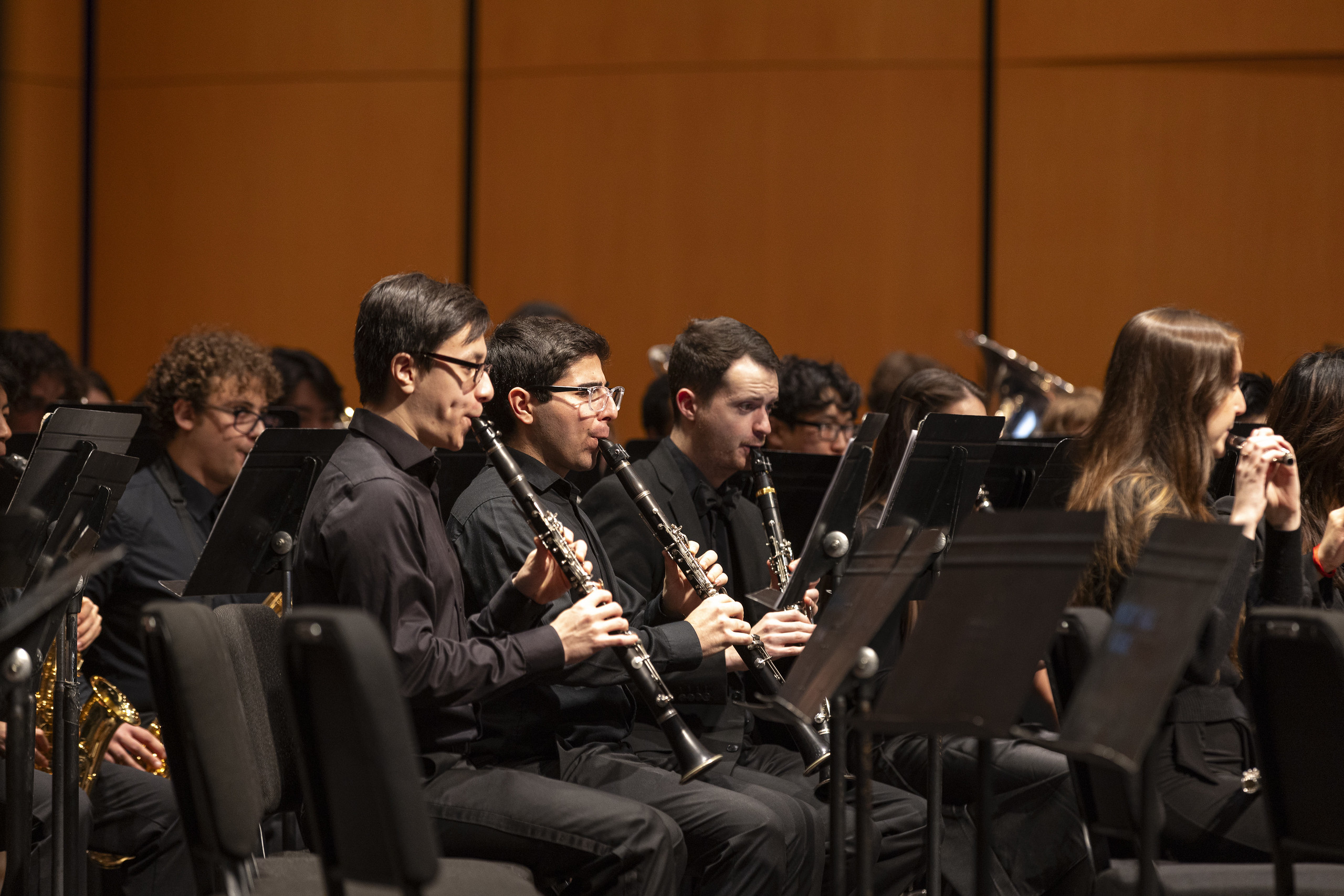
Composer Simon Alami is special guest of the Wind Ensemble and Symphonic Band (Erin Bodnar, director) for Mystic Threads, a program of music by Victoriano Valencia, Jodie Blackshaw, Reena Esmail, Minoo Dixon, Florent Schmitt, and Luigi Zaninelli, as well as Alami's new work, Symphonic Dances (2026).
Program
The UW Wind Ensemble and UW Symphonic Band present:
“Mystic Threads”
Thursday March 12, 2026 7:30 pm Meany Hall
Dr. Erin Bodnar, conductor
Yuman Wu, graduate conductor
Solomon Encina, graduate conductor
Simon Alami, guest composer
UW Symphonic Band
Three Dances of Enchantment (2007) ……………….....………..……Luigi Zaninelli (b. 1932)
The Via Veneto (Fox Trot)
Vichet Ros, undergraduate conductor
She Walks Through the Fair (Waltz)
The Feast of Saint Rocco (Tarantella)
Noah Scanlan, graduate conductor
Night Market (2020) ……….....…………...........................….… ……….Minoo Dixon (b. 1999)
Yuman Wu, graduate conductor
Chamak (2022)…………..................….……….....………..……………. Reena Esmail (b. 1983)
Avinash Bose, tabla
Ember (Bhajani)
Luster (Vilambit Teentaal)
Spark (Rupak and Dadra)
INTERMISSION
UW Wind Ensemble
Dionysiaques (1913)……………………..…………………………Florent Schmitt (1870-1953)
Peace Dancer (2017)……………………..………….....……......…….Jodie Blackshaw (b. 1971)
Solomon Encina, graduate conductor
Symphonic Dances (2026)………………………………………………Simon Alami (b. 1966)
Call of the Reeds
Snowprints of a New Beginning
Steps on the Wind
Whispering Steps
Dawn of the Dance
world premiere
Arullo (2003)……….…………………………..….........……Victoriano Valencia (b. 1970)
Mocarí
Goyo
Mayo
Program Notes
Three Dances of Enchantment is a suite of three dances inspired by personal experiences in my life that, through the years, continue to resonate in my memory.
I. The Via Veneto is a musical reminiscence of those “dolce vita” days I spent on one of Rome’s most fashionable streets. Here, as a young film composer, I watched and learned, with great fascination, about the world of Italian film-making.
II. She Walks Through the Fair is a haunting, bittersweet melody that I discovered on my visit to Ireland. Dedicated to Kylie Charra Keene.
III. The Feast of Saint Rocco is a joyous Italian-American celebration dedicated to Saint Rocco held every summer in my hometown of Raritan, New Jersey. It was here, in my father’s arms at the age of five, that I first experienced the vibrant, bold tartness of an Italian band. It was loud and so wonderful!
- Program note by composer
The grinning moon has taken control of the sky. A young grey Wolf looks over the "Seaport," drowning in mist as he has lost his way home. A smell … no, not just that, a commotion too? The young grey Wolf follows his senses as it races towards a large wooden gate – and as if the moon is whispering to him, he reads "The Market.: Suddenly an Antelope asks him if he needs help, and the Wolf hesitantly answers him as the Antelope uncovers his hands with inly seven fingers left. Fear … Shock … Hunger … surge through the Wolf's body as the Antelope begins naming prices of his fingers for the Wolf to consume. The Wolf is lost in a daze; he's never consumed another animal, yet here's his opportunity. "The Finger Seller" pushes him again and again, his pinky worth less than his index finger, the Wolf starts to salivate. His body brimming with hunger and his mind flooding with hatred for himself, it becomes overwhelming. Teeth are show, his mouth gaging open, saliva dripping down his chin. He chomps his mouth down, the Antelope looks up, he still has all his seven fingers and then sees the young grey Wolf sprinting into "The Market."
The young grey Wolf has found himself in the center of The Market. Everything is bustling. There's every single type of carnivorous present under the glow of the moon. Almost as if moving like moths attracted to light, merchants' stand with stronger scents draw in more people. To his right he sees a stand being flooded as new rabbit hide is being put up. To his left, he begins to hear a voice call out to him – a merchant. He begins a rapid-fire sales pitch, words come tumbling out, enticing and enchanting market-goers as they pass by. Louder and louder, the voices of the merchants grow into a singular chorus … until he turns around to the Merchant.
Much grander than these past merchants, it becomes overwhelming, he can feel his heart, solid thuds resounding in his chest. The Wolf is swept away by the crowd of carnivores flooding the stand. Stranded in the middle of the market, he notices four tiger merchants switch their attention the young, stumbling Wolf. They're a rambunctious bunch, but they move in chaotic symbiosis, calculatingly off-beat as they sway toward the wide-eyed Wolf. From behind one tiger's back, a loosely wrapped cloth appears in his paw.
The Wolf inhales.
The stench of a lamb. The Merchants push it onto him once, then again, and on the third beat, the young grey Wolf falls into his temptations.
As the Wolf leaves The Market, he hears the tigers fade into the distance as they sell to another customer. He finds himself back where he started, the "Seaport," with the moon grinning above him like a devilish cat. In his left hand, he grips a bloodied muslin cloth. As the mist parts in the horizon, he makes out the faint glow of dawn. Somewhere in his mind, he remembers yearning for home. Yet he stands rooted, as the silence and the hollowness of the disappearing Night Market consume him.
- Program note by Minoo Dixon and Nguyen Pham
The word "chamak" means ‘spark’ in Hindi -- and the title of this work was inspired by a beautiful couplet from the Indian saint-poet Kabir:
जैसे तिल में तेल है
ज्यों चमक में आग
तेरा साईँ तुझ में है
तू जाग सके तो जाग
which translates to:
Just as a seed holds oil
And a spark holds fire
Your own spirit is inside of you
If you can awaken it, you must.
Each of the three movements of this piece explores a different translation of the word "chamak:" the first is Ember, which is a dark, smoky, lilting melody in Raag Bhimpalas. The second, Luster, is a warm, intimate journey in Raag Hamsadhwani. And the last movement, Spark, is a fiery, vibrant jaunt in Raag Jog.*
I hope this piece ignites a spark in two ways. As young creative people, just beginning to find their way in the world, I hope this piece is a reminder to follow that spark that lies within each of them. And more broadly, I hope that this piece sparks an interest in Indian classical music in the band world — these musical cultures have been separate for so many years, and I hope this piece sparks further connection between these two worlds.
*If you know these raags well, you’ll hear that both the Hamsadhwani and Jog are a little bit ‘mishra’ — meaning that there are a few turns of phrase that move slightly outside the parameters of the ‘pure’ version of the raag.
- Program note by composer
Dionysiaques was composed for the 100-member Garde Républicaine Band in Paris in 1913, mere months after Schmitt attended the premiere performance of Stravinsky’s Rite of Spring. Its own premiere had to wait until 1925 because of World War I but it has been performed frequently since the mid-20th century and it now stands as one of the cornerstone pieces of the early wind band repertoire.
The title comes from the “Dyonisia” – ancient Greek celebrations honoring Dionysus, the god of wine. He was thought to have provided man with the vineyard, and subsequently the harvest, winemaking, drunkenness and the means for mystical trances.
The piece itself begins ominously as the low brass and woodwinds set the stage for an exotic and almost hypnotic journey. Schmitt’s impressionistic tendencies are immediately evident: wandering melodies emerge in the woodwinds and gradually gain momentum. Their fluidity is slowly abandoned in favor of festivity, perhaps encouraged by the ‘fluid’ of Dionysus, be it red or white. The bacchanal eventually bursts forth, brimming with rhythmic vitality and a relentless insistence on partying all the way to the verge of control, and perhaps a bit beyond.
- Program Note by Cynthia Johnston Turner
Peace Dancer is inspired by the First Nations text of the same name by Roy Henry Vickers (Squamish Nation). In the words of the author:
The story Peace Dancer is about a song and dance that is thousands of years old originating from the time of the flood. Songs have been composed for different Chiefs up and down the Pacific Northwest coast. The Chief who is chosen to do this sacred dance is recognized as a healer in each community, and the songs and dances are a reminder of the great flood and how the people lost their way and their love for all things in creation. During the dance there is a time when the dancer shakes the eagle down from their headdress to remind the people of the flood.
While this text affords many music-making opportunities, the composer chose to focus on one moment.
We have really lost our way, we have not taught our children love and respect.
This is achieved by dividing this short piece into "moments" of meditation, awakening, realization, and humility. It takes you, the audience, on an emotional journey, similar to realizing you have been in the wrong; maybe you have been unkind or acted in a way that does not become you. Once you realize the consequences of your actions, remorse and the understanding that there is a need to move forward with grace and humility follows. Thus is the lesson of Peace Dancer.
- Program note by composer
Symphonic Dances is a continuous cycle of five interconnected dances for wind symphony — a musical journey between two worlds: Morocco, where the composer was born and raised, and Québec, Canada, where he has lived for over forty years. Rather than treating these cultures as static portraits, the music lets them breathe, evolve, and ultimately transform each other. The result is not a postcard from two places, but a living conversation between them.
The five dances trace a deliberate arc. The cycle opens rooted in Morocco, travels toward Québec, revisits each world in altered form, and finally arrives somewhere that belongs to both — and to neither alone.
Dance of the Reeds opens with earthy, grounded energy. Rhythmic ideas inspired by the Indigenous music of Morocco's Atlas Mountains shape the pulse — physical, breath-driven, communal.
Snowprints of a New Beginning pivots toward Québec, drawing on two traditional reels — one by Hermas Réhel, another by Yvon Mimeault — recast through the composer's own musical voice. The music moves with collective forward momentum before gradually dissolving into silence.
Steps on the Wind returns to Morocco. Agile outer sections frame a central passage rooted in Chaâbi, a groove-based rhythm from Moroccan popular music, before the Atlas-mountain character reasserts itself with renewed energy.
Whispering Steps turns once more toward Québec, revisiting reel material in a more reflective, restrained light. A transformed traditional song surfaces, the dance impulse kept alive beneath a quieter surface.
Dawn of the Dance draws the full journey into focus. Trumpets and trombones trade fragments associated with each tradition, pulling against each other before the music loses its footing entirely. Out of that uncertainty, a broad melody emerges — one that resists easy attribution. It does not sound Moroccan. It does not sound Québécois. It sounds like something new. The work builds from there to an expansive climax and closes with a bright, energetic final dance in a language that is wholly its own.
Symphonic Dances came to life through an invitation from conductor Dr. Erin Bodnar, following her conducting of the premiere of the composer's chamber work Moroccan Dances at the Mostly Modern Festival in 2024. That invitation opened an entirely new world — the rich and expansive world of wind symphony writing — one the composer had not previously explored, and one he now intends to pursue with deep curiosity and commitment. Dr. Bodnar's trust did more than spark a single piece; it opened a door the composer looks forward to walking through many times to come. For that friendship, and for that gift, he is profoundly grateful.
The composer also gratefully acknowledges ethnomusicologist Khalil Moqadem for his guidance on Moroccan musical traditions, and Québec traditional music expert Alexis Chartrand for his insights into Québec dance practices.
Program note by the composer
Arrullo is a suite in three movements that form part of the Five Pieces of Columbian Music Youth Band project, which earned the 2003 National Composition Scholarship from the Colombian Ministry of Culture. The three movements: Mocarí (pre-Colombian indigenous settlement in the present-day Córdoba region of Columbia), Goyo (father) and Mayo (mother), are based on modal melodic materials used by the traditional groups of Gaitas (flutes) and Baile Cantao (Song & Dance). The orchestral treatment is grounded as much in the tones of the rural bands of the region (known as pelayeras) as the global urban sounds that evoke the North American soundtrack.
The arrullo (lullaby) appears in Goyo as an oboe solo, taken from the traditional song of the Colombian north coast:
Duérmete niño
Duémete ya
Duerme que viene
La zorra pelá
Which translates to:
Go to sleep
Go to sleep now
Sleep
The possum is coming
This movement offers a strong contrast with the first one, which presents the Walt Disney sound, the collective children’s memory of our time, as the idea of a lullaby. The third movement expresses the notion of the lullaby from the perspective of festivals and dance, in exploring the superimposing of binary and ternary pulses over the same metric time signature. With harmonies that are static at times, consistency is obtained through the recurrent use of a chord formed by a perfect fourth and major second.
- Program note by composer
UW Symphonic Band
Flute
Naomi Cho, Fr., Flute Performance, Auburn
Ananya Sai Parlapalli, Fr., Biochemistry & Flute Performance, Spokane, WA
Rob Rosenthal, Fr., Flute Performance, Evanston, IL
Gabriel Rui, Fr., Engineering Undeclared, San Francisco, CA
Emily Wen, Fr., Flute Performance, Sherwood, OR
Xiage Zhang, Gr., Flute Performance, Shanxi Province, China
Oboe
David Kelly, Fr., Pre-Sciences, Chelan
Meagan Paxman, So., Pre-Sciences, Vancouver
Brandon Tsai, So., ECE, Shoreline
Bassoon
Arina Pushkina, So., Materials Science Engineering, Woodinville
Clarinet
Ezra Agpaoa, So. Music Education, Everett
Willow Chartrand, So., Biology (MCD), Los Alamos, NM
Matilda Gauss, Sr., Material Science and Engineering, Bellevue
Nick Hildebrand, Fr., Microbiology, San Pedro, CA
Audrey Jamrowski, Fr., English, Port Orchard
Andrew Kester, Fr., Pre-Science, Aurora, CO
Arman Vega, Fr., Geoscience, Pasco
Bass Clarinet
Conrad Gauss, So., Electrical & Computer Engineering, Bellevue
Saxophone
Polina Dorogova, Jr., Psychology & Music, Gig Harbor
Kaua Roberton, So., Music Education, Spokane
Vichet Ros, Sr., Music Education, Burien
Daniel Song, So., Chemical Engineering, Bothell
Yu Wang, Fine Art, Taipei, Taiwan
Josh Williams, Fr., Music Education, Zillah
Trumpet
Deneil Betfarhad, So., Pre-Sciences, Westport, CT
Nico Masputra, Jr., Neuroscience
Vaughn B. Schnelle, Sr., Music History, West Seattle
Arjun Sur, Fr., Pre-Sciences, San Diego, CA
Reimer Wolf, Fr., Mechanical Engineering, Oahu, HI
Horn
Andrew Chen, Community Member, Othello
Cole Dickson, Fr., Engineering, Snohomish
Yihan Li, Jr., Horn Performance
Trombone
Daniel Abraham, So., Math, Tacoma
Steve Teng, So., Pre-Science, Taipei, Taiwan
Robin Yi, Fr., Pre-Humanities, Santa Cruz, CA
Bass Trombone
Isaiah Ikeda, Fr., Medical Laboratory Science, Spokane
Jason Lai, So., Mechanical Engineering, Camas
Euphonium
John Yi, Community Member
Tom Lewis, Sr., Mechanical Engineering: Mechatronics, Snoqualmie
Tuba
Sam Charney, Gr., Astronomy, Swarthmore, PA
Robin Ding, Fr., ECE, ZhuHai, China
Percussion
Avi Bose, Community Member
Patrick Henry, So., Business & Psychology, Vancouver
Kendall Johnson, Gr., Mechanical Engineering, La Conner
Alexander McLean, So., Environmental Science, Snoqualmie
Jaden Zika, Jr., Psychology, Livermore, CA
Ava Ruth Paulson, Jr.,Psychology & Sociology, Omaha, NE
Piano
Oliver Schoonover, Gr., Music Composition, Tallahassee, FL
String Bass
Lexi Vance, Gr, Environmental Health Science, Tucson, AZ
Graduate Conductor
Noah Scanlan, Gr., Architecture, Ridgecrest, CA
UW Wind Ensemble
Flute/Piccolo
Brooke Bart, Jr., Scandinavian Studies & Music, Endwell, NY
Xinyi Ma, Gr., Flute Performance, Henan, China
Grace Playstead, Gr., Flute Performance, Olympia
Peyton Ray, Sr., Flute Performance, Denver, CO
Claire Wei, Jr., Flute Performance, Bellevue*
Oboe
MinhThi Butler, Sr., Oboe Performance
Max Bolen, So., Marine Biology & Music Education, Ballard
Will Cummings, Fr., Linguistics & French, Chehalis
Aika Ishizuki, Fr., Pre Sciences, Seattle
Bassoon
Levi Beck, Fr., Music Performance, Snohomish
Annika Fisher, Ju., Anthropology, Lake Forest Park
Alex Fraley, So., Music Education, Kenmore*
Ryan Kapsandy, Sr., Bassoon Performance
Rian Morgan, Sr., Nutrition (FSNH), Des Moines
Clarinet
Caitlin Dong, So., Biology (MCD) & Music Performance, Englewood, CO
Alex Gee, Sr., Mechanical Engineering, Camas
Arthur Gim, Jr., Mechanical Engineering, Bothell
Alessandro Martinez, Jr., Environmental Engineering, Olympia
Luqi Wang, Gr., Music Performance, Dalian, China*
Eric Zhu, Fr., Engineering Undeclared, Guangdong, China
Jason Liu, Community Member, Mathematics, Camas
Bass Clarinet
Akshat Ghuge, So., Informatics, Dallas, TX
Michael Stella, Jr., Political Science, Puyallup
Saxophone
Kairui Cheng, Fr., Computer Science, Bothell
Curtis Chung, Sr., Mechanical Engineering, Sunnyvale, CA
Graeme Gentle, Fr., Applied Music, Spokane
Kyle Grant, Jr., Music Education & Saxophone Performance, Sumner*
Vichet Ros, Sr., Music Education, Burien
Katherine Zundel, Sr., Saxophone Performance & Mathematics, Clinton
Trumpet
Meier Eagan, Music Education, Seattle
Hans Faul, Sr., Trumpet Performance, Seattle*
Erika Berreth, Ju., Aeronautical and Astronautical Engineering, Redmond
Antti Mannisto, Sr., Physics, Bellevue
Kevin Nguyen Thomas, So., Trumpet Performance, Spokane
Horn
Ethan Hicks, Fr., Music Performance, Anacortes
Cassidy Rea, Fr., Music Performance, Vancouver*
Olivia Stall, Fr., Pre-Social Sciences, Bothell
Ben von Jess, Jr., Music Education, Renton
Trombone
Owen Fang, Fr., Trombone Performance, Redmond
Richie Torres-Antúnez, Jr., Music Performance & Applied Math, Mattawa*
Neal Muppidi, Sr., Music Performance
Bass Trombone
Evan Mao, Jr., Computer Science, Redmond
Euphonium
Aidan Borlet, Fr., Pre-Science, Austin, TX
Simona Yaroslavsky, Jr., Psychology/Law, Societies and Justice, Mercer Island*
Tuba
Dylan Aagaard, Fr., Tuba Performance, Debary, FL
Foster Patterson, Sr., Music Education, Aberdeen*
String Bass
Jason Lai, So., Mechanical Engineering, Camas
Percussion
Cyan Duong, Jr., Music Education, Monroe
Monaka Kakuta, Fr., Music Performance, Shoreline
Ryan Kinder, Fr., Computer Science, Mercer Island
Colin Lehman, So., Music Education, Moses Lake
Ivy Moore, Jr., Music Performance & Bioresource Science & Engineering, Norfolk, VA
Hazel Salvaggio, Jr., Music Performance, Manhattan Beach, CA*
Xander Swanson, Fr., Music Performance, Marysville
Piano
Kaisho Barnhill, Sr., Music Education, Music Theory, Psychology, Vancouver
*principal
Biographies
Simon Alami
Simon Alami composes music for orchestra, wind ensemble, and chamber performance. His works have been performed by the Brazilian National Symphony Orchestra, Marco Polo Orchestra, American Modern Ensemble, and PANdemonium4 Flute Quartet at festivals including the Mostly Modern Festival, Veneto Arts and Music Summit, and Brasília Orchestral Summit.
In 2024, he was awarded First Prize at the 6th Swiss International Music Competition and First Runner-Up at the Arts & Letters Club of Toronto Emerging Composer Competition. His work has received support from the Canada Council for the Arts and the Conseil des arts et des lettres du Québec.
Born in Fez, Morocco, Alami grew up surrounded by music. His father was a singer at Radio Télévision Marocaine. After immigrating to Canada and a career in business administration, Alami began composing during the pandemic. His first work, Piano Quintet No. 1, premiered in 2023 and led to mentorship with composers Robert Paterson, Saad Haddad, and Antonio Gervasoni. He took early retirement in January 2025 to compose full-time.
Alami's music explores what he calls "a conversation between traditions"—treating cultural materials as living elements that transform through contact. His most personal work, Symphonic Dances for wind symphony (commissioned by the University of Washington, premiere March 2026), traces a journey between Morocco and Québec through five interconnected dances. Other significant works include Moroccan Dances Suite, Obsidian Reflections, and Evanescent Frequency.
Alami is an Associate Composer of the Canadian Music Centre and a member of the Canadian League of Composers. He resides in Montreal.

Erin Bodnar is Visiting Associate Professor and Director of Concert Bands at the University of Washington in the 2025-26 academic year.
Bodnar is Associate Professor of Music and Director of Bands at the University of North Florida, where she conducts the Wind Symphony and Concert Band, instructs courses in conducting and coordinates the UNF Conducting Symposium. Under Dr. Bodnar’s baton, the UNF Wind Symphony performed at the World Association of Symphonic Bands and Ensembles in Buñol, Spain in July 2019. The UNF NuMIX, co-directed by Dr. Bodnar and Dr. Venet, performed at the College Band Directors National Association Southern Division Conference in February, 2022.
Prior to her appointment at UNF, Dr. Bodnar was Director of Bands at Graceland University for four years, during which time the Symphonic Band performed at the Iowa Bandmasters Association Conference. During 2013-2014, Dr. Bodnar was the conductor of the Wind Symphony and Orchestra at Mahidol University in Bangkok, Thailand.
Dr. Bodnar maintains an active schedule as a guest conductor and clinician, traveling to Argentina, Thailand, Indonesia, and throughout the United States and Canada. Dr. Bodnar has contributed to A Composer's Insight: Thoughts, Analysis and Commentary on Contemporary Masterpieces for Wind Band, Volume 5, the GIA Teaching Music Through Performance Series for Volume 7 and the revised Volume 1.
She excelled at teaching both middle and high school band in Alberta, Canada for which she received the Keith Mann Young Band Director’s Award and the Edwin Parr First Year Teacher Award. Dr. Bodnar has presented at conferences in Canada, the United States, Scotland, Thailand and Austria.
Her research interests include conducting pedagogy and motor cognition, and her articles have been published in the Journal of Music Teacher Education and Music Perception. An avid runner and group fitness instructor, Dr. Bodnar has completed 54 marathons, including 6 Boston marathons, ten 50 km races and one 100 km race.

Yuman Wu is a Graduate Assistant at the University of Washington, where she is pursuing a Doctor of Musical Arts (D.M.A.) in Instrumental Conducting under the mentorship of Timothy Salzman and Erin Bodnar. At UW, she serves as the conductor for UW Concert Band, assistant conductor for the UW Wind Ensemble and Symphonic Band, and contributes to the Husky Marching Band. She also assists in teaching the undergraduate conducting classes, working closely with music education majors. As a conductor, multi-instrumentalist, and educator, Yuman enjoys playing music from all cultural backgrounds, innovating new ideas, and leading the music industry forward with inclusivity. She was recently selected as one of five conductors for the prestigious 2025 U.S. Army Band Conductors Workshop, where she conducted The U.S. Army Band “Pershing’s Own” in a public performance at the Rachel M. Schlesinger Concert Hall in Washington, D.C.
Yuman holds a Master of Music in Wind Conducting from the Peabody Institute of Johns Hopkins University, where she studied with Dr. Harlan Parker and served as Teaching Assistant for Secondary Instrumental Conducting. She also earned a Master of Science in Business Analytics from Cornell University. Yuman completed three Bachelor's degrees in Music, Statistics, and Economics from the University of Illinois at Urbana-Champaign.
Yuman has a strong interest in marching bands, the fusion of Asian and Western music, the integration of technology and music, and helping more people learn and appreciate music. Yuman also embraces cultural diversity, leading and establishing an ensemble that fuses Asian and Western music during her academic years. She has frequently performed and showcased this ensemble at consulate events. Additionally, as a Teaching Assistant with the Student Disability Service during her Master program, she assists visually impaired students by translating musical scores and providing necessary support in their study and daily lives.
Solomon Encina is a Graduate Assistant at the University of Washington, where he is pursuing a Doctor of Musical Arts (D.M.A.) in Instrumental Conducting. Solomon holds a Bachelors of Music degree in Instrumental Performance in Percussion from California Baptist University. He also holds a Masters in Music Education degree from Azusa Pacific University where he studied under Dr. Alexander Koops and Dr. John Burdett.
Solomon is a native of the Southern California region, where he has taught and arranged music for several high quality institutions. Most recently, he served as the Director of Bands at Los Osos High School in Rancho Cucamonga, CA, where the band, orchestra and color guard program regularly received high distinction awards at festivals throughout the state under his direction. During this time he also performed as a percussionist with several touring groups throughout the United States and as a guest conductor of the European Tour for Southern California Ambassadors of Music. After several years as a high school educator, Solomon is thrilled to begin pursuing his highest academic aspirations by attending UW to study under Professor Timothy Salzman.
Solomon Encina has affiliations with the National Association for Music Education (NAfME), the College Band Directors National Association (CBDNA), the California Music Educators Association (CMEA), and the Southern California School Band and Orchestra Association (SCSBOA). Solomon Encina is proudly endorsed by the Vic Firth Company and is a part of the Vic Firth Education team.