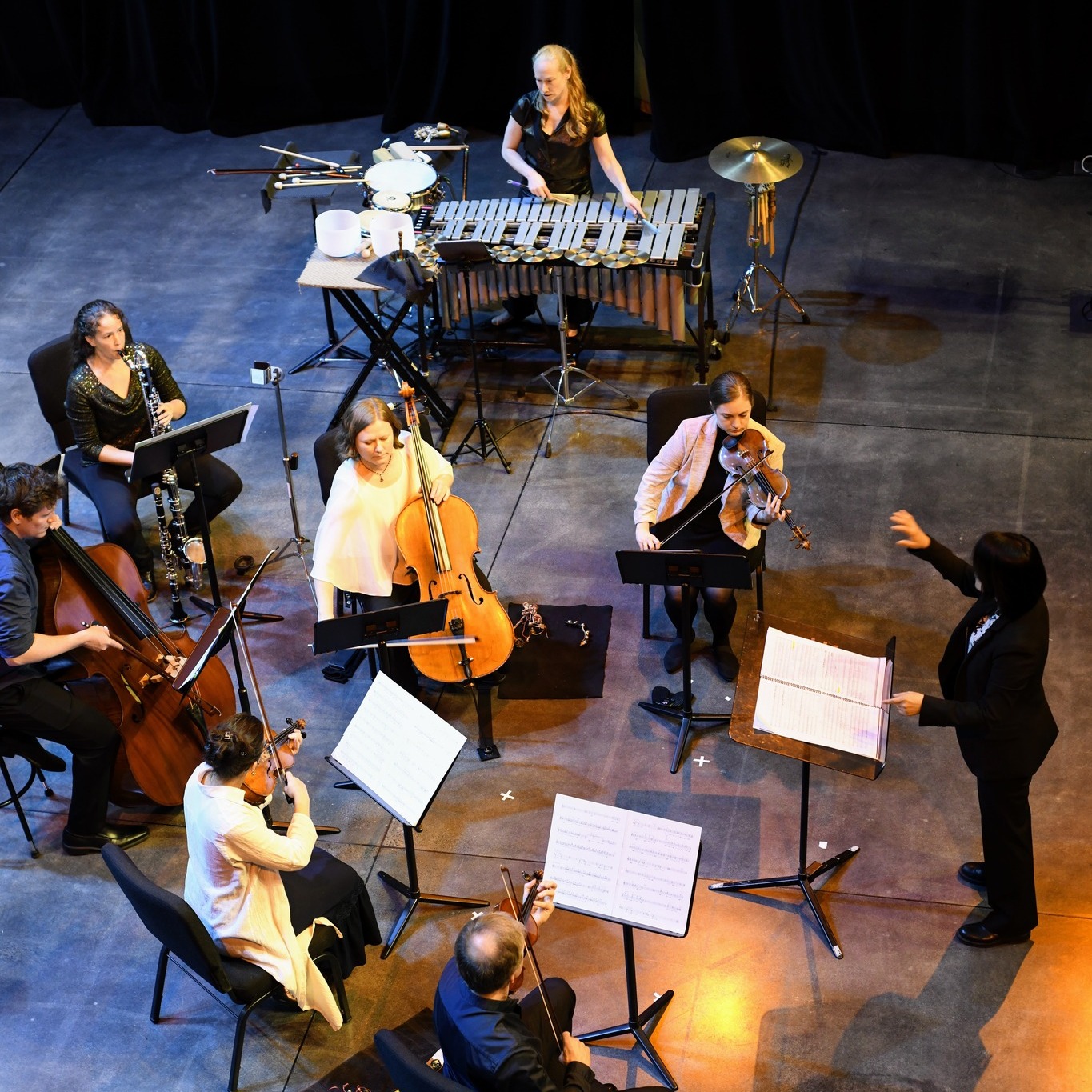
Seattle’s contemporary music orchestra performs new works for sinfonietta by faculty composers William Dougherty, Joël-François Durand, and Huck Hodge and by graduate student composer Oliver Schoonover. A performance of György Ligeti's Piano Concerto features guest pianist Aaron Wonson. With Donna Shin, flute, and select graduate-student members of the UW Modern Music Ensemble. Julia Tai conducts.
Program
OLIVER SCHOONOVER: tearing down a forest to build a dog bar (2026) (world premiere)
JOËL FRANÇOIS-DURAND: Musica fict(iv)a for wind quintet (2026) (preview)
I. Musica fict(iv)a
Interlude
II. Variation en noir et blanc
WILLIAM DOUGHERTY: the new normal (2016)
HUCK HODGE: La Llorona for flute and ensemble (2012)
Donna Shin, flute soloist
INTERMISSION
GYÖRGY LIGETI: Piano Concerto (1985-1988)
I. Vivace molto ritmico e preciso
II. Lento e deserto
III. Vivace cantabile
IV. Allegro risoluto
V. Presto luminoso
Aaron Wonson, piano soloist
Seattle Modern Orchestra
Julia Tai, conductor
Evan Pengra Sult, flute *^
Janet Putnam, oboe *~
Angelique Poteat, clarinet *^~
Cameron Deluca, ocarina
Steven Morgan, bassoon *^~
Jill Jaques, horn ~
Brian Shaw, trumpet *^~
Grant Reed, trombone *^~
Bonnie Whiting, percussion *^~
Tyler Smith, percussion *
Jiaxuan Wu, piano *~
Jingshi Zhao, piano ^
Pala Garcia, violin I *^~
Mikhail Schmidt, violin I
Eric Rynes, violin II *^
Taylor DeCastro, violin II
Erin Wight, viola *^~
John Popham, cello *^~
Abbey Blackwell, bass *^~
*Schoonover ^Dougherty ~Hodge
Program Notes
OLIVER SCHOONOVER: tearing down a forest to build a dog bar (2026)
The woods by my parents’ apartment are being torn down. I grew up playing in these woods. I remember waking up before dawn to go on early morning runs with my dad and brother. My dad would lead the way to break through the spiderwebs that were built across the trail the night before. The sound of the frogs from the pond in the morning was enormous. Sometimes if we were really quiet, we would get into a long staring contest with a fox. After every hurricane or tropical storm, we would go to see what had fallen. Pine trees snapped, brought down to the forest floor, but providing new life to moss and fungi. Now they’re cleared away, for Doghaus, a bar you can bring your dog to if you pay the membership fee.
Every time I come back home, more trees have been removed. The pond’s been filled in to make a driveway. I don’t know what they did with the frogs. My parents started seeing deer outside their apartment, searching for a new home.
I want to be clear that I’m not a NIMBY. I would celebrate affordable housing, community owned grocery stores, projects that benefit our community. I also want to be clear that I love both dogs and bars. But I’ve had a hard time expressing my anger towards this membership dog bar, being built on a road inaccessible to anyone without a car, destroying the rich ecosystem and driving out the original inhabitants.
In this piece, I’ve asked members of the ensemble to share their own memories of nature that are meaningful to them. We all have unique experiences in nature that have shaped us, and many of the locations of these memories are disappearing. Writing this piece has helped me feel and process my emotions as I watch my childhood woods being torn down. As you listen, I want to invite you to think about your own memories of nature, and celebrate the ways that nature has affected you in your life.
JOËL-FRANÇOIS DURAND: Musica fict(iv)a for wind quintet (2026) (preview)
Musica fict(iv)a is a set of seven pieces and two interludes that make extensive use of first-order beats—an acoustic phenomenon that occurs when two pitches of very close frequency are played at the same time—presented in various musical contexts. In each piece, the beats take on a different role. The title Musica fict(iv)a refers to both the notion of "outside" notes found in the musical theory of musica ficta from the middle ages, and to the "fictive" character of the beats produced by these outside notes.
In parallel to the medieval notion of Musica ficta, the reference here is to the fact that the tonal inflections that generate beats don’t so much create a microtonal language as they are explorations of the musical potential of beats, in particular as we approach the unison. In that sense, they operate outside the conventional notion of intervals.
Fictive music: since the beats are not actually produced by the musicians (the performers just played two closely related, but different tones), but result from the acoustic phenomenon of interference, one could argue that the music they create is not "real": it exists in another, non-material dimension. The beats produce a "fictive," but clearly perceived musical line beyond the more traditional musical gestures.
One of the main reasons why I find this particularly interesting is because these two types of discourse, the fictive and the traditional ones, require very different types of listening, different types of attention. The listener has to switch their level of attention in order to follow one or the other type, and perceiving them at the same time is akin to listening to a new kind of polyphony.
We will hear movements I and II, and the first Interlude tonight:
I. Musica fict(iv)a
Interlude I
II. Variation en noir et blanc
- In I., Musica fict(iv)a, the held notes that create the beat phenomenon (at first in the duo flute-clarinet) are hidden behind faster gestures in the other three instruments, and can be heard as an echo. They progressively come more to the foreground in the course of the piece.
- In II., Variation en noir et blanc (Variation in black and white), the beats are the result of melodic lines of tiny, microtonal intervals played by clarinet, French horn and bassoon against a more steady held tone; additionally, one of the lines (generally in the bassoon) is a glissando, which enhances the constant variation of beats.
WILLIAM DOUGHERTY: the new normal (2016)
The summer of 2016 was a particularly violent and dark time in the world, one that now reads less as an aberration than as an early signal of a longer period of instability that continues today. The aftermath of the Arab Spring, which began in late 2010, gave way to protracted conflict across North Africa and the Middle East, and to the mass displacement of civilians from cities still marked by war. Across Europe, stagnant wages and the arrival of refugees—many fleeing the war in Syria—contributed to a political backlash and the rise of populist, often xenophobic, right-wing movements. The United Kingdom voted to leave the European Union, choosing a path of isolation over long-standing economic and political partnership. In the United States, the presidential election cycle was marked by a pervasive sense of unease, as a candidate gained traction with a message that framed the country in stark and divisive terms, resonating strongly with segments of the population who felt excluded from the promises of globalization. At the same time, gun violence in major cities such as Chicago and Philadelphia surged, and mass shootings—in malls, nightclubs, churches, universities, workplaces, and courthouses—became a recurring feature of public life. The experiences of Black Americans living with biased policing were brought into wider public view through the increasing ubiquity of mobile recording and social media, which in some cases broadcast acts of violence in real time.
This work emerged as a response to those conditions. It is constructed through a process of collage, connecting short samples drawn from six different musical sources. The piece unfolds in four continuous sections. Following a brief introduction, each section draws on sampled material as its primary source. Some samples appear in their original form in the fixed media part, while others are transformed—filtered, stretched, or orchestrated—and performed by the instrumentalists.
The second section incorporates a recording made by 20th-century ethnomusicologist and folklorist Alan Lomax of Black prisoners at the Mississippi State Penitentiary at Parchman in 1947, singing “Old Alabama” while chopping wood. Its harmonic framework is derived from “Ahi troppo, ahi troppo e duro,” an aria from Claudio Monteverdi’s 1608 Ballo delle ingrate. In the aria, a woman condemned to Hades laments her return to the underworld after briefly experiencing the warmth and light of the living world. This section also features orchestrated material derived from Merzbow’s 1996 album Pulse Demon.
The third and fourth sections similarly draw on historical material for their harmonic basis, in this case a passage from Henry Purcell’s Music for the Funeral of Queen Mary (1695), specifically “In the midst of life we are in death.” Across these sections, non-voiced sounds—pops, clicks, static, and beeps drawn from police radio recordings connected to mass shootings and the killings of unarmed Black Americans—are layered into dense, heterophonic textures.
HUCK HODGE: La Llorona for flute and ensemble (2012)
This chamber concerto draws on images from the 1585 Florentine Codex of Bernardino Sahagun. Known in English as A General History of the Things of New Spain, this codex is regarded as the first ethnographic study of pre- Columbian Mexico. This piece focuses on the final volume, The Conquest, and in particular, on the accounts of the omens that were in circulation among the Nahua (Aztecs) some years before. Though written in a temporally and culturally specific context, these texts are striking for their sheer poetic beauty as well as their universal evocations of loss, fear and hope. One of the more arresting passages is as follows,
A sixth omen: often was heard a woman going weeping, going crying out. Loudly did she cry out at night. She walked about saying: “¡O hijos míos, ya nos perdimos (O My sons, now we are about to go)!” Sometimes she said: “¿O hijos míos, adónde os llevaré (My sons, where am I to take you)”?
This depiction bears a striking similarity to the figure of la llorona (the Weeping Woman), a ghostly figure that appears in various forms in the folklore of Mesoamerica and whose cries fortell the coming of death and misfortune. In some accounts, if her cry sounds close at hand then the spirit is far away and all is well, but if she sounds distant then la llorona is in reality close by and death will come soon. In an exploration of this disorienting experience of space and distance, the ensemble is amplified and its sound sent to various unpredictable locations in the performance hall. This work was commissioned by the Talea Ensemble with support from New Music USA for the 2012 Contempuls Festival, Prague.
GYÖRGY LIGETI: Piano Concerto (1985-1988)
I composed the Piano Concerto in two stages: the first three movements during the years 1985-86, the next two in 1987, the final autograph of the last movement was ready by January, 1988. The concerto is dedicated to the American conductor Mario di Bonaventura.
The markings of the movements are the following:
1. Vivace molto ritmico e preciso
2. Lento e deserto
3. Vivace cantabile
4. Allegro risoluto
5. Presto luminoso.
The first performance of the three-movement Concerto was on October 23rd, 1986 in Graz. Mario di Bonaventura conducted while his brother, Anthony di Bonaventura, was the soloist. Two days later the performance was repeated in the Vienna Konzerthaus. After hearing the work twice, I came to the conclusion that the third movement is not an adequate finale; my feeling of form demanded continuation, a supplement. That led to the composing of the next two movements. The premiere of the whole cycle took place on February 29th, 1988, in the Vienna Konzerthaus with the same conductor and the same pianist.
The orchestra consisted of the following: flute, oboe, clarinet, bassoon, horn, trumpet, tenor trombone, percussion and strings. The flautist also plays the piccoIo, the clarinetist, the alto ocarina. The percussion is made up of diverse instruments, which one musician-virtuoso can play. It is more practical, however, if two or three musicians share the instruments. Besides traditional instruments the percussion part calls also for two simple wind instruments: the slide whistle and the harmonica.
In the Piano Concerto I realized new concepts of harmony and rhythm.
The first movement is written simultaneously 12/8 and 4/4 (8/8). This “three over two” relation is in itself nothing new. Because, however, I articulate 12 triola and 8 duola pulses, an entangled, up till now unheard kind of polymetry is created. The rhythm is additionally complicated because of asymmetric groupings inside two speed layers, which means accents are asymmetrically distributed. These groups, as in the talea technique, have fixed, continuously repeating rhythmic structures of varying lengths in speed layers of 12/8 and 4/4. This means that the repeating pattern in the 12/8 level and the pattern in the 4/4 level do not coincide and continuously give a kaleidoscope of renewing combinations.
In our perception we quickly resign from following particular rhythmical successions and that what is going on in time appears for us as something static, resting. This music, if it is played properly, in the right tempo and with the right accents inside particular layers, after a certain time “rises", as it were, as a plane after taking off: the rhythmic action, too complex to be able to follow in detail, begins "flying". This diffusion of individual structures into a different global structure is one of my basic compositional concepts: from the end of the fifties, from the orchestral works Apparitions and Atmosphères I continuously have been looking for new ways of resolving this basic question. The harmony of the first movement is based on mixtures, hence on the parallel leading of voices. This technique is used here in a rather simple form; later in the fourth movement it will be considerably developed.
The second movement (the only slow one amongst five movements) also has a talea type of structure, it is however much simpler rhythmically, because it contains only one speed layer. The melody is developed through a rigorous interval mode in which two minor seconds and one major second alternate, therefore nine notes inside an octave. This mode is transposed into different degrees and it also determines the harmony of the movement; however, in the closing episode in the piano part there is a combination of diatonics (white keys) and pentatonics (black keys) in brilliant, sparkling quasimixtures, while the orchestra continues to play in the nine tone mode.
In this movement I used isolated sounds and extreme registers (piccolo in a very low register, bassoon in a very high register, canons played by the slide whistle, the alto ocarina and brass with a "harmon-mute"' damper, "cutting" sound combinations of the piccolo, clarinet and oboe in an extremely high register, also alternating of a whistle-siren and xylophone). The third movement also has one speed layer and because of this it appears as simpler than the first, but actually the rhythm is very complicated in a different way here. Above the uninterrupted, fast and regular basic pulse, thanks to the asymmetric distribution of accents, different types of hemiolas and "inherent melodical patterns" appear (the term was coined by Gerhard Kubik in relation to central African music). If this movement is played with the adequate speed and with very clear accentuation, illusory rhythmic-melodical figures appear. These figures are not played directly; they do not appear in the score, but exist only in our perception as a result of co-operation of different voices.
Already earlier I had experimented with illusory rhythmics: in Poème symphonique for 100 metronomes (1962), in Continuum for harpsichord (1968), in Monument for two pianos (1976), and especially in the first and sixth piano etude Désordre and Automne à Varsovie (1985).
The third movement of the Piano Concerto is up to now the clearest example of illusory rhythmics and illusory melody. In intervallic and chordal structure this movement is based on alternation, and also inter-relation of various modal and quasi-equidistant harmony spaces. The tempered twelve-part division of the octave allows for diatonical and other modal interval successions, which are not equidistant, but are based on the alternation of major and minor seconds in different groups. The tempered system also allows for the use of the anhemitonic pentatonic scale (the black keys of the piano). From equidistant scales, therefore interval formations which are based on the division of an octave in equal distances, the twelve-tone tempered system allows only chromatics (only minor seconds) and the six-tone scale (the whole-tone: only major seconds).
Moreover, the division of the octave into four parts only minor thirds) and three parts (three major thirds) is possible. In several music cultures different equidistant divisions of an octave are accepted, for example, in the Javanese slendro into five parts, in Melanesia into seven parts, popular also in South¬east Asia, and apart from this, in southern Africa. This does not mean an exact equidistance: there is a certain tolerance for the inaccurateness of the interval tuning.
These tunings have attracted me for several years. However I did not want to re-tune the piano (microtone deviations appear in the concerto only in a few places in the horn and trombone parts led in natural tones). After the period of experimenting, I got to pseudo- or quasi¬equidistant intervals, which is neither whole-tone nor chromatic: in the twelve-tone system, two whole-tone scales are possible, shifted a minor second apart from each other. Therefore, I connect these two scales (or sound resources), and for example, places occur where the melodies and figurations in the piano part are created from both whole tone scales; in one band one six-tone sound resource is utilized, and in the other hand, the complementary. In this way whole-tonality and chromaticism mutually reduce themselves: a type of deformed equidistancism is formed, strangely brilliant and at the same time "slanting"; illusory harmony, indeed being created inside the tempered twelve-tone system, but in sound quality not belonging to it anymore.
The appearance of such "slanted¬equidistant harmony fields" alternating with modal fields and based on chords built on fifths (mainly in the piano part), complemented with mixtures built on fifths in the orchestra, gives this movement an individual, soft-metallic colour (a metallic sound resulting from harmonics).
The fourth movement was meant to be the central movement of the Concerto. Its melodc-rhythmic elements (embryos or fragments of motives) in themselves are simple. The movement also begins simply, with a succession of overlapping of these elements in the mixture type structures. Also here a kaleidoscope is created, due to a limited number of these elements - of these pebbles in the kaleidoscope - which continuously return in augmentations and diminutions.
Step by step, however, so that in the beginning we cannot hear it, a compiled rhythmic organization of the talea type gradually comes into daylight, based on the simultaneity of two mutually shifted to each other speed layers (also triplet and duoles, however, with different asymmetric structures than in the first movement). While longer rests are gradually filled in with motive fragments, we slowly come to the conclusion that we have found ourselves inside a rhythmic-melodical whirl: without change in tempo, only through increasing the density of the musical events, a rotation is created in the stream of successive and compiled, augmented and diminished motive fragments, and increasing the density suggests acceleration.
Thanks to the periodical structure of the composition, "always new but however of the same" (all the motivic cells are similar to earlier ones but none of them are exactly repeated; the general structure is therefore self-similar), an impression is created of a gigantic, indissoluble network. Also, rhythmic structures at first hidden gradually begin to emerge, two independent speed layers with their various internal accentuations.
This great, self-similar whirl in a very indirect way relates to musical associations, which came to my mind while watching the graphic projection of the mathematical sets of Julia and of Mandelbrot made with the help of a computer. I saw these wonderful pictures of fractal creations, made by scientists from Brema, Peitgen and Richter, for the first time in 1984. From that time they have played a great role in my musical concepts. This does not mean, however, that composing the fourth movement I used mathematical methods or iterative calculus; indeed, I did use constructions which, however, are not based on mathematical thinking, but are rather "craftman’s" constructions (in this respect, my attitude towards mathematics is similar to that of the graphic artist Maurits Escher). I am concerned rather with intuitional, poetic, synesthetic correspondence, not on the scientific, but on the poetic level of thinking.
The fifth, very short Presto movement is harmonically very simple, but all the more complicated in its rhythmic structure: it is based on the further development of ''inherent patterns" of the third movement. The quasi-equidistance system dominates harmonically and melodically in this movement, as in the third, alternating with harmonic fields, which are based on the division of the chromatic whole into diatonics and anhemitonic pentatonics. Polyrhythms and harmonic mixtures reach their greatest density, and at the same time this movement is strikingly light, enlightened with very bright colours: at first it seems chaotic, but after listening to it for a few times it is easy to grasp its content: many autonomous but self-similar figures which crossing themselves.
I present my artistic credo in the Piano Concerto: I demonstrate my independence from criteria of the traditional avantgarde, as well as the fashionable postmodernism. Musical illusions which I consider to be also so important are not a goal in itself for me, but a foundation for my aesthetical attitude. I prefer musical forms which have a more object-like than processual character. Music as "frozen" time, as an object in imaginary space evoked by music in our imagination, as a creation which really develops in time, but in imagination it exists simultaneously in all its moments. The spell of time, enduring its passing by, closing it in a moment of the present is my main intention as a composer. -György Ligeti
Biographies
Seattle Modern Orchestra
Founded in 2010, Seattle Modern Orchestra (SMO) is the only large ensemble in the Pacific Northwest solely dedicated to the music of the 20th and 21st centuries. Led by co-artistic directors Julia Tai and Bonnie Whiting, SMO commissions and premieres new works from an international lineup of composers, in addition to presenting important pieces from the contemporary repertoire that are rarely if ever heard by Seattle audiences. The ensemble “operates at that exciting cusp between old and new, between tradition and innovation” (Vanguard Seattle) curating new sounds and experiences for concert goers in the region.
SMO provides audiences with performances of the best in contemporary chamber and orchestral music, and develops podcasts, lectures, educational residencies, and other forms of community engagement in an accessible and inviting format all designed to expand the listener’s appreciation and awareness of the music of today.
Aaron Wonson
Pianist Aaron Wonson is equally at home with the music of Ives and Ligeti as he is with Bach, Debussy, or Thelonious Monk. Jeremy Denk described his technique as “scary,” and his extensive new music collaborations include composers Phillip Cashian, Lei Liang, Elizabeth Ogonek, and conductors David Dzubay and Timothy Weiss. Recent recording projects include an arrangement of Bela Bartok’s first violin sonata for piano and alto saxophone and a jazz trio album.
Wonson holds degrees from Oberlin Conservatory, studying with Peter Takács, and from Jacobs School of Music, with Spencer Myer. He is currently pursuing a DMA degree in piano performance and pedagogy at Boston University with Andrius Zlabys. While at the Jacobs School, he was involved in a piano, violin, and clarinet trio funded by the Verdehr Trio of Michigan University. In addition to classical performance, Wonson also composes, plays jazz, and teaches at the Rhode Island Philharmonic Music School. He currently resides in the greater Boston area.
Oliver Schoonover
Oliver Schoonover is a composer and pianist based in Seattle, Washington. He writes music that celebrates the musicality of everyday objects and the performer as a human being. He is especially interested in ASMR sounds, soft sounds that produce a tingling, static-like sensation.
Oliver is currently pursuing a master of music in composition at the University of Washington. Previously, he graduated from Florida State University with a B.M. in composition. His works have been performed by Polymorphia, the FSU Electric Chamber Orchestra, the St. John's Episcopal Church Compline Choir, at the FSU Festival of Creative Arts, and at TEDxFSU.
As a pianist, he has performed contemporary music with Polymorphia, the FSU Electric Chamber Orchestra, the FSU Wind Ensemble, and the UW Wind Ensemble and Symphonic Band, and has performed at the FSU Festival of New Music, the FSU Festival of Creative Arts, and the FSU Panama City ASCENT Tech Expo.

William Dougherty is an American composer, sound artist, educator, and writer who joined the University of Washington faculty in January 2025. Dougherty's works have been performed internationally by ensembles including BBC Scottish Symphony Orchestra (Glasgow), The Sun Ra Arkestra (Philadelphia), Yarn/Wire (New York), Ensemble Phoenix (Basel), TILT Brass (New York), Ensemble for New Music Tallinn (Estonia), JACK Quartet (New York), and Talea Ensemble (New York). His music has been featured in festivals such as Tectonics Glasgow (2023), IRCAM's ManiFeste (2019), musikprotokoll (2018), Donaueschingen Musiktage (2017), New Music Miami (2017), Tectonics Festival New York (2015), the New York City Electroacoustic Music Festival (2015), the 47th Internationale Ferienkurse für Neue Musik in Darmstadt (2014), the New York Philharmonic Biennale (2014), and broadcast on BBC Radio 3.
Dougherty was the recipient of the Luciano Berio Rome Prize in Music Composition from the American Academy in Rome. He has received additional recognitions, awards, and fellowships from Harvard University's Radcliffe Institute for Advanced Study, Columbia University's Institute for Ideas & Imagination, Civitella Ranieri Foundation, the American Academy of Arts and Letters, Gaudeamus Muziekweek, the Internationale Gesellschaft für Neue Musik (IGNM/ISCM), the Aaron Copland House, SEAMUS/ASCAP, BMI, PARMA Recordings, the PRS for Music Society, the American Composers Forum, the Philadelphia Orchestra Association, the Institute for European Studies, and the UK Foreign Aid and Commonwealth Office.
Dougherty earned his Doctorate of Musical Arts (DMA) degree at Columbia University in New York City, where he taught and assisted undergraduate courses in composition, music technology, and music theory at Columbia University. He previously served on the composition faculty at Temple University.
Dougherty graduated with a Bachelor’s in Music Composition from Temple University’s Boyer College of Music and Dance in Philadelphia where he studied with Maurice Wright, Richard Brodhead, and Jan Krzywicki. As a Marshall Scholar, Dougherty earned his Master’s from the Royal College of Music in London studying with Kenneth Hesketh and Mark-Anthony Turnage after which he completed supplementary studies (Ergänzungsstudium) under the guidance of Georg Friedrich Haas at the Hochschule für Musik Basel in Switzerland. In 2018-19, William completed the Cursus Programme in composition and computer music at IRCAM in Paris while in residence at Cité Internationale des Arts.
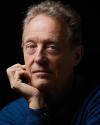
Composing, writing, teaching, inventing new ways of hearing – all are linked in the work of Joël-François Durand. As a composer, his career was launched in Europe with important prizes: a Third Prize at in the 1983 Stockhausen Competition for the piano piece “…d’asiles déchirés…,” the Kranichsteiner Preis from the Darmstadt Summer Courses for New Music in 1990. Commissions and performances from many of today’s most significant ensembles followed – Ensemble Intercontemporain, London Sinfonietta, Arditti Quartet, Jack Quartet, Quatuor Diotima, ASKO, Ensemble Recherche, musikFabrik, Talea Ensemble, Dal Niente Ensemble, BBC Symphony Orchestra, Orchestre Philarmonique de Radio France, Deutsches Symphonie Orchester Berlin, Seattle Symphony Orchestra. Durand is Professor of Composition at the School of Music, University of Washington, as well as Acting Director. He has been awarded the Donald E. Petersen Endowed Professorship for 2019-22. Durand’s works are singular and powerful, combining rigorous and innovative structures with a prominent lyrical impulse. Durand’s music and personality received critical attention in the 2005 book Joël-François Durand in the Mirror Land (University of Washington Press and Perspectives of New Music) edited by his University of Washington School of Music colleague Jonathan Bernard, which features in addition to analyses by Bernard and several of the School’s students, an innovative self-interview authored by Durand himself. Recent projects for Durand include a work for large orchestra, Tropes de : Bussy, based on some of Debussy’s piano Préludes, commissioned by the Seattle Symphony Orchestra, which was premiered April 18-20, 2019 and a work for viola and ensemble, to be premiered by Melia Watras, viola and the Dal Niente ensemble in May 2020.
Commercial recordings of his music are available on the Auvidis-Naïve, Mode Records, Wergo, Albany Records and Soundset Recordings labels. In 2010, Durand embarked on a new path: he designed and started commercial production of a new tonearm for record players. The Talea, as it was called, took the audio world by storm and was followed by three further models, the Telos, the Kairos and most recently (2019), the Tosca also aimed at the most refined audio reproduction systems. For his work at his company Durand Tonearms LLC, he was made a University of Washington Entrepreneurial Fellow in 2010. As a guest composer and lecturer, Durand has contributed to the “Centre de la Voix” in Royaumont, France where he was co-director of the composition course in September 1993, the “Civica Scuola di Musica” in Milan, Italy (1995), the Royal Academy for Music in London, UK (1997), the Internationale Ferienkurse für Neue Musik in Darmstadt (1984, 1990, 1992, 1994), the “VIII. Internationaler Meisterkurs für Komposition des Brandenburgischen Colloquiums für Neue Musik”, Rheinsberg (1998), Washington State University, Pullman, WA (2004), and Stanford University (2006), among others. In the Fall 1994 he was Visiting Assistant Professor in Composition at the University of California at San Diego.
Durand is listed in the New Grove Dictionary of Music and Musicians.
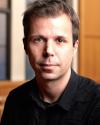
Huck Hodge is professor and chair of the composition program in the school of music. A composer of “harmonically fresh work", "full of both sparkle and thunder” (New York Times), his music has been praised for its “immediate impact” (Chicago Tribune), its "clever, attractive, streamlined" qualities (NRC Handelsblad, Amsterdam), and its ability to "conjure up worlds of musical magic” with “power and charisma" (Gramophone Magazine, London). There is a dramatic interplay of color, light, and darkness in his music, which emerges from an uncanny blending of pure and dissonant harmonies, widely spaced orchestrations and vast, diffuse timbres.
Hodge is the recipient of many prestigious awards and distinctions. Among these is the Charles Ives Living, the largest music award conferred by the American Academy of Arts and Letters. His other major awards include the Rome Prize (Luciano Berio Fellowship), the Gaudeamus Prize, a Guggenheim Fellowship, commissions from the Koussevitzky Foundation in the Library of Congress, the Fromm Foundation at Harvard University, the American Composers Forum (JFund), the Barlow Endowment, Music at the Anthology (MATA), the American Academy in Rome, Muziek Centrum Nederland, Musik der Jahrhunderte, and the National Theater and Concert Hall of Taiwan, in addition to multiple grants and awards from ASCAP, the Bogliasco Foundation, Copland House, the Deutscher Akademischer Austauschdienst (DAAD), MacDowell, New Music USA, the Siemens Musikstiftung, and Yaddo.
His music has been performed at Carnegie Hall, Lincoln Center and at numerous major festivals — the New York Philharmonic Biennial, Berliner Festspiele, Gaudeamus Muziekweek, Shanghai New Music Week (上海当代音乐周), ISCM World Music Days, and many others in over twenty countries on six continents. Other performances include those by members of the Berlin Philharmonic and Ensemble Modern, the ASKO / Schönberg Ensemble, the Seattle Symphony, and the Orchestra of the League of Composers. His chamber music has been premiered, performed and recorded by a long list of soloists and ensembles such as the Daedalus, JACK, Mivos, and Pacifica string quartets, the Adapter, Aleph, Argento, Dal Niente, Divertimento, Insomnio, SurPlus, and Talea ensembles, and his colleagues David Gordon, Donna Shin, Cristina Valdés, Cuong Vu, and Bonnie Whiting. His published music is distributed by Alexander Street Press (US) and Babel Scores (France). Recordings of his music appear on the New World and Albany record labels and have been featured in numerous national and international broadcasts.
Before joining the University of Washington, Hodge taught composition at Columbia University, where he earned his M.A. and D.M.A. studying with Fred Lerdahl, George Lewis, and Tristan Murail. Prior to this, he studied composition, theory, and new media at the Staatliche Hochschule für Musik und Darstellende Kunst in Stuttgart, Germany, with Marco Stroppa and Georg Wötzer as well as music, German literature and philosophy at the University of Oregon and the Universität Stuttgart. He has been a visiting professor/invited lecturer on music and aesthetics at a variety of institutions including the University of Chicago, CNMAT/UC Berkeley, UCSD, Columbia University, Eastman School of Music, Manhattan School of Music, NYU, and the Universität der Künste in Berlin, and he served for three years as the director of the Merriman Family Young Composers Workshop at the Seattle Symphony.

Flutist Donna Shin has been praised for her beautifully-spun phrases, seductive sound, sterling technique, and charismatic exchanges with the audience. Described as “dazzling” by the Boston Globe, Shin has built an enviable reputation as a versatile performer of solo, chamber, orchestra, jazz and ancient Asian repertoire. Performing in concert halls throughout the Americas, Europe and Asia, she is admired for her adventurous programming and expressive flair.
Devoted to the role of artist-teacher, she is the flute professor, chair of woodwind and brass studies, and director of the Chamber Music Lab at the University of Washington School of Music after holding faculty posts at the University of South Carolina School of Music and Oklahoma State University. She frequently appears as artist-performer and master class clinician at universities and flute clubs throughout the world, modeling the artist-teacher path for young flutists.
Shin has been featured in solo performances with the North Korean National Symphony Orchestra, People’s Liberation Army Band of China, Seattle Symphony Orchestra, Eastman Philharmonia, Sewanee Summer Music Festival, University of Washington Symphony Orchestra, New England Conservatory Wind Ensemble, University of South Carolina Wind Ensemble, Oklahoma State University Wind Ensemble, and University of Washington Wind Ensemble.
Shin performed for two seasons as principal flute with the Heidelberg Schlossfestspiele Orchester in Germany. In the Boston area, she performed with the Boston Philharmonic Orchestra, the New Bedford Symphony, and the Isabella Stewart Gardner Chamber Orchestras. She has also performed with the Seattle Symphony, Northwest Sinfonietta, South Carolina Philharmonic, Tulsa Symphony Orchestra, New World Symphony, Tulsa Signature Symphony, Lake Placid Sinfonietta, Tanglewood Music Center, National Repertory Orchestra, Aspen Music Festival, National Orchestral Institute, and Norfolk Chamber Music Festival.
Shin has won prizes in competitions held by the National Flute Association, April Spring Friendship Arts Festival in North Korea, Performers of Connecticut, James Pappoutsakis Society, and Seattle Flute Society, to name a few. As a founding member of Paragon Winds woodwind quintet, she was awarded fellowships from the New England Conservatory and Yale University’s Norfolk Chamber Music Festival, and won the Grand Prize at the Coleman National Chamber Ensemble Competition in Pasadena, California. In concert, Shin has collaborated with esteemed artists such as Yo-Yo Ma, Andrea Bocelli, and Pulitzer Prize winners George Crumb and John Harbison.
Committed to developing young artists and reaching out to audiences, Shin has introduced new music programs to a variety of communities, ranging from rural Oklahoma to communist North Korea to castle communities in northern Italy. Recent international concert tours include: Brazil, China, Japan, North and South Korea, and Uzbekistan.
Shin earned degrees with the highest honors from the Interlochen Arts Academy, Eastman School of Music and the New England Conservatory, including the esteemed Performer’s Certificate at the Eastman School. As instructor of chamber music and flute at the University of Rochester and the Eastman School of Music, she was awarded the “Eastman School of Music Excellence in Teaching” prize. During her doctoral studies at Eastman, she became the first woodwind player in the school’s history to be nominated for the highly coveted Artist's Certificate. Shin's primary teachers include: Bonita Boyd, Paula Robison, Julius Baker, Rick Breitstein, Karla Flygare, and Bonnie Blanchard.
During the summer months, Shin performs as artist-teacher at the Sewanee Summer Festival in Tennessee, ARIA International Summer Academy in Massachusetts, and Snowater Flute Festival in Washington. Her prior summer activities have included leadership of study abroad performance courses in northern Italy and Young Artist Competition Coordinator for the National Flute Association.