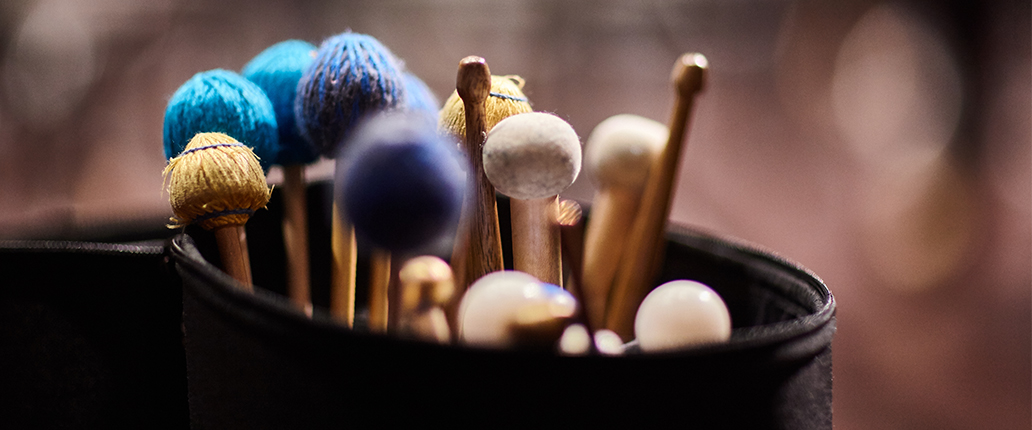
The UW Percussion Ensemble (Bonnie Whiting, director) and UW Steelband (Shannon Dudley, director) present a shared year-end program.
Program
University of Washington Percussion Ensemble
IV. (1935) - Johanna Magdalena Beyer (1888-1944)
I. Restless (from Suite for Percussion, 1939)
IV. (1935)
Träd (2006) - John Ericsson (b. 1974)
Halo (2012) - Joe W. Moore III (b. 1986)
Six Pieces for Piano (1903-05) - Ottorino Respighi (1879-1936); arr. Kaisho Barnhill
arranged for vibraphone and piano (2026)
III. Notturno
Ragtime Suite - arr. Bob Becker (b. 1947)
Xylophonia - Joe Green, 1925
Colin Lehman, xylophone
The Whistler - George Hamilton Green, 1924
Monaka Kakuta, xylophone
Log Cabin Blues - G. H. Green, 1924
Xander Swanson, xylophone
Bye-Bye Medley (1927 - Ray Henderson and Fred Hamm/Dave Bennett/Bert Lown/Chauncey Gray
Devon Rafanelli, xylophone
In Common Time (2017) - Tom Lopez (b. 1965)
UW Percussion Ensemble
Kaisho Barnhill, Penny Crichton, Simon Harty, Monaka Kakuta, Colin Lehman, Dustin Lie, Ivy Moore, Colin Nelson, Devon Rafanelli, Hazel Salvaggio, Tyler Smith, Xander Swanson, Nat Yamamoto
Dr. Bonnie Whiting, Director
Intermission
University of Washington Steelband
Yesterday - Lennon/McCartney; arr. Shannon Dudley
Soloists: Marques Locke, Joey Schafer
Guantanamera - Joseito Fernández; arr. Shannon Dudley
Soloists: Marques Locke, Joey Schafer, Elena Hafner
Tico Tico no Fubá - Zaquinho de Abreu; arr. Joey Schafer
Manicero - Moises Simón; arr. Shannon Dudley
Soloists: Elena Hafner, Joey Schafer, Teddy Seligman, Calder Broadhead
Charlotte St. - Ray Holman; arr. Shannon Dudley
Soloists: Joey Schafer, Elena Hafner, Gabriel Kennedy-Gibbens, Calder Broadhead
UW Steelband
Calder Broadhead, Damon Chan, Elena Hafner, Gabriel Kennedy-Gibbens, Marques Locke, Hannah Park. Joel Prinos, Joseph Schafer, Teddy Seligman, Xander Swanson, Nina Tharamal
Dr. Shannon Dudley, Director
Program Notes
Johanna Magdalena Beyer composed some of the first pieces with open/indeterminate percussion instrumentation; Beyer’s IV precedes John Cage’s Quartet by just a few months. To illustrate the flexibility of this technique, we present Beyer’s short IV twice with different instrument choices. Works like this one illustrate structure, form, and time in a starkly experimental way, articulating musical phrases in terms of resonance, sound, silence, and duration. Percussionists are drawn to these early pieces in part because they offer an opportunity to creatively engage our favorite sounds within strict formal guidelines. Beyer’s later work, Three Movements for Percussion, is similarly forward-looking. Tonight we present the first movement, Restless: a rhythmic palindrome written for more traditionally orchestral percussion instruments. Beyer’s music anticipates so many qualities of the later, outwardly divergent but similarly process-driven schools of modernism and minimalism: confrontational sounds; ritualistic rigor; austerity that shades into deadpan wit; persistently rational procedures that channel the emotional heft of an obsessive quest.
Träd (“Trees” in Swedish) is a showcase of the marimba's textural range via a forest of hands on a single instrument. John Ericsson asks each player to drive the piece forward with an individual motive, while melodies float above the undulating chord progressions.
Halo is written for percussion trio and is one of the first pieces I composed while beginning my compositional studies at LSU under Dinos Constantinides and Brett Dietz. The term “halo” refers to the optical phenomena that occur when the light from the sun or moon is reflected or refracted by ice particles in the atmosphere causing a ring of colored light to appear around the celestial body. This serves as inspiration for the piece and is portrayed throughout the piece from the instrumentation to the compositional processes." - Joe W. Moore III
During the “roaring” 1920’s an exciting kind of ragtime music became the rage in North America. Popularly known as “novelty ragtime”, this music was associated with the various dance styles in vogue at the time. Highly technical, often programmatic and certainly speedier than previous ragtime music, it was a perfect vehicle for the xylophone. Propelled by the newly-invented phonograph, the xylophone as a solo instrument enjoyed a true ‘golden age’ during the 1920’s and 30’s. Xylophone soloists appeared with piano accompaniment, in dance orchestras and concert bands, and were heard regularly on radio broadcasts and in animated cartoons and motion pictures. Bye Bye Medley features two great Tin Pan Alley songs from the 1920’s. The first is Ray Henderson’s famous stop-time melody Bye Bye Blackbird (lyrics by Mort Dixon) which is still popular as a jazz standard. Second is Bye Bye Blues, written by Fred Hamm, Dave Bennett, Bert Lown and Chauncey Gray. An old banjo favorite, this tune was often used as a virtuoso showpiece by xylophonists as well.” -Bob Becker
In Common Time was inspired by Terry Riley's composition “In C.” From the time I was a young musician, I’ve enjoyed performing and listening to Terry Riley’s seminal composition. It is recognized as one of the first, if not the first, pieces of minimalist music. Performances of “In C” can have any number of performers on any instrument, who all play through the same sequence of short melodic fragments. Each player decides how many times to repeat each fragment before moving on to the next, thus creating a constantly shifting fabric of melodic interplay.
In 2014, a full fifty years after “In C” was written, I began working on a musical response. The simple premise at the core of my piece is the exploration of rhythm, as opposed to Riley’s heterophonic exploration of pitch. In my piece, a minimum of 8 percussionists on a variety of instruments play through a sequence of rhythmic fragments. The result is a constantly shifting fabric of timbre and rhythm. I am very grateful for the dedication and commitment of Michael Rosen and the phenomenal performers of the Oberlin Percussion Group who presented the premiere of this work in 2017. -Tom Lopez
Notes on the Steelband instruments
The steel pan (sometimes called steel drum) was an innovation made by people of African descent in Trinidad for their carnival percussion ensembles. In the 19th century these ensembles typically featured call and response singing accompanied by drums, but colonial restrictions on drumming compelled them to try different things. Bamboo stamping tubes, known as tamboo bamboo, were popular in carnival during the early 20th century. In the 1930s tamboo bamboo ensembles began incorporating metal containers of various kinds, and at some point it was discovered that the surface of a metal drum could be tuned to different pitches. Musical rivalry between neighborhoods drove the rapid development of this idea into a new melodic instrument by the mid-1940s, and ambitious steel bands learned to play music of all kinds, from calypso to classical music. Today the steel pan is Trinidad and Tobago’s national instrument and steel bands feature many different types of pan, from the low booming basses to high-pitched tenors. Though modern steel pans are crafted by expert tuners who use oscilloscopes to perfect the overtones, most of them are still built from 55-gallon steel barrels that are manufactured for shipping oil, chemicals and other commodities. The steel band’s roots in making music from discarded metal are also reflected in the brake drum, a discarded car part whose ringing clanging rhythm is the heartbeat of the “engine room” alongside drumset, scratcher, congas and other percussion.
Acknowledgements
Many thanks to: Tyler Smith (our TA), Devon Rafanelli (our grad student worker), the Meany Center staff, Doug Niemela and the School of Music staff, as well as our Director Joël-François Durand.
The University of Washington acknowledges the Coast Salish peoples of this land, the land which touches the shared waters of all tribes and bands within the Suquamish, Tulalip and Muckleshoot nations.
Director Biographies

Bonnie Whiting (she/her) performs, commissions, and composes new experimental music for percussion. She seeks out projects involving the speaking percussionist, non-traditional notation, improvisation, and interdisciplinary performance. Her debut album, featuring an original solo-simultaneous realization of John Cage's 45' for a speaker and 27'10.554” for a percussionist, was released by Mode Records in April 2017. Her sophomore album Perishable Structures, launched by New Focus Recordings in 2020, places the speaking percussionist in the context of storytelling and features her own music as well as works by Vinko Globokar, Frederic Rzewski, Richard Logan-Greene, and Susan Parenti.
Her recent season highlights include onstage work in the multimedia chamber opera The Ritual of Breath Is the Rite to Resist, featuring productions at Lincoln Center’s Summer for the City, at The Hopkins Center at Dartmouth College, and at Stanford Live; a reprise of composer Wang Lu’s Stages for solo speaking/singing percussionist at New York’s Performance Spaces for the 21st Century (PS21); and four performances of a new concerto written for her by Jonathan Bingham with the National Symphony Orchestra for the family pops series at the Kennedy Center alongside renowned children’s book author Mo Willems. Whiting also creates original, improvised music with clarinetist James Falzone and pianist Lisa Cay Miller; their first album was released on Allos Documents in 2024, and the trio performs this season in Seattle, Vancouver, and Portland.
In 2022 she premiered Through the Eyes(s): an extractable cycle of nine pieces for speaking/singing percussionist collaboratively developed with composer Eliza Brown and ten artists and writers incarcerated at the Indiana Women’s Prison. The project was featured on NPR’s nationally-syndicated Slingshot, and locally via Seattle’s ClassicalKING radio station. Whiting has an ongoing relationship as a soloist with the National Orchestra of Turkmenistan via the U.S. Embassy Cultural Affairs Office, playing concerti in Ashgabat in 2017 and 2018. She performs frequently with percussionist Jennifer Torrence, giving concerts of new experimental work for speaking percussionists throughout Norway and the US. Her collaboration with multimedia artist Afroditi Psarra generated the album <null_abc>, released on the Zero Moon label in 2018, and their project with designer Audrey Desjardins on transcoding data from IoT devices as performance received a 2019/20 Mellon Creative Fellowship. The project was explored in a workshop at the 2020 Transmediale Festival in Berlin, and currently lives as an interactive net art installation. She spent four years performing music for voice and percussion with the Harry Partch Ensemble on the composer’s original instrumentarium while the instruments were in residence at the UW. Whiting has presented solo and small ensemble shows at The Stone in New York, the Brackish Series in Brooklyn, The Lilypad in Boston, The New York City Electroacoustic Music Festival, at Hallwalls in Buffalo, the Tiny Park Gallery in Austin, The Wulf in LA, the Carl Solway Gallery in Cincinnati, The Grove Haus in Indianapolis, on the Wayward Music Series in Seattle, on tour throughout New Zealand, and at colleges and universities around the country.
Whiting is the Co-Artistic Director and core percussionist of the Seattle Modern Orchestra, the Pacific Northwest’s only large ensemble solely dedicated to music of the 20th and 21st Centuries, and she plays vibraphone with the Torch Quartet. As a chamber musician, she has collaborated with many of today's leading new music groups, including red fish blue fish percussion group, (George Crumb's Winds of Destiny directed by Peter Sellars and featuring soprano Dawn Upshaw for the Ojai Festival), eighth blackbird (the “Tune-in” festival at the Park Avenue Armory), the International Contemporary Ensemble (on-stage featured percussionist/mover in Andriessen's epic Die Materie at the Park Avenue Armory, and the American premiere of James Dillon's Nine Rivers at Miller Theatre), Talea Ensemble (Time of Music Festival in Finland), Bang on a Can (Steve Reich's Music for 18 Musicians for the LA Philharmonic's Green Umbrella Series) and Ensemble Dal Niente (the Fromm Concerts at Harvard.) She attended Oberlin Conservatory (BM), the University of Cincinnati College-Conservatory of Music (MM), and the University of California San Diego (DMA). She is an Associate Professor of Music at the University of Washington, where she has been Chair of Percussion Studies since 2016.

Shannon Dudley, professor of Ethnomusicology, holds a PhD from the University of California at Berkeley. He teaches courses that include music of Latin America and the Caribbean, American popular music, Music and Community, Comparative Musicianship and Analysis, and graduate seminars in Ethnomusicology. He also directs the UW steeelband.
Dudley has conducted research in Trinidad and Tobago, focusing on the history and music of steelbands. More recent research interests include the musical geography of Santurce, Puerto Rico, as well as Latino contributions to American popular music. His theoretical interests include nationalism, transculturation, and participatory music practices.
His publications include Carnival Music in Trinidad (Oxford University Press, 2004), as well as Music From Behind the Bridge (Oxford University Press, 2008), a history of Trinidad steelband music, and numerous other articles on Caribbean music, including and "Judging by the Beat: Calypso vs. Soca," Ethnomusicology (1996), and “El Gran Combo, Cortijo, and the Musical Geography of Cangrejos/Santurce, Puerto Rico,” Journal of Caribbean Studies (2008).
Dudley is one of the curators (along with Marisol Berríos-Miranda, and Michelle Habell-Pallan) for American Sabor: Latinos in U.S. Popular Music, a bilingual museum exhibit that opened at the Experience Music Project in Seattle in 2008. Between 2008 and 2015 American Sabor was exhibited in 18 cities in the U.S. and Puerto Rico, first in its original version and later in a smaller version prepared in collaboration with the Smithsonian Institution Traveling Exhibit Service. Published as a book with University of Washington Press in 2018 (americansabor.music.washington.edu), American Sabor won the ARSC's 2019 prize for Best Historical Research in Recorded Rock and Popular Music.
In Seattle Dudley performs on steel pan with Dingolay, and participates in the Seattle Fandango Project (SFP), a community music group that practices son jarocho. He helps to run the Ethnomusicology division's Visiting Artist program, which includes Community Artists in Residence from Mexico, Puerto Rico, and elsewhere who participate in collaborations between local arts organizations and university programs.