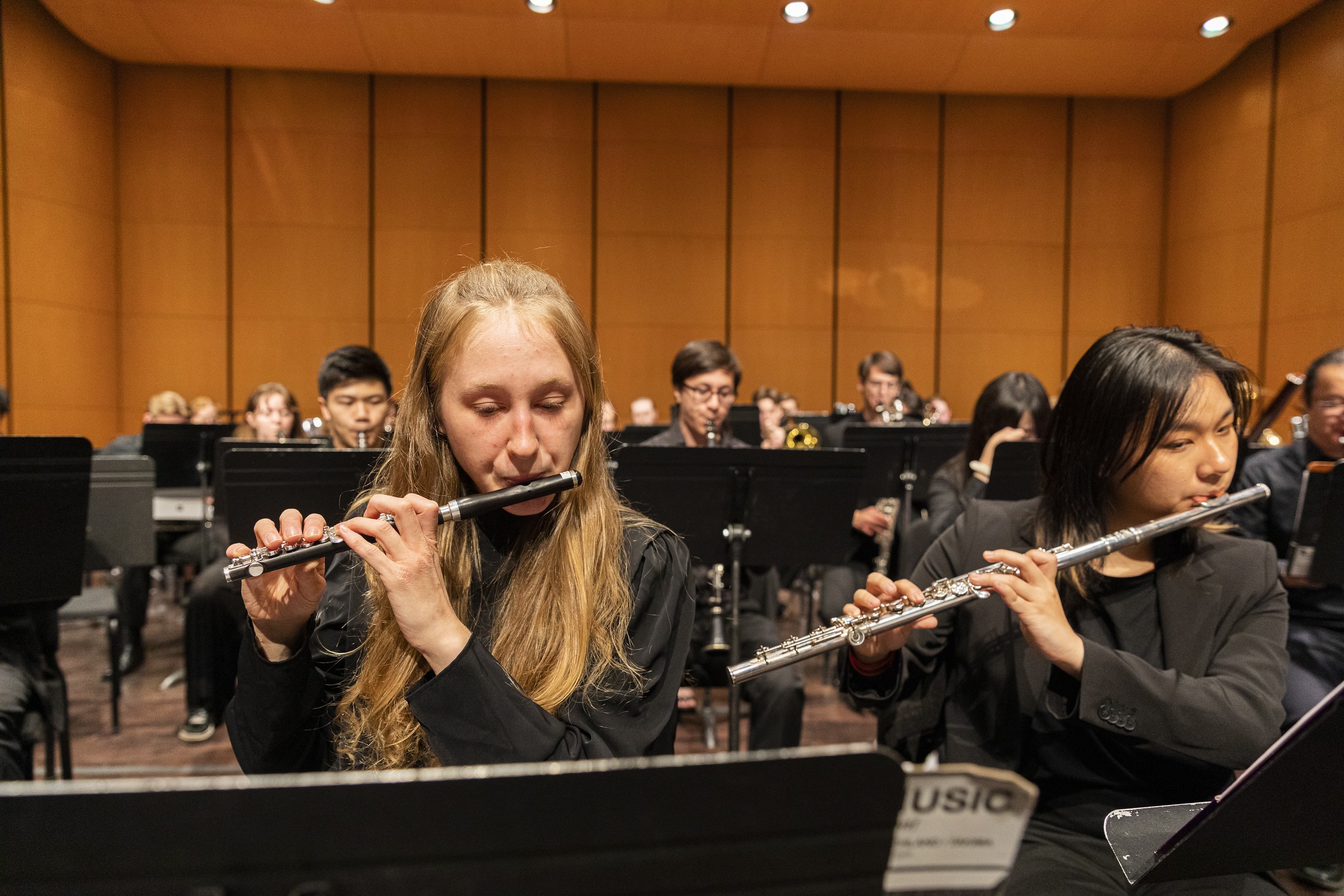
The Wind Ensemble and Symphonic Band (Erin Bodnar, director) present "Emblems," featuring music by Aaron Copland, Wim Bex, Kevin Day, Dwayne Milburn, John Mackey and others. With Eden Garza, bass trombone.
Program
Wind Ensemble and Symphonic Band
"Emblems"
Erin Bodnar, conductor
Eden Garza, bass trombone
Solomon Encina, graduate conductor
Nicholas Renaud, graduate conductor
Noah Scanlan, graduate conductor
Yuman Wu, graduate conductor
UW Symphonic Band
Erin Bodnar, conductor
Big Things (2026) - Holly Harrison (b. 1988)
Big Smoke
Big Boots
Big Heart
Some treasures are heavy with human tears (2022) - John Mackey (b. 1973)
American Hymnsong Suite (2007) - Dwayne Milburn (b. 1963)
Prelude on Wondrous Love
Ballad on Balm in Gilead
Noah Scanlan, graduate conductor
Scherzo on Nettleton
March on Wilson
Nicholas Renaud, graduate conductor
-Intermission-
UW Wind Ensemble
Erin Bodnar, conductor
Emblems (1964) - Aaron Copland (1900-1990)
Vademecum (2008/2014) - Wim Bex (b. 1977)
School Life
Love Life
Café Life
Eden Garza, bass trombone
Concerto for Wind Ensemble (2021) - Kevin Day (b. 1996)
Flow
Yuman Wu, graduate conductor
II. Riff
Solomon Encina, graduate conductor
Program Notes
Written in three movements, Big Things is all about…well, big things. From the urban feel of Big Smoke to the swagger of Big Boots, to the courageous spirit of Big Heart. Think big city buzz, big attitude, and big endings. When first writing the work, my ear was drawn to masses of big bold sounds: a mix of big contrasts, big grooves, and big beats. In Australia, we often refer to large cities as the ‘big smoke’. With more than a trace of disco, the opening movement captures the bustling, bursting energy of big cities, imagining a streetscape dancefloor flooded with commuters. Big Boots embraces a sleazy funk groove with a smattering of honky-tonk. With big boots to fill, who be er to call on than the bass section? This movement offers plenty of swagger, stomp, and bass breakdowns. The final movement, Big Heart, is a big ending in disguise. Featuring numerous soloists in the lyrical first half, melodic strains and lines become increasingly entangled throughout. This lyrical web ultimately gives way to triumph, showcasing two contrasting sides of what I like to think of as the heart of band.
Program Note by composer
(CONTENT WARNING: This program note describes an act of public mass violence and may be traumatic or uncomfortable to some readers. Discretion is advised.)
At 1:05 a.m. on Sunday, August 4, 2019, in the Oregon Historic District of Dayton, Ohio, a man armed with a semiautomatic AM-15 approached a crowded neighborhood bar and opened fire. In under 30 seconds, he fired 41 rounds, killing nine people and injuring another 17. That’s where the story of John Mackey’s Some treasures are heavy with human tears begins.
One of the victims of the shooting was Megan Betts, a 22-year-old woman who had played trumpet in her high school band in nearby Bellbrook. The Bellbrook program reached out to Mackey to commission a work that would commemorate the tragedy, a task he approached with some reluctance:
"I’ve been asked on several occasions to write pieces in response to tragedies, but I’ve rarely felt like it was appropriate. Something about this, though -- happening in Dayton, where I’ve been many times, and so close to Columbus, where I grew up -- that I felt like I wanted to try to say something musically, even though I was at a loss for what I could say verbally. Fortunately, Abby (my spouse) found this incredible title, which says so much before the music even starts. The last thing the community needed was a piece of music that relived the event. The piece isn’t trying to sound like WHAT happened; it’s trying to convey what it feels like to KNOW that it happened."
The piece is not programmatic. Rather, it exists in abstraction: a meditation on grief. In framing the work in this way, Mackey’s music transcends elegizing a singular horrific event and instead provides an artistic representation of how we cope with all tragedies, both those that are intensely personal and the ones that are communal. It explores a wide range of emotions, from denial through shock, fury, and anguish before finally finding an incomplete peace.
Some treasures are heavy with human tears begins with a simple motivic gesture: a rocking oscillation between flute and vibraphone that sounds akin to a lullaby. This principal motive carries throughout the piece, acting as the listener’s avatar through the emotional journey. A melody spins out from it, accompanied by ethereal ringing provided by crystal glasses and whirly tubes, and although the overall mood is one of melancholy, the atmosphere is also peaceful until a disorienting fog of trombone glissandi passes over. The songlike melody continues, at times abruptly shifting from the resigned mood of the home key of G minor to the distantly bright C major, evoking a fleeting remembrance of a more hopeful spirit, before just as quickly dissipating back. The simplicity of the opening returns, but this time fuller, with more voices joining before the glissando cloud returns (this time augmented by timpani), ushering in a new mood: confusion. The opening gesture reemerges, ceaselessly rocking in a rhythmic nature, oblivious to a building torment in the surrounding harmonies which become brasher and angrier as the piece approaches its dramatic climax. The apex of the piece is a wail, acknowledging the reality of the trauma in a moment of agony bordering on rage. This too, however, subsides, and the peacefulness of the beginning of the work returns to stay with one exception: as the final phrase of the work cadences and the last tones decay, a single muted trumpet rises from the silence in a bright flash and is suddenly extinguished.
- Program Note by Jacob Wallace
American Hymnsong Suite is firmly rooted in my family history as church musicians. I grew up singing and playing many different hymns, including the four tunes featured in this work. The final impetus to compose this particular treatment came during the course of an organ concert in Atlanta, Georgia. One section of the program featured innovative settings of three hymns. With the gracious consent of composers Joe Utterback and Brooks Kukendall, I adapted their settings to act as the inner movements of the suite, bracketed with my own original treatments of favorite hymns.
The Prelude on Wondrous Love (“What Wondrous Love is This”) opens with a chant-like statement of this Southern tune before proceeding to a more kinetic retelling. Ballad on “Balm in Gilead” features a rich jazz harmonization of this familiar spiritual. The Scherzo on “Nettleton” (“Come Thou Fount of Every Blessing”) contains all the rhythmic playfulness inherent in the best orchestral third movements, and the March on “Wilson” (“When We All Get to Heaven”) calls to mind the wildest marching band ever heard.
While audience members will certainly make various connections to this piece, the ongoing goal is to introduce all listeners to the richness of our American musical heritage.
- Program Note by composer
In May, 1963, I received a letter from Keith Wilson, President of the College Band Directors National Association, asking me to accept a commission from that organization to compose a work for band. He wrote: 'The purpose of this commission is to enrich the band repertory with music that is representative of the composer's best work, and not one written with all sorts of technical or practical limitations.' That was the origin of Emblems. I began work on the piece in the summer of 1964 and completed it in November of that year. It was first played at the CBDNA National Convention in Tempe, Arizona, on December 18, 1964, by the Trojan Band of the University of Southern California, conducted by William A. Schaefer.
Keeping Mr. Wilson's injunction in mind, I wanted to write a work that was challenging to young players without overstraining their technical abilities. The work is tripartite in form: slow-fast-slow, with the return of the first part varied. Embedded in the quiet, slow music the listener may hear a brief quotation of a well-known hymn tune Amazing Grace, published by William Walker in The Southern Harmony in 1835. Curiously enough, the accompanying harmonies had been conceived first, without reference to any tune. It was only a chance of perusal of a recent anthology of old 'Music in America' that made me realize a connection existed between my harmonies and the old hymn tune.
An emblem stands for something - it is a symbol. I called the work Emblems because it seemed to me to suggest musical states of being: noble or aspirational feelings, playful or spirited feelings. The exact nature of these emblematic sounds must be determined for himself by each listener.
- Program Note by composer
Vademecum was written between October 2007 and May 2008. It was commissioned by the Metropole Brass Band and dedicated to Geert De Vos.
The concerto is an ode to three distinct facets of the bass trombone: it’s dark, harsh, and aggressive character -- its lyrical, melodious, and romantic nature -- and its playful, virtuoso abilities. It can be considered a translation into music of the shared time the composer and the soloist spent during their studies together. Love Life is an ode to the relationship between Geert and his wife Katrien. It also describes the energy between a man and a woman when love is dawning, and how the outside world reacts to it: some people with joy, others with questions, but in the end love prevails.
- Program Note by composer
After several fruitful conversations with Dr. Cynthia Johnston Turner, director of bands at the University of Georgia, the concept for the Concerto for Wind Ensemble began to take form. We had talked about doing a potential commission for the UGA Hodgson Wind Ensemble, and ultimately the conversation led to the idea of doing a substantial work to further the wind band repertoire. I knew off the bat that I wanted to write something that reflected my upbringing as a young black man and the musical culture that I grew up in, which hasn’t always been represented in concert band music.
My experience and the inspiration for this work come from a world of various intersections. My father, born in West Virginia, was a hip-hop producer in the late 1980s who worked in Southern California, and my mother (also from West Virginia) was a gospel singer. During my childhood, I grew up listening to hip-hop, R&B, jazz, and gospel music. Simultaneously, I was learning classical music through playing in band, and later orchestra. I was playing jazz and gospel music on piano, while also playing classical music on euphonium and tuba. This dual learning environment had a huge impact on my musicianship and my development as a composer. While these words had been separated in my head when I was growing up, in this work I intentionally wanted to merge them together in new fusions, paying homage to my parents, the culture I grew up in, and to the wind band world.
What came from this concept is this Concerto for Wind Ensemble, a five-movement work for band that is my most ambitious composition to date, and a work that took almost two years to compose. The movements entitled Flow, Riff, Vibe, Soul, and Jam reflect the various musical styles that I have been immersed in. Vibe and Soul are specifically dedicated to my parents, without whom I could not have made it this far. I am immensely grateful to Dr. Turner and to the consortium members of this work, who believed in my vision and sought to bring this work to life. I’m happy to share this contribution and love letter to the wind band and to the culture.
- Program Note by composer
Biographies
Canadian conductor-educator-tenor Nicholas Renaud is passionate about working with others toward musical growth and dynamic performances. Currently, Nicholas is pursuing his DMA in Choral Conducting at the University of Washington under the supervision of Dr. Geoffrey Boers and Dr. Giselle Wyers, where he serves as Assistant Conductor of the award-winning UW Chorale, co-conductor of the UW Recital Choir, the Glee Club Tenor-Bass Choir, and Choral Cohort Ensemble, and as a Graduate Teaching Assistant in the School of Music.
Out in the community, Nicholas works frequently as a tenor, guest conductor, clinician and French-language diction coach for local choirs and serves as Artistic Director of La Chorale francophone de Seattle, a multi-generational community choir specializing in the performance of French-language music from around the world. He also serves as Associate Artistic Director of the Magnolia Chorale, a large, auditioned multigenerational concert choir which regularly performs major works. Prior to commencing his studies at UW, Nicholas conducted a variety of community bands and choirs and had a busy career teaching K-12 Music and French classes in public schools and serving his fellow teachers as a union activist in and around Vancouver, Canada.
Nicholas holds degrees and graduate-level diplomas in music, French and education from some of Canada's top universities. While completing his Bachelor of Music at the University of Victoria, he served as Assistant Director of the Vocal Jazz Ensemble and Chamber Singers, and as Conductor of the Massed Men's Choir and Director of the Vocal Jazz Women's Chorus, Ellavation. He has been the recipient of numerous fellowships, scholarships and awards, but his proudest accomplishment throughout his studies was receiving the Outstanding Practicum Award from the University of British Columbia. This was given in recognition of Nicholas' dedication, commitment and diligence while teaching high school students in choir, band and IB French classes during his Bachelor of Education degree.
An earnest scholar, Nicholas' research interests include inclusive and decolonial approaches to leadership and pedagogy, incorporating voice science in the choral rehearsal process, empathetic choral conducting, and early Canadian choral music. Nicholas is devoted to building community and cooperation through the study of music, engaging in innovative teaching that involves a variety of approaches and activities to foster teamwork. He works hard to empower others––no matter their age or experience level––to develop confidence as they learn to express their creativity through group music-making and engaging musical performances.
Noah Scanlan is a Master of Architecture student at the University of Washington with a background in music performance and conducting. A California native, Noah grew up in the small town of Ridgecrest, California, and was constantly exposed to all genres of music at home. This introduction shaped his interest in playing the saxophone and, eventually, conducting, leading him to continue his music making endeavors in his undergraduate studies.
Noah received his Bachelor of Arts in Music and Bachelor of Science in Civil Engineering at California Polytechnic State University, San Luis Obispo. It was here that his interests in conducting grew, leading him to be a field conductor for the Cal Poly Mustang Marching Band, a student conductor for the Cal Poly Symphony, and a conductor for various small ensembles. After deciding to pursue a career in architecture, Noah continues to pursue musical opportunities whenever possible. He has kept his passion for music alive at UW by taking music courses, conducting the UW Symphonic Band, and playing the piano at home.
Solomon Encina is a Graduate Assistant at the University of Washington, where he is pursuing a Doctor of Musical Arts (D.M.A.) in Instrumental Conducting. Solomon holds a Bachelors of Music degree in Instrumental Performance in Percussion from California Baptist University. He also holds a Masters in Music Education degree from Azusa Pacific University where he studied under Dr. Alexander Koops and Dr. John Burdett.
Solomon is a native of the Southern California region, where he has taught and arranged music for several high quality institutions. Most recently, he served as the Director of Bands at Los Osos High School in Rancho Cucamonga, CA, where the band, orchestra and color guard program regularly received high distinction awards at festivals throughout the state under his direction. During this time he also performed as a percussionist with several touring groups throughout the United States and as a guest conductor of the European Tour for Southern California Ambassadors of Music. After several years as a high school educator, Solomon is thrilled to begin pursuing his highest academic aspirations by attending UW to study under Professor Timothy Salzman.
Solomon Encina has affiliations with the National Association for Music Education (NAfME), the College Band Directors National Association (CBDNA), the California Music Educators Association (CMEA), and the Southern California School Band and Orchestra Association (SCSBOA). Solomon Encina is proudly endorsed by the Vic Firth Company and is a part of the Vic Firth Education team.
Yuman Wu is a Graduate Assistant at the University of Washington, where she is pursuing a Doctor of Musical Arts (D.M.A.) in Instrumental Conducting under the mentorship of Timothy Salzman and Erin Bodnar. At UW, she serves as the conductor for UW Concert Band, assistant conductor for the UW Wind Ensemble and Symphonic Band, and contributes to the Husky Marching Band. She also assists in teaching the undergraduate conducting classes, working closely with music education majors. As a conductor, multi-instrumentalist, and educator, Yuman enjoys playing music from all cultural backgrounds, innovating new ideas, and leading the music industry forward with inclusivity. She was recently selected as one of five conductors for the prestigious 2025 U.S. Army Band Conductors Workshop, where she conducted The U.S. Army Band “Pershing’s Own” in a public performance at the Rachel M. Schlesinger Concert Hall in Washington, D.C.
Yuman holds a Master of Music in Wind Conducting from the Peabody Institute of Johns Hopkins University, where she studied with Dr. Harlan Parker and served as Teaching Assistant for Secondary Instrumental Conducting. She also earned a Master of Science in Business Analytics from Cornell University. Yuman completed three Bachelor's degrees in Music, Statistics, and Economics from the University of Illinois at Urbana-Champaign.

Erin Bodnar is Visiting Associate Professor and Director of Concert Bands at the University of Washington in the 2025-26 academic year.
Bodnar is Associate Professor of Music and Director of Bands at the University of North Florida, where she conducts the Wind Symphony and Concert Band, instructs courses in conducting and coordinates the UNF Conducting Symposium. Under Dr. Bodnar’s baton, the UNF Wind Symphony performed at the World Association of Symphonic Bands and Ensembles in Buñol, Spain in July 2019. The UNF NuMIX, co-directed by Dr. Bodnar and Dr. Venet, performed at the College Band Directors National Association Southern Division Conference in February, 2022.
Prior to her appointment at UNF, Dr. Bodnar was Director of Bands at Graceland University for four years, during which time the Symphonic Band performed at the Iowa Bandmasters Association Conference. During 2013-2014, Dr. Bodnar was the conductor of the Wind Symphony and Orchestra at Mahidol University in Bangkok, Thailand.
Dr. Bodnar maintains an active schedule as a guest conductor and clinician, traveling to Argentina, Thailand, Indonesia, and throughout the United States and Canada. Dr. Bodnar has contributed to A Composer's Insight: Thoughts, Analysis and Commentary on Contemporary Masterpieces for Wind Band, Volume 5, the GIA Teaching Music Through Performance Series for Volume 7 and the revised Volume 1.
She excelled at teaching both middle and high school band in Alberta, Canada for which she received the Keith Mann Young Band Director’s Award and the Edwin Parr First Year Teacher Award. Dr. Bodnar has presented at conferences in Canada, the United States, Scotland, Thailand and Austria.
Her research interests include conducting pedagogy and motor cognition, and her articles have been published in the Journal of Music Teacher Education and Music Perception. An avid runner and group fitness instructor, Dr. Bodnar has completed 54 marathons, including 6 Boston marathons, ten 50 km races and one 100 km race.

Eden Garza, a native of South Texas, joined the Seattle Symphony September 2022. He received his Masters Degree from the University of Texas at Austin, where he studied with Dr. Nathaniel Brickens and his Bachelors Degree from Texas A&M University Kingsville, where he studied with Dr. Oscar Diaz. As a soloist, Eden has been featured with TAMUK’s Jazz Band I, the South Texas Trombone Sound, the TAMUK Trombone Choir, the TAMUK Wind Symphony at the Texas Music Educators Association Conference, the University of Texas Trombone Choir at the Texas Music Educators Association Conference, ITF with the University of Texas Trombone Choir, at the Midwest Clinic with the TAMUK Trombone Choir, and at the ITF’s Composers Workshop. Garza has been awarded first prize for various competitions that include the Edward Kleinhammer Orchestral Bass Trombone Competition, the Big 12 Bass Trombone Competition, the Donald Yaxley Solo Bass Trombone Competition, the ITA trombone quartet competition, and the Hungarian Online Trombone Competition. Eden also serves as a faculty member for the University of Washington School of Music.