A spring quarter sabbatical in 2025 provided the time and space for Professor Giselle Wyers to complete and debut parts of "The Lips of the Sky," a multi-movement choral work that premiered at Carnegie Hall in May 2026 in a performance presented by MidAmerica Productions. Wyers took the title and text from a poem by Nicomedes Suárez-Arauz, a poet from the Amazonian region of Bolivia, discovered while wandering the poetry stacks at Suzzallo Library in Spring Quarter 2024, and subsequently incorporated more poetry, text, and movements into the work. The lead-up to the premiere and its presentation, in previews and concerts at the UW and in the community, brought together the threads of past, current, and new connections, involving Wyers’ current singers in choirs at the UW and further afield, former conducting students now engaged in their own conducting careers, and new singers and instrumentalists participating in the production. Co-chair of the UW’s Choral Conducting program and director of the University Chorale took time for an emailed interview with School of Music publicist Joanne DePue in the final weeks of the 2025-26 academic year. The conversation has been lightly edited for publication.
Q: The premiere of "The Lips of the Sky" and the lead up to the Carnegie Hall performance saw the involvement of alumni, current students, the community choir you conduct outside of the UW, and singers and conductors who responded to your call for participation. Was that intentional from the outset, or did the collaboration develop throughout the process?
A: I think when creating art as well as creating collaborations, things often start with a single idea or a single seed that eventually sprouts into something much larger, and that was definitely the case with the Lips of the Sky. My original hope was to write a single four-minute octavo entitled The Lips of the Sky. That was composed in the spring of 2024 and premiered by Concord Chamber Choir that winter and subsequently published by GIA Publications. It wasn't until the spring of 2025, with the luxury of having an artistic sabbatical, that I was able to imagine a larger-scale work built around that initial movement. Similarly, it took time to see how the overall project could take shape within my various musical communities. It seemed like the initial movement was resonating with my singers after the premiere and that gave me the courage and confidence to write more material. And as I talked to my Chorale members, Chorale alumni, and the cooperating conductors in Minnesota, as well as Concord Chamber Choir, it was a slow build, but a gradual intensification of people's commitment and interest in becoming involved in something as big and momentous as a Carnegie Hall premiere.
Q: You debuted some of the movements during your 2025 sabbatical in performances led by former conducting students who have gone on to lead their own choirs and programs outside of Washington state. I’m thinking of the Giselle Wyers Choral Festival that took place last fall in Edina, Minnesota, which involved several of your former conducting students and their respective choirs--Jennifer Rodgers (’20 DMA, Choral Conducting, now at Iowa State University), Elisabeth Cherland (’19 DMA, Choral Conducting, now at Minnesota State University Mankato), Richard Carrick (DMA, Choral Conducting, now at College of St. Scholastica), and Bret Amundson (’12 DMA, Choral Conducting, now Dean of Arts at College of St. Scholastica). Did you compose with those conductors in mind? If not, how did you decide which movement to pair with which conductor/choir?
A: I did actually create each movement with those conductors in mind! I was imagining a cycle of pieces that could represent the human lifecycle and the way that the sun rises and sets as a metaphor for that, but at the same time, I was also looking into how I might fuse my interest in the dance method Laban movement with my passion for composing. That was put into my original sabbatical application, in fact, as an interdisciplinary form of inspiration for the art of conducting and composition, borne out of a dance theorists’ approach to movement.
There were four conductors initially involved- this expanded to five by the time of the October Giselle Wyers festival. The only piece that was not “premiered” was movement five, the Lips of the Sky, because it had already been premiered the December before by Concord. I asked each of the four alumni conductors (Jen, Elisabeth, Richard, and Bret) to choose one of the four Laban drives. “Drives” in the Laban system are combined elements of movement that bring out different characters and styles of moving in the world. The elements are “space, time, weight, and flow,” and when combined in groups of three, you end up with “action, passion, vision, and spell.”
Because these conductors had trained in Laban movement with me as part of their doctoral degrees, they already had a pretty good idea of how that might manifest musically and in their gestures. The first movement, for Jen Rogers, was Spell Drive; Elisabeth chose Vision Drive (Movement 2). Richard chose Passion Drive (Movement Four) And Bret’s (Movement Three) was Action Drive. It’s a little bit complicated to describe, especially because one of the conductors, Bret Amundson, ended up not being able to participate in the project due to very good news of getting a new job in another state, but his colleague, Grace Young, took over and eventually premiered the piece with the Lake Superior Youth Chorus with great success.
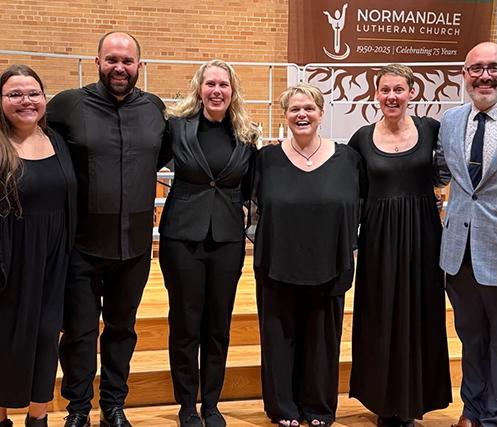
Professor Giselle Wyers reunited with former graduate conducting students for the Giselle Wyers Choral Festival in Minnesota in early October, 2025.
Q: Did the conductors’ interpretations of your work align with what you had envisioned while composing? Did their interpretations ever add a direction or nuance or dimension to the piece that you decided to “keep” as you moved forward toward the world premiere? In other words, did the pieces continue to evolve over time as you worked with various groups and conductors?
A: The conductor's interpretations of each movement definitely aligned with what I had envisioned and brought more depth and imagination to the overall artistic product and process. I knew going into the October premieres that revisions would probably be necessary. Being able to workshop the pieces with the choirs and then hear them in the initial premieres was really helpful. As a composer who is also a conductor, I work hard to imagine the sound of a new piece, but there are always going to be differences from what you imagined when you're working with real communities and real choirs. Some of the changes were subtle but important; for instance, tweaking the metronome markings that I had suggested. Others were more related to the balance of the sound, making sure that the piano part did not overbalance the choir sound, and removing elements of the piano part that were perhaps unnecessarily difficult. So I made changes, in some cases, right then and there, on the same day before the audience arrived for the premiere. Later, I also decided to alter some of the textures of the sung parts, and I made revisions to the final movement, The Green Ray, to allow for better flow of the ideas in the text.
Some of the things that inspired me about the interpretations of my former students included their depth of interpretation, and their ability to really bring a richness to the timbre and a richness of overtones to the sound. So whether I was making clear decisions about phrasing or dynamics, or the overall core sound, those were are all things that I was inspired to keep and to bring into my own interpretation when I was working with my own choral communities. Another way that the pieces continue to evolve over time was that I re-scored two of the movements to be arranged for SATB (Soprano, Alto, Tenor, Bass), that were written originally for treble and children's choir. I also wrote string parts for all six movements for the Carnegie Hall premiere.
Q: Did most of the University Chorale go to NYC to participate in the premiere?
A: Around 40 university Chorale students were able to go on this self-funded trip. We began initially discussing this possibility during spring of 2025, and I gave them gave them a sense of the cost, the timeline, and what it entailed. As is often the case, as the project gained momentum and as students began to discover the music and get to know each other better, their confidence and interest in the project grew, so that ultimately around 40 students were able to go.
Q: You describe the movements of the piece as tracing “the arc of the sun crossing the sky and descending into twilight, serving as a metaphor for the human life cycle.” I also remember reading something you had written about the movements aligning with different “drives” of Laban movement. Did this continue to be a dominant theme in the work as you had first envisioned? I notice it wasn’t mentioned in the program note for the UW presentation of the movements.
A: I think the use of the Laban drives was mostly an inspiration for allowing me to start the compositional process, as well as an enticing invitation to explore expression with the graduate students who ultimately premiered the individual movements. I knew this was something they had been interested in while studying conducting with me, and I was curious what perspectives they might have about how to use Laban as a vehicle for expression so many years after having graduated from the University of Washington. Using Laban drives was also helpful for me as a composer to enforce a certain amount of variety in my writing. Like many composers, I have signature sounds and styles that could potentially become redundant. I knew that by assigning a different drive to at least of four out of the six movements, I could find a more versatile approach.
The arc of the sun across the sky and the idea of the human life cycle was also present at the same time, and became a powerful framework, a kind of North star, for the performers to guide their own connection to the piece. The Laban drives would have been much more complicated to try to describe (in a program note), and more theoretical, whereas everyone can relate to the idea of making the most of our unique, precious lives and thinking about how our energy and legacies continue past our individual lifespans, in mysterious yet undeniable ways.
Q: During the year-end UW concert on May 28, you did not conduct the movements from Lips of the Sky; rather, four of the graduate student conductors led those movements. How does it feel, as a composer, to experience a work you have composed being conducted by your current or former conducting students?
A: You're absolutely right that in the year-end concert on May 28, I chose to offer movements from the Lips of the Sky to my graduate students. Four of them led four of the movements, and that was a deliberate choice on my part. This was not only to give them the experience of working with UW Chorale and having performance opportunities, but, also because it's really important as a composer to allow other people to interpret and conduct your work. Otherwise, it can become myopic, and there can be a lot of things missed in terms of the interpretation. It might seem as though the composer would have the best possible chance of interpreting the work, but sometimes a composer can become too close to their own material. And it can be really refreshing and important to allow others to encounter the work and find nuance and new possibilities within each page of the music. This was certainly the case with the movements that each student chose. It seemed clear to me that they had chosen movements that matched their own various expressive personalities, and then in how they followed through with rehearsing and performing each piece for a live audience. It was really interesting and inspiring for me to see all of that take shape with me wearing my composer’s hat and participating as a collaborator rather than as a conductor dictating how each phrase should sound or dictating how each musical event should unfold.
Q: Along those lines, can you describe a typical sort of relationship between a professor such as yourself and former graduate students who go on to subsequently become your professional peers in the “choral world” or in academia. It must be gratifying to reunite and see where their work has taken them. Can you speak to that?
A: It is, in fact, very gratifying to follow the work of graduate students that have now become peers in the world and often friends. It's a special thing to have had some amount of influence over the areas of research and musical repertoires that they've chosen to engage in, or at least having the opportunity to guide them to discover all that they can while they are students. It's a thrill to see them thriving and offering new ideas to the field and to see the ways in which their work is embraced by the next generation of students and wider communities. To know that you had a small part in that is very gratifying. It's also just a lot of fun to see these people that you spent so many hours with during their education, to see them again in a more equal dynamic where they are self-sufficient within their careers and thriving and excited to share all the ways in which their University of Washington experience informs their present and future work.
Q: Your Carnegie Hall performance was shared with alumna Jen Rodgers, now at the University of Iowa. When you watch a former student conduct, do you ever see them incorporate elements of the craft (not sure that’s the right word) that you emphasized during their studies with you?
A: I do sometimes see a former student incorporating elements of the craft, things that perhaps I emphasized during their studies, but it is rarely related to how their gesture necessarily looks. It's more related to a commonality, a kinship of leadership style, especially a collaborative model of really engaging with each member of the choir in creative ways that allow them to feel like they're more than a single spoke in a wheel. One of the things that I value most in my leadership in conducting style is student-centered learning and the idea that every individual is essential to the whole. I have always been driven by a desire to de-center the authoritative model of the conductor and put singers and students in the center of the overall experience of being in a choir. That is something that I definitely see in Jen Rodger's work, and it is certainly a part of her tremendous success since leaving University of Washington, and her work bringing together communities for projects in Carnegie Hall, not just once, but twice now. Her very powerful way of harnessing group dynamics as well a sense of artistic ownership by each individual was hopefully informed in part by my work with her while she was assistant conductor of UW Chorale.
Q: In the weeks leading up to the premiere, you and the University Chorale experienced the horrific sudden loss of Juniper Blessing, UW sophomore and beloved member of the choir who was murdered in early May in off-campus UW housing. That unspeakable traumatic event and its effect on you and the students lived alongside the need to continue preparing for an end-of-quarter concert and a Carnegie Hall debut—a big career milestone for you personally. How did singing factor into your and the students’ grief, mourning, and acknowledgement—it doesn’t seem apt to say “acceptance”—of the unfathomable reality of Juniper’s death? How does the healing begin, or is it even possible to heal from such a loss?
A: I know that's a very difficult question to ask, and equally difficult for me to try to answer, but I do appreciate the fact that we both are trying to figure out how music could offer a response—or, even healing attributes-- after such a horrific event, which took the life of a cherished member of our community. I think what I learned from attempting to shepherd my students—and myself—through grief and shock, was that sometimes a professor/leader won't—and can’t—have the answers. And that what is more important is to “sit (figuratively) in the ashes of the sorrow and shock.” To sit with people in their authentic response to events, instead of feeling responsible for changing anything or making anything better.
The first week after Juniper was killed, the students did not sing in rehearsal. We tried to sing, together, after the shock had worn off, but we realized that what we needed more than singing was just to be together. To talk, to cry, to discuss how we felt in small groups and in collective grieving, sharing memories and talking generally about how loss and tragedy can play into informing the spiritual, psychic, and emotional growth in each and every one of us.
I shared my own grief journey after losing my mother when I was 26, when she died at age 55 of a glioblastoma. And I did share with the choir my own personal experience of how I used music as a force for healing. In my view, music, and the texts that we choose to sing, offer a very powerful portal into how we focus. By using specific themes to contextualize our lives, we might be able to ponder what matters in the world, or even just rely on the soothing quality of the sound itself to offer a new kind of attention.
Someone I once admired said that there are two currencies in life, the currency of time and the currency of attention. So part of what I was trying to do as the leader of UW Chorale was to help redirect the students' attention toward the least damaging way of understanding what had happened to Juniper, while also acknowledging the horrific, senselessness of the event. I wanted us to ask if by choosing how to integrate the reality of tragedy into our artistic and personal lives, could there be a way to have more control over its sway over us? Could channeling our thoughts and our actions help bring meaning to a senseless event?
Ultimately, with small group discussion and the students' ability to reflect anonymously by writing on index cards, the University Washington Chorale decided to perform a piece in honor of Juniper at the May 28 concert. The piece is called Underneath the Stars, and the text reflects on the sadness of losing someone. The refrain is “Go gently.” It seemed like an appropriate piece to sing in her honor, especially considering that Juniper was selected to sing a solo in that piece and would have sung the solo on the stage that night, had she still been with us.
Each student, ultimately, will have to decide for themselves how—and if—music can factor into healing. But I believe that as a leader, my best role was to ask those questions along with them. And offer gentle ideas from my own personal experience about how attention to specific themes in the text of the music that we sang might offer guidance or healing in the face of the trauma and grief of what we were all experiencing.
Q: What's next for you, as a composer, as you reflect on last year's milestone experiences?
A: Of course every year cannot and should not be quite so monumental, but I am really excited to sink my teeth into two scheduled commission projects; one with a long-time collaborator, Gilroy High School choir director Jon Souza, who has commissioned me four times in the past, as well as the invitation to write an art song to be accompanied by the Iowa City Community String Orchestra, to a text by Kahlil Gibran. Last year's compositional adventures definitely helped me stretch and grow and I hope this coming year will bear some of those fruits of my learning.

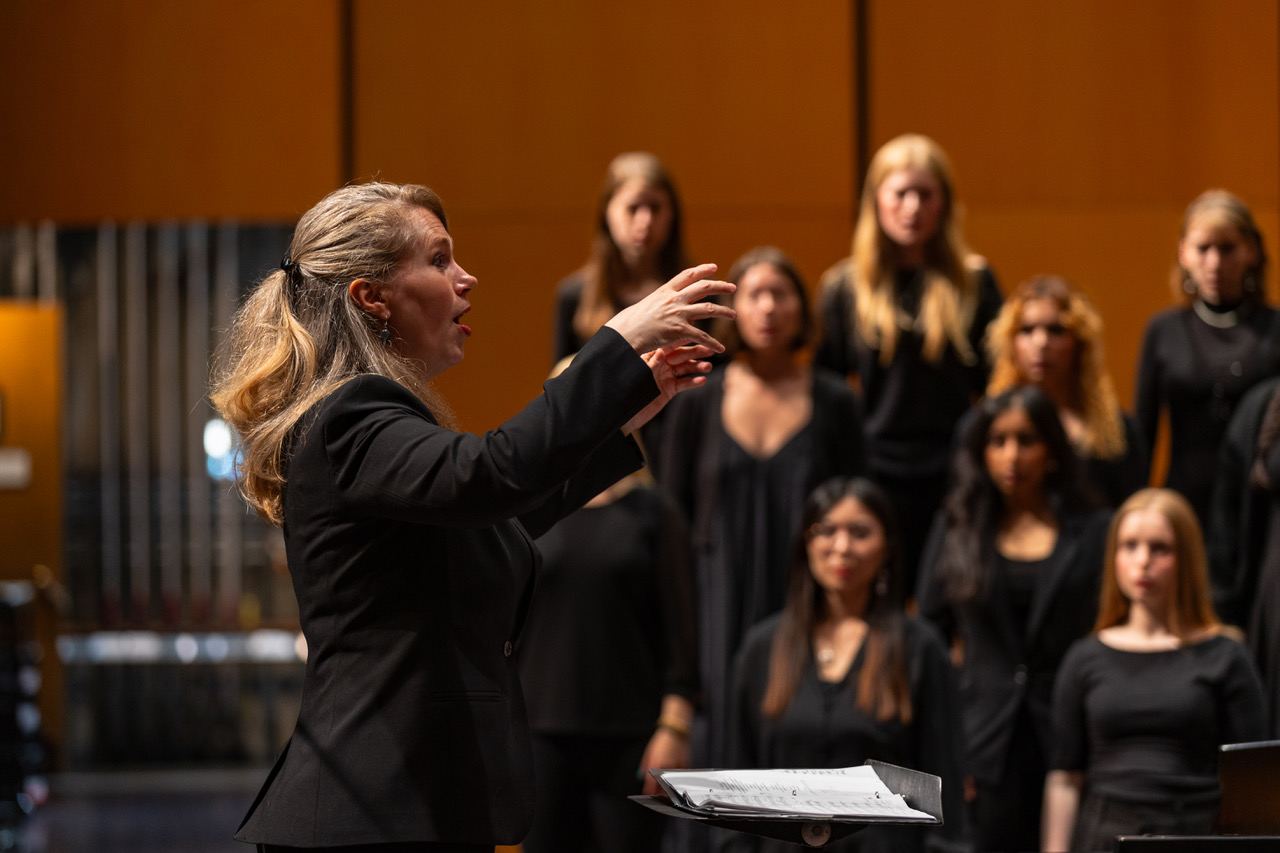
Giselle Wyers premieres her work "Lips of the Sky" at Carnegie Hall in May 2026 (Photo: Courtesy Giselle Wyers).