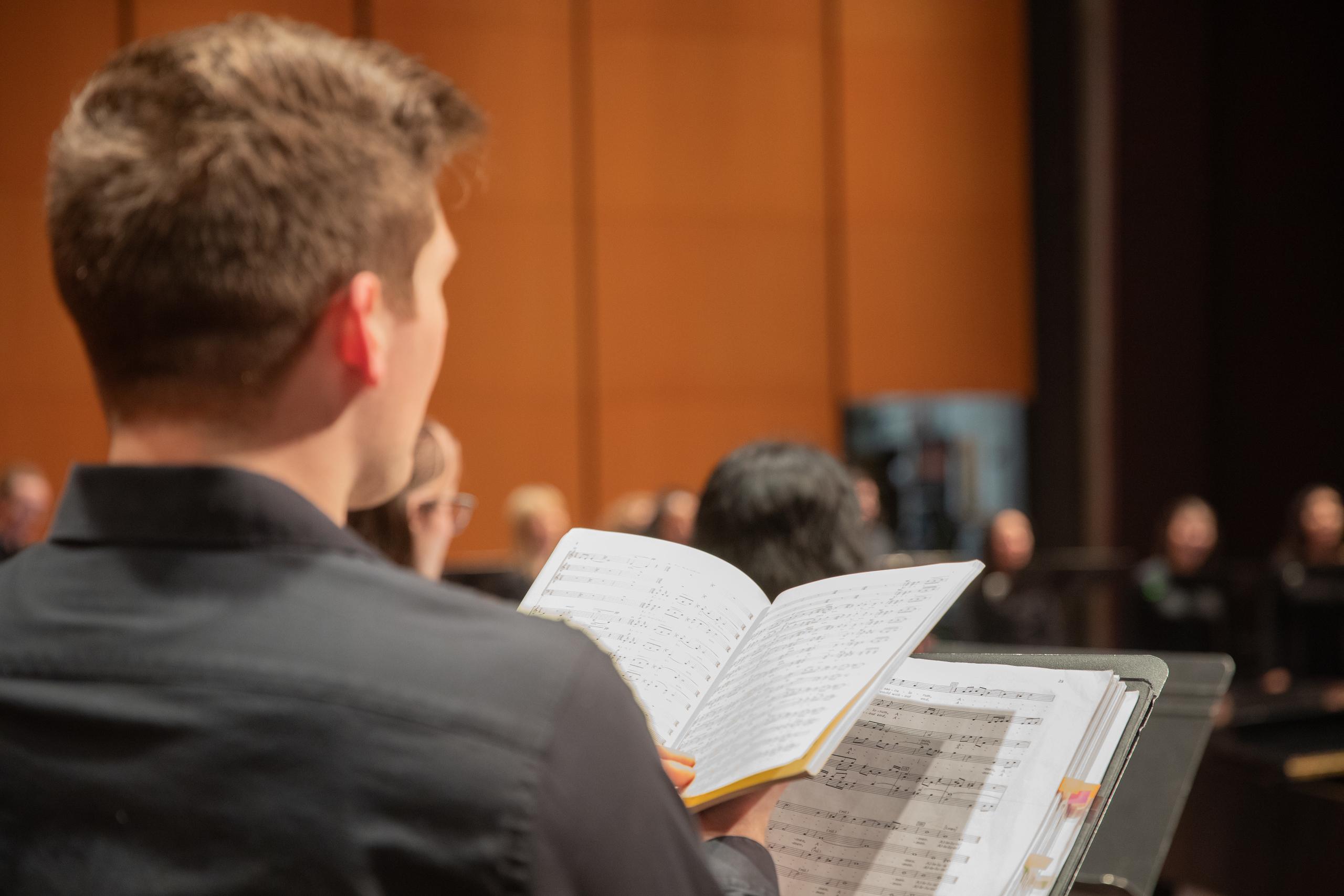
The Chamber Singers and University Chorale present "A Thousand Cadences," featuring J.S. Bach’s Magnificat, Reena Esmail’s This Love Between Us: Prayers for Unity, and movements from The Lips of the Sky, a new set of works by UW professor Giselle Wyers. With special guests the Seattle Bach Orchestra (Tekla Cunningham, director).
Program
A Thousand Cadences
University of Washington Chorale
Giselle Wyers, Conductor
Assistant Conductors:
Julianna Grabowski; Nic Renaud; Chung-An Wang; Helen Woodruff
Collaborative Pianist: Serena Chin
Rehearsal collaborative pianists:
Serena Chin; Ingrid Verlhulsdonk
Du Dob Dob (Latvian) - Vaclovas Augustinas
Soloists: Tina Amrith and Katelyn Wales
Percussionist: Soren Fosnick Davis
Giselle Wyers, conductor
The Lips of the Sky - Giselle Wyers
3. Imagine You Know How To Fly
Conducted by Julianna Grabowski
4. You are the Music
Conducted by Helen Woodruff
5. The Lips of the Sky
Conducted by Chung-An Wang
6. The Green Ray
Conducted by Nic Renaud
Dark Clouds/Sky - Children’s song arr. Tsai Yu-Shan
Conducted by Chung-An Wang
Underneath the Stars - Kate Rusby
Conducted by Helen Woodruff
University of Washington Chamber Singers
Geoffrey Boers, director
Assistant Conductors: Michael McKenzie; Scott Fiske; Tatiana Boggs
Collaborative Pianists: Ingrid Verlhulsdonk, Serena Chin
Magnificat in D, BWV 243 - Johann Sebastian Bach (1685-1750)
1. Magnificat
3. Quia respexit
Soledad Mayorga-Maldonado, soprano
4. Omnes generationes
10. Suscepit Israel
11. Sicut locutus est
12. Gloria Patri
This Love between Us: Prayers for Unity - Reena Esmail (b. 1983)
I. Buddhism
II. Sikhism
Tatiana Boggs, alto
III. Christianity
IV. Zoroastrianism
Kevin Allen-Schmidt, bass
V. Hinduism
Julianna Grabowski-Porceng, soprano
Nicholas Renaud, tenor
VI. Jainism
VII.Islam
“Dona nobis Pacem,” from B minor Mass, BWV 232 - Johann Sebastian Bach (1685-1750)
Program Notes
The Lips of the Sky
On a quiet May afternoon, I wandered the poetry stacks of the University of Washington’s historic Suzzallo Library in search of inspiration. Within minutes, I came across a simply bound, typed collection entitled Mantras: An Anthology of Immanentist Poetry. Intrigued, I flipped through the pages and was immediately drawn to “The Lips of the Sky,” an enchanting poem by Nicomedes Suárez-Arauz, a Bolivian poet from the Amazonian region of Bolivia.
After setting this text to music and premiering it with Concord Chamber Choir in December 2024, I began to envision a larger work: a cycle of choral pieces tracing the rise and fall of the sun as a metaphor for the passage of time in human life. During a three-month spring sabbatical in 2025, I discovered additional texts and ideas that supported this vision, culminating in a 25-minute cycle entitled The Lips of the Sky. It was an honor and pleasure to premiere separate movements in Minneapolis with University of Washington alumni conductors and their respective college choirs in October. Tonight, you will hear four of the six movements.
The six movements of The Lips of the Sky trace the arc of the sun crossing the sky and descending into twilight, serving as a metaphor for the human life cycle.
Mvt 3, Imagine You Know How to Fly, reflects promise, optimism, and bravery in the face of uncertainty. Pastoral imagery invites the singer—and listener—to feel at home in nature’s landscapes, where surprises can be celebrated rather than feared.
The text of Mvt 4, by American poet Amy Lowell, explores universal aspects of the human experience. While we may think of our lives as “a song,” Lowell urges us to look deeper, imagining all living beings within a vast ocean of shared experience and consciousness. Ocean imagery runs throughout The Lips of the Sky. In this movement, music and the ocean become parallel forces—vast, timeless, and powerful—uniting and inspiring us. Humanity is likened to “one music with a thousand cadences,” each voice unique yet part of a greater whole.
The title movement, The Lips of the Sky (Movement V), hints at both the grandeur and intimacy of the approaching night, and how we are simultaneously cradled and swallowed up by nature. I aimed to create a work that is sincere yet harmonically surprising.
The final movement, The Green Ray, draws inspiration from Jules Verne’s iconic novel, reimagined here as poetry. It describes the rare phenomenon of a brilliant green flash that appears as the sun dips below the ocean horizon at sunset. I sought to portray the end of life not as something fearful or mournful, but as a burst of radiant energy that continues to reverberate beyond its original form.
Recurring upward-rolling arpeggios suggests the motion of ocean waves. Choral voices often abandon text for the universal “ah,” shaped into sighing motifs that evoke the gentle murmuration of water. Musical ideas from the opening movement return here, bringing the 25-minute journey full circle and allowing the day to conclude in a shimmering finish.
—Giselle Wyers
Magnificat, This Love Between Us and Dona Nobis Pacem
Across today’s program runs a single, insistent human aspiration: the wish to see the world made whole. Not resolved or simplified, necessarily, but somehow held within a form of justice large enough to contain all of humanity’s beautiful variations. The three works presented here do not approach that longing as an idea alone, but instead as the fragile act of voices and instruments trying to mean something together in time.
To begin, we have Johann Sebastian Bach’s Magnificat. At its core, it is the Virgin Mary’s response to the announcement—communicated to her by a supernatural angel of God—that she will bear a child. In the Lutheran Germany of Bach’s time, her words would not have been heard as abstract theology, but as something far more immediate: a young woman’s response to a life-altering interruption. But Mary does not merely receive the news; she interprets it, claims it, and gives it her own voice, using the words of her time to make a wish for the future. And what she says is anything but passive, because the Magnificat is not only praise, it is a radical reordering of the world.
The proud are scattered. The powerful are cast down. The hungry are filled. The rich are sent away empty. It is, in other words, a vision of a world in which dignity is restored, and inequity is exposed, confronted, and undone. And perhaps that is why, out of over 1,100 works that Bach composed, his Magnificat has had such enduring appeal: because Mary’s proclamation of social justice continues to meet us wherever we are. It offers, again and again, the possibility that fairness, shared humanity, and deep personal meaning might still be drawn from our world.
At the center stands Indian American composer Reena Esmail’s This Love Between Us: Prayers for Unity, a work that gathers the many devotional languages of the Indian subcontinent into a shared musical space. It is bookended by two of Baroque composer Johann Sebastian Bach’s choral works and, in being placed between them, Esmail’s music enters into a living conversation with its eighteenth-century counterpart, offering another way of listening and another way of giving voice to the same enduring questions.
This Love Between Us: Prayers for Unity places texts from India's religious traditions in musical dialogue with one another. While it is written for the same eighteenth-century orchestral forces as Bach’s Magnificat, it opens into a different musical and spiritual world through Esmail’s addition of instruments used in North Indian classical music. The Baroque orchestra on stage, with its clarity of line, counterpoint, and harmonic motion, is set alongside the cyclical rhythmic structures (tal) and richly inflected melodic frameworks (raga) of Hindustani music, performed here by a sitar (a plucked string instrument) and tabla (a pair of tuned hand drums). Hindustani classical music—also known as North Indian classical music—has developed over more than a thousand years, shaped through courtly, devotional, and folk traditions, and sustained through an oral practice in which music is transmitted and refined as much through listening and imitation as through notation.
Over the course of the work, these approaches come into contact, creating a miraculous communication between musical worlds. Bach’s sound world is not translated here so much as used to build something different, with the same strings, winds, percussion, and voices serving as unchanged sonic bodies in different temporal and cultural circumstances. What we hear is not imitation, but a shared musical space inhabited nearly 300 years apart. And even the act of tuning becomes part of this underlying continuity. This blending of cultural and musical perspectives becomes central to This Love Between Us: not conflict, but coexistence; multiple identities and musical languages inhabiting a shared artistic space. What emerges is not the erasure of difference, but a generous, curious, and attentive listening—an invitation to hear how many voices can speak at once and still find connection in a world that often seeks to separate.
When an orchestra does this at the beginning of a concert, they usually gather to a single pitch where the note “A” is sounded at 440 hertz. This is the modern standard—bright and exact—the frequency by which instruments in our time agree to agree. But here, the music leans elsewhere: to A=415 Hz, the Baroque era’s equivalent pitch, lower by a half step. Keen ears will hear how the sound settles differently in the room—less brilliant, more burnished; less declarative, more inward; maybe a bit softer—shaped not only by the lowered pitch, but by instruments built using Baroque construction techniques, which themselves change the grain of the sound.
From within that altered air, these works begin to speak to one another—not as past and present, but as concurrent expressions of a single, enduring human reaching: toward justice, toward one another, toward peace.
Adapted from Joshua Shank
Notes and Translations
Texts and Translations
Du Dob Dob:
Who is riding over the field?
When shall we arrive?
We shall take a new carriage.
We shall go into the church.
I shall ring you. You shall ring me.
Dark Clouds/Sky / 天烏烏:
天烏烏
The sky is dark, dark.
天烏烏欲落雨
The sky is dark, and it is going to rain.
阿公仔夯鋤頭欲掘芋
Grandpa carries a hoe and goes to dig for taro.
掘阿掘 掘著一尾辿鰡鼓
He digs and digs, and digs up a loach.
伊呀嘿都真正趣味
Oh, now that is really fun / really interesting.
阿公仔欲煮鹹
Grandpa wants to cook it salty.
阿媽欲煮汫 伊欲煮汫
Grandma wants to cook it plain; she wants to cook it light.
兩個相打弄破鼎
The two of them quarrel and end up breaking the pot.
伊呀嘿都啷噹叱噹嗆
Oh, then it goes clang, bang, crash!
哇哈哈
Wa-ha-ha! / Hahaha!
Magnificat:
Magnificat anima mea Dominum;
et exsultavit spiritus meus in Deo salutari meo,
quia respexit humilitatem ancillae suae;
Ecce enim ex hoc beatam me dicent omnes generationes.
quia fecit mihi magna, qui potens est, et sanctum nomen eius.
Et misericordia eius a progenie in progenies timentibus eum.
Fecit potentiam in brachio suo;
dispersit superbos mente cordis sui;
deposuit potentes de sede, et exaltavit humiles;
esurientes implevit bonis
et divites dimisit inanes.
Suscepit Israel puerum suum, recordatus misericordiae suae,
sicut locutus est ad patres nostros,
Abraham et semini eius in saecula.
Gloria Patri, et Filio, et Spiritui Sancto,
sicut erat in principio, et nunc, et semper: et in Saecula saeculorum.
Amen.
Text from Luke 1:55 with the Lesser Doxology (Gloria Patri)
Translations for each movement below
1. Magnificat anima mea
My soul magnifies the Lord.
3. Quia respexit humilitatem
For he has regarded the lowliness of his servant. Behold, from henceforth, I will be called blessed...
4. Omnes generationes
...by all generations.
10. Suscepit Israel
He has helped his servant Israel in remembrance of his mercy.
11. Sicut locutus est
As he spoke to our fathers, to Abraham. and his descendants forever.
12. Gloria Patri / Sicut erat in principio
Glory to the Father, the Son, and to the Holy Spirit,
As it was in the beginning, is now and ever shall be, Amen.
This Love Between Us: Prayers for Unity:
1. Buddhism
All beings tremble before violence
sǝbbĕ tāntǝsī dǝndāsǝ
All fear death
sǝbbĕ bhǝyyǝntĭ mǝchūnō
All love life
sǝbbĕ sǝm jĭvītǝm pĭyǝm
See yourself in others.
Then whom can you hurt?
What harm can you do?
For he who seeks happiness (su-khǝ)
By hurting those who seek happiness
Will never find happiness
For your brother and your sister, they are like you
They, too, long to be happy
Never harm them.
dǝndēnā nǝ hĭmsǝtī
And when you leave this life
Then you will find happiness too
Text from the Dhammapada
(Danda Vagga - 10:129-132)
Sung in English and Pali
2. Sikhism
How can we call someone evil, when all are the creation of One?
mǝndā kĭs nō akhĭyāī jān sǝbhnā sāhĭb ēk
Text from the Guru Granth Sahib (p.1238)
Sung in English and Gurumukhi
3. Christianity
Owe no man anything but to love one another.
ǝnyōnyĕm snĕhĭkyūgā
For he that loveth his neighbor hath fulfilled the law.
For, Thou shalt not kill
kŭllā chĕyyĭǝrūthǝ
Thou Shalt not steal
Mōshtĭkĕrūthǝ
Thou Shalt not bear false witness
kǝllǝ sāchyǝm pārāyǝdǝdā
Thou shalt not covet
Mōhikkĕrūthǝ
And if there be any other commandment, it is comprised in this word:
Thou shalt love thy neighbor as thyself.
nĭnnĕpolĕ nĭntĕ ǝyyālkārǝnĕyūm snēhĭkĕnǝm
The love of our neighbor hath no evil. Love, therefore, is the fulfilling of the law.
The night is passed and the day is at hand.
Let us therefore cast off the works of darkness and put on the armour of light.
jēātĭs
Text from the Bible (Romans 13:8-13)
Sung in English and Malayalam
4. Zoroastrianism
All humankind would know its own lineage and stock;
hamāg mardōm paywand ud tōhmag ī xwēš dānist hē;
never would a brother be abandoned in love by his brother nor a sister by her sister.
haguriz brād ōy ī brād ud xwah ōy ī xwah az dōstīh bē nē hišt hē.
Text from the Pahlavi Rivayat (8a8)
Sung in English and Pahlavi
5. Hinduism
This love between us was born from the first humans;
mōhī tōhī ādī ǝnt bǝnāī
It cannot be eradicated
ǝb kăsĕ lǝgǝn dŭrāī
as the river finds its way into the ocean
jăsĕ sǝrītā sĭndh sǝmāī
what is inside me flows into you.
hǝmǝrā mǝn lāgā
[For the] one who sees all beings in the Self and the Self in all beings,
[he] harbors no hatred;
To the seer, all things become the Self.
What delusion, what sorrow can there be
for him (the one?) who beholds such oneness?
Are you searching for me?
mōkō kǝhĩ ḍhūnḍhĕ bǝndĕ
I am in the next seat
My shoulder rests against yours.
mẽ tō tĕrĕ pās hĕ
The [Lord] is inside you, and also inside me;
sāhĕb hǝm mẽ sāhĕb tŭm mẽ
[just as] the bloom is hidden in the seed.
jăsĕ prānā bīj mẽ
Text from the Isa Upanishad (verses 6-7) and selections from Kabir (c. 1440-1518)
Sung in English and Hindi
6. Jainism
If the mind is sinful,
Blamable,
intent on works,
acting on impulses,
producing cutting and splitting,
quarrels, faults and pains,
if it injures living beings,
if it kills creatures,
then one should not employ such a mind in action.
tǝhǝpǝgārǝm mǝnǝm nō pǝdhārĭjjā gǝmǝnāĕ.
If the speech is sinful,
Blamable,
intent on works,
acting on impulses,
producing cutting and splitting,
quarrels, faults and pains,
if it injures living beings,
if it kills creatures,
then one should not utter that sinful speech.
tǝhǝpǝgārǝm vāĭm nō ŭccārĭjjā.
jĕ yĕ mǝnĕ pāvǝĕ
Sāvǝjjĕ
Sǝkĭrĭyĕ
Ǝnhǝyǝkǝrĕ
Chǝyǝkǝrĕ
Bhǝyǝkǝrĕ
Ǝhĭgǝrǝnĭĕ
Pāŭsĭĕ
Pārĭyāvĭĕ
Bhūōvǝghāĭĕ
tǝhǝpǝgārǝm mǝnǝm nō pǝdhārĭjjā gǝmǝnāĕ.
Text from the Acharanga Sutra, Part 3: Lecture 15
Sung in English and Adha Maghadi
7. Islam
The lamps may be different, but the Light is the same
All religions, all this singing, one song.
I have bestowed on each one a unique mode of worship,
I have given every one a unique form of expression.
I look not at the tongue and speech, I look at the spirit and the inward feeling.
Religions are many, God is one.
The lamps are different, but the Light is the same: it comes from Beyond.
Concentrate on the essence,
Concentrate on the Light.
Ōm shāntĭ shāntĭ shāntĭ
Sādhū Sādhū
Wāhĕgŭrū
Āmīn
Āmĕn
Wāj Bāj
Concentrate on the Light.
Text by Rumi (1207-1273), supplemented with phrases of affirmation drawn from Sikh, Islamic, Hindu, and Christian Traditions
Sung in Sanskrit, Punjabi, Arabic, and English.
Dona nobis pacem:
Grant us peace.
Text: Last line from the ‘Agnus Dei’ of Latin Mass liturgy
University Chorale
Soprano
Tina Amrith
Elizabeth Brown
Lauren Chenoweth
Aria Fowler
Sofia Groff
Mari Hirayama
Evelyn Jones
Tanushri Narendran
Sophia Peterson
Anya Riabov
Olivia Spaid
Hope Villarreal
Katelyn Wales
Jolee Zamira
Tara Zolfalghari
Alto
Mallak Attwa
Ariel Baldwin
June Belisle
Juniper Blessing
Samara Chacko
Suwan Chambers
Julianna Cullen
Alexis Georgiades
Lainey Graham
Sydney Jordan
Alex Retteghieri
Madeline Rivera
Leah Peterson
Jessica Thaxton
Anne Tinker
Anna Vu
Haley Westberg
Tenor
Beau Bradney
Gray Creech
Eric Gagliano
Armour Johnson
Braden Innes
Colin Loerkhe
Liam Natarajan
Andrew Nguyen
Haoran Peng
Tyler Santos
Nick Seamons
Caleb Strader
Luke Van Sickle
Bass
Eden Alvarado
Thayden Boome
Will Cummings
Mario D'Ambrosio
Luke Granger
Jack Hawley
Will Henry
Aidan Maynard
Gavin Morrow
Timon Nguyenphuoc
Paul Orekhov
Anthony Pacurar
Noah Tonneson
Marshall Tsai
Daniel Vizenor
Chamber Singers
Soprano
Jaden Ritscher
Hope Villarreal
Tyleen Stults
Jenny Green
Helen Woodruff
Mari Hirayama
Julianna Grabowski-Porceng
Kyla Marshall
Soledad Mayorga-Maldonado
Alto
Katia Velit
Heidi Blythe
Tatiana Boggs
Ava Valentin
Lameya Appling
Alexandra Rameau
Maddie Rivera
Jaminfaye Reduque
Tenor
Nicholas Renaud
Caleb Strader
Zayn Mir
Beau Bradney
Emmanuel Noyola-Juarez
Grayson Creech
Julian Zhang
David Ferguson
Bass
Chung-An Wang
Jack Hawley
Thayden Boome
Adam Freemantle
Santiago Miranda-Marion
Michael McKenzie
Scott Fikse
Kyle Mahoney
Seattle Bach Orchestra
Director: Tekla Cunningham
Violin I: Tekla Cunningham* and Eleanor Legault
Violin II: Ethan Lin* and Elizabeth Phelps
Viola: Joanna Hood* and Byron Rakitzis
Cello: William Skeen
Bass: Stephen Swanson
Flute: Josh Romatowski* and Janet See
Oboe: Curtis Foster* and Darlene Franz
Bassoon: Anna Marsh
Trumpet: Kris Kwapis*, Luke Balslov, and Gordon Ullman
Timpani: Mark Goodenberger
Tabla: Ravi Albright
Sitar: Sampada Bhalerao
*denotes principal
Acknowledgements
Special thanks to
Gina Holvoet, Scandinavian Studies Department
Choral Arts Northwest
Seattle Bach Festival Orchestra
Ravi Albright and Sampada Bhalerao
Justin Birchell
University of Washington Land Acknowledgement
“We acknowledge that we live and work on the unceded ancestral lands of the Coast Salish people, the land which touches the shared waters of all tribes and bands within the Suquamish, Tulalip and Muckleshoot nations, and pay our respects to elders past and present. We make this acknowledgment as one part of our commitment to working to create inclusive and respectful partnerships that honor Indigenous cultures, histories, identities, knowledges, and sociopolitical realities, that dismantle ongoing legacies of settler colonialism, and they recognize the hundreds of indigenous Nations who continue to resist, live, and uphold their sacred relations across their lands.”

Geoffrey Boers is Director of Choral Activities at the University of Washington in Seattle, a program widely recognized as forward thinking, unique, and of great distinction. Under his direction, the graduate choral program has developed a singular mission: to nurture the whole student as conductor-teacher-servant-leader-scholar. This vision has led the program to become one of the most vibrant and innovative in the country, attracting students from around the world interested in exploring the future of our art. Through his teaching he is exploring the evolution of conducting gesture and rehearsal pedagogy and their connection with the emerging neuroscience of mirror neurons, empathy, perception, learning, and personal transformation. His exploration has led to new thoughts about conducting and teaching with regard to breath, movement, artistry, personal awareness, and cultural development. Recently, his work has led to the mentoring of local choral cohorts of teachers and conductors who are interested in building professional communities of ongoing mentorship and musical development. He has developed such mentorship programs across the United States and Canada. In addition to these thoughts about mentorship he is actively working with other leaders in ACDA and NAfME to develop a more unified and useful system for development of musicianship, assessment, adjudication, and repertoire grading.
Geoffrey maintains an active conducting, teaching, workshop and clinic schedule; his recent engagements have included conducting concerts in Orchestra Hall in Minneapolis, Meyerson Concert Hall in Dallas, New York’s Alice Tully and Avery Fischer Hall at Lincoln Center, the Mormon Tabernacle in Salt Lake City, and Benaroya Hall in Seattle. In addition he has served as artist-in-residence in Toronto, Ontario, Mainz, Germany, as well as Seoul, Korea with the world-renown choir the Incheon City Chorale.
In addition to his position at the UW, Boers sings professionally and is the conductor of the Tacoma Symphony Chorus where he conducts both the choir and symphony players in a four-concert season.
Since his tenure at the University of Washington, the choral program has become a leader in promoting the performance, study and exchange of Baltic music in the United States. The choir has toured to the Baltic countries in 2000, 2005, 2010, and 2013. Geoffrey Boers was awarded a prestigious Royalty Research Grant in 2004 to create a Baltic Choral Library in collaboration with the UW Library as well as State and academic libraries in the Baltic. This collection of scores, manuscripts, vocal music, and writings is the first of its kind in the United States. This collection has promoted yearly exchanges with choirs and conductors from the Baltic area who travel each year to Seattle. Further, it has led to numerous UW choral students winning awards and scholarships to travel, study, and work in the Baltic countries.

Giselle Wyers (she/her/hers) is the Donald E. Petersen Endowed Professor of Choral Music at the University of Washington, where she conducts the award-winning University Chorale and teaches graduate and undergraduate courses in choral conducting and music education. She serves as the newly appointed School of Music's designated Diversity Liaison. University Chorale’s latest CD, Chasing Daybreak, will begin streaming in January 2024 on Apple Music and Spotify. Their third CD, Resonant Streams (on the MSR Music Recordings label) was featured in a 2018 Gramophone magazine article. Wyers is the newly appointed director of Concord Chamber Choir, an adult community chorus within the Columbia Choirs community. Her professional project choir Solaris Vocal Ensemble, specializes in the performance of contemporary American choral literature. Their premiere album Floodsongs, on the Albany Music label, won the American Prize Ernst Bacon Memorial Award for the Performance of American Music in 2017-18.
As a guest conductor, Wyers has led high school honor choirs and all-state choruses in New York (Alice Tully Hall, Lincoln Center), Kansas, Wisconsin, Georgia, Missouri, Louisiana, Connecticut, Nebraska, Texas, Washington, Alaska, Idaho, Nevada and Vancouver, Canada. She has conducted semi-professional ensembles across the United States and in Germany, the Netherlands, Estonia, and Sweden.
Wyers is a leading national figure in the application of Laban movement theory for conductors. She has served as guest lecturer in conducting at Sweden’s Örebro Universitet, European Festival of Church Music (Germany), Latvian Academy of Music, Eastman School of Music, Ithaca College, Westminster Choir College, University of Iowa, Hobart and William Smith Colleges and Portland State University.
Wyers’ choral works are published by Santa Barbara Music Publishing Company as part of the "Giselle Wyers Choral Series," as well as with MusicSpoke and Hildegard Publishing. Her works have been performed across the United States, South America, Canada, Australia, Cuba, and numerous European cities. She conducted her 30-minute choral cycle entitled And All Shall Be Well, in Carnegie Hall during May of 2022 with a consortium of NW-based choruses, and she will return with a newly composed choral/orchestral work in May of 2026. In 2021-22, she served as composer-in-residence for the Greater Seattle Choral Consortium's annual festivities celebrating the return of in-person singing (her appearance was sponsored by Consortio). Wyers is also committed to mentoring scholar-writers in the field, and served on the editorial board of ACDA’s Choral Journal for six years.
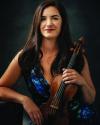
Tekla Cunningham, baroque violin, viola and viola d'amore, enjoys a varied and active musical life. At home in Seattle, she is concertmaster of Stephen Stubbs' Pacific MusicWorks, principal second violin with Seattle Baroque Orchestra & Soloists, and plays regularly as concertmaster and principal player with the American Bach Soloists in California. She directs the Whidbey Island Music Festival, a summer concert series presenting vibrant period-instrument performances of repertoire ranging from Monteverdi to Beethoven.
She has appeared as concertmaster/leader or soloist with the American Bach Soloists, Baroque Chamber Orchestra of Colorado, Seattle Baroque Orchestra, and Musica Angelica (Los Angeles). She has also played with Apollo’s Fire, Los Angeles Opera, Philharmonia Baroque Orchestra, and at the Carmel Bach Festival, San Luis Obispo Mozart Festival, Indianapolis Early Music Festival, Savannah Music Festival and the Bloomington Early Music Festival. She has worked with many leading directors including Rinaldo Alessandrini, Giovanni Antonini, Harry Bicket, Paul Goodwin, Martin Haselböck, Monica Huggett, Nic McGegan, Rachel Podger, Jordi Savall, Stephen Stubbs, Jeffrey Thomas, Elizabeth Wallfisch and Bruno Weil.
An avid chamber musician, Tekla enjoys exploring the string quartet repertoire of the 18th and early 19th century with the period-instrument Novello Quartet, whose abiding interest is the music of Haydn. She is also a member of La Monica, an ensemble dedicated to music of the 17th century, whose concerts have been reviewed as “sizzling”, and praised for their “irrepressible energy and pitch-perfect timing”. With Jillon Dupree, harpsichord, and Vicki Boeckman, recorders, she plays in Ensemble Electra, known for its inventive programs and energetic performances.
She can be heard on recordings with the American Bach Soloists, Apollo’s Fire, Philharmonia Baroque Orchestra, Tafelmusik, Seattle Baroque Orchestra, San Francisco Bach Choir, various movie soundtracks including Disney’s Casanova, La Monica’s recent release The Amorous Lyre, a recording of repertoire of Merula and his contemporaries and the Novello Quartet’s recording of Haydn’s Op. 50 string quartets. This summer she recorded Mozart’s Flute Quartets with Janet See, Laurie Wells and Tanya Tomkins.
Tekla received her musical training at Johns Hopkins University and Peabody Conservatory (where she studied History and German Literature in addition to violin), Hochschule für Musik und Darstellende Kunst, in Vienna, Austria, and at the San Francisco Conservatory of Music, where she completed a Master’s degree with Ian Swenson. She teaches Suzuki violin in both German and English and is on the early music faculty of Cornish College for the Arts.